

116
them, including of their biomass and more rarely of production. Production measurements have been conducted on beds composed of single species, mainly by the
productive structure analysis method. We outline of the methodology below; and for
details, see Murase (2010).
Unlike eelgrass or kelps, which have meristems at the base of the shoots or thalli,
the growth point of Sargassum is at the top of thalli (the tip of the main branch).
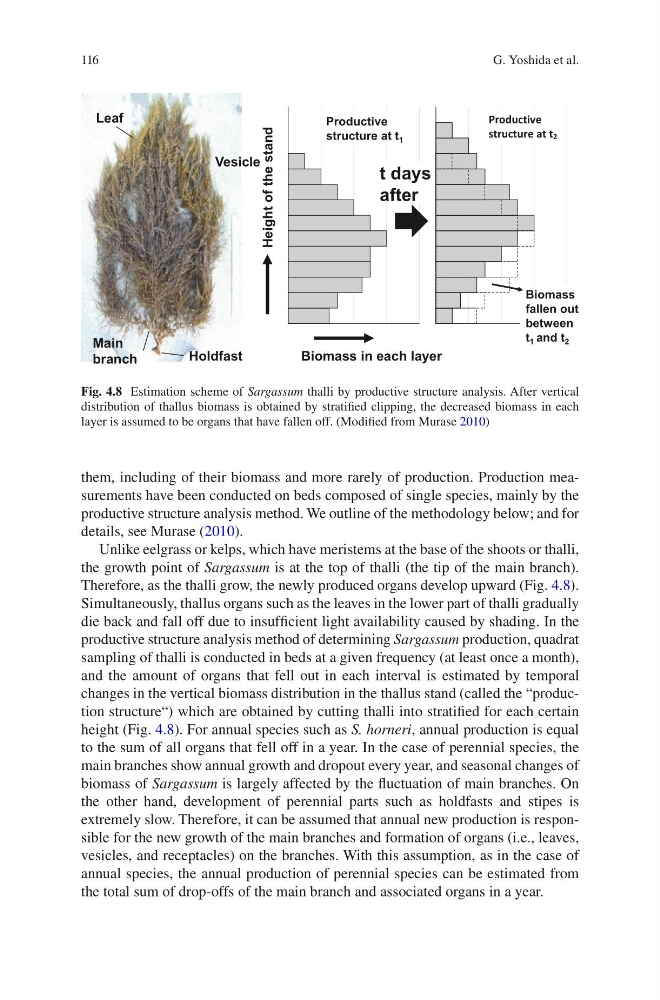
Therefore, as the thalli grow, the newly produced organs develop upward (Fig. 4.8).
Simultaneously, thallus organs such as the leaves in the lower part of thalli gradually
die back and fall off due to insufficient light availability caused by shading. In the
productive structure analysis method of determining Sargassum production, quadrat
sampling of thalli is conducted in beds at a given frequency (at least once a month),
and the amount of organs that fell out in each interval is estimated by temporal
changes in the vertical biomass distribution in the thallus stand (called the “production structure“) which are obtained by cutting thalli into stratified for each certain
height (Fig. 4.8). For annual species such as S. horneri, annual production is equal
to the sum of all organs that fell off in a year. In the case of perennial species, the
main branches show annual growth and dropout every year, and seasonal changes of
biomass of Sargassum is largely affected by the fluctuation of main branches. On
the other hand, development of perennial parts such as holdfasts and stipes is
extremely slow. Therefore, it can be assumed that annual new production is responsible for the new growth of the main branches and formation of organs (i.e., leaves,
vesicles, and receptacles) on the branches. With this assumption, as in the case of
annual species, the annual production of perennial species can be estimated from
the total sum of drop-offs of the main branch and associated organs in a year.
t days
after
Height of the stand
Biomass in each layer
Productive
structure at t2
Productive
structure at t 1
Biomass
fallen out
between
t 1 and t 2
Holdfast
Main
branch
Vesicle
Leaf
Fig. 4.8 Estimation scheme of Sargassum thalli by productive structure analysis. After vertical
distribution of thallus biomass is obtained by stratified clipping, the decreased biomass in each
layer is assumed to be organs that have fallen off. (Modified from Murase 2010)
G. Yoshida et al.
them, including of their biomass and more rarely of production. Production measurements have been conducted on beds composed of single species, mainly by the
productive structure analysis method. We outline of the methodology below; and for
details, see Murase (2010).
Unlike eelgrass or kelps, which have meristems at the base of the shoots or thalli,
the growth point of Sargassum is at the top of thalli (the tip of the main branch).
Therefore, as the thalli grow, the newly produced organs develop upward (Fig. 4.8).
Simultaneously, thallus organs such as the leaves in the lower part of thalli gradually
die back and fall off due to insufficient light availability caused by shading. In the
productive structure analysis method of determining Sargassum production, quadrat
sampling of thalli is conducted in beds at a given frequency (at least once a month),
and the amount of organs that fell out in each interval is estimated by temporal
changes in the vertical biomass distribution in the thallus stand (called the “production structure“) which are obtained by cutting thalli into stratified for each certain
height (Fig. 4.8). For annual species such as S. horneri, annual production is equal
to the sum of all organs that fell off in a year. In the case of perennial species, the
main branches show annual growth and dropout every year, and seasonal changes of
biomass of Sargassum is largely affected by the fluctuation of main branches. On
the other hand, development of perennial parts such as holdfasts and stipes is
extremely slow. Therefore, it can be assumed that annual new production is responsible for the new growth of the main branches and formation of organs (i.e., leaves,
vesicles, and receptacles) on the branches. With this assumption, as in the case of
annual species, the annual production of perennial species can be estimated from
the total sum of drop-offs of the main branch and associated organs in a year.
t days
after
Height of the stand
Biomass in each layer
Productive
structure at t2
Productive
structure at t 1
Biomass
fallen out
between
t 1 and t 2
Holdfast
Main
branch
Vesicle
Leaf
Fig. 4.8 Estimation scheme of Sargassum thalli by productive structure analysis. After vertical
distribution of thallus biomass is obtained by stratified clipping, the decreased biomass in each
layer is assumed to be organs that have fallen off. (Modified from Murase 2010)
G. Yoshida et al.