

110
4.3.1 Eelgrass Bed (Amamo-ba)
4.3.1.1 Measurement of Production by the Leaf-Marking Method
Seagrasses including Z. marina generally develop the rhizomes in the soft sediments
of sand or mud. Leafy thalli or, depending on the species, upright stems arise from
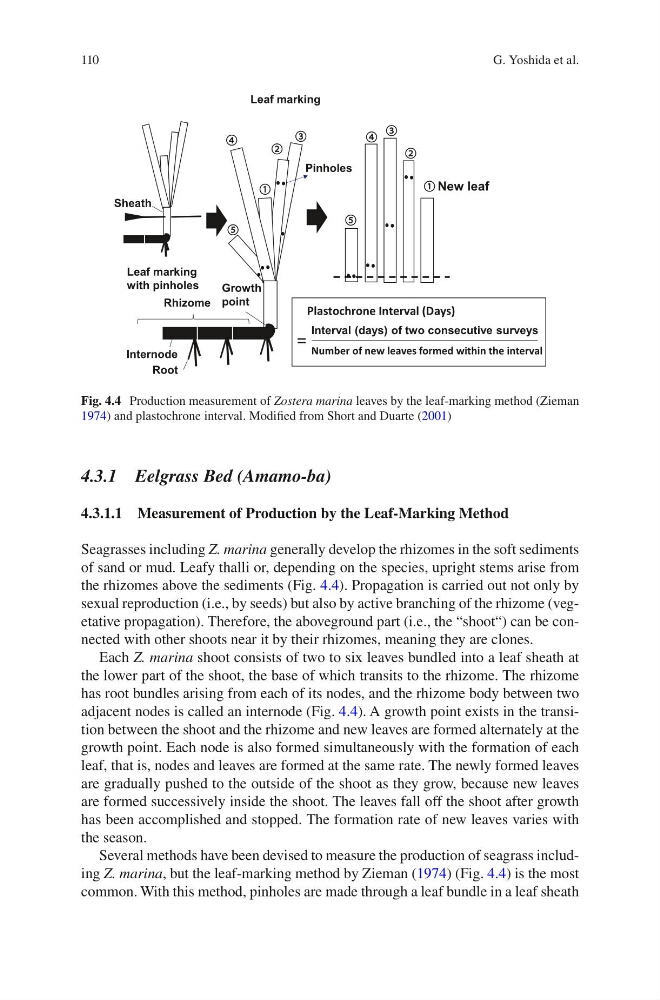
the rhizomes above the sediments (Fig. 4.4). Propagation is carried out not only by
sexual reproduction (i.e., by seeds) but also by active branching of the rhizome (vegetative propagation). Therefore, the aboveground part (i.e., the “shoot“) can be connected with other shoots near it by their rhizomes, meaning they are clones.
Each Z. marina shoot consists of two to six leaves bundled into a leaf sheath at
the lower part of the shoot, the base of which transits to the rhizome. The rhizome
has root bundles arising from each of its nodes, and the rhizome body between two
adjacent nodes is called an internode (Fig. 4.4). A growth point exists in the transition between the shoot and the rhizome and new leaves are formed alternately at the
growth point. Each node is also formed simultaneously with the formation of each
leaf, that is, nodes and leaves are formed at the same rate. The newly formed leaves
are gradually pushed to the outside of the shoot as they grow, because new leaves
are formed successively inside the shoot. The leaves fall off the shoot after growth
has been accomplished and stopped. The formation rate of new leaves varies with
the season.
Several methods have been devised to measure the production of seagrass including Z. marina, but the leaf-marking method by Zieman (1974) (Fig. 4.4) is the most
common. With this method, pinholes are made through a leaf bundle in a leaf sheath
Leaf marking
with pinholes
New leaf
Sheath
Growth
point
Internode
Interval (days) of two consecutive surveys
=
Root
Rhizome
Plastochrone Interval (Days)
Number of new leaves formed within the interval
Leaf marking
Pinholes
Fig. 4.4 Production measurement of Zostera marina leaves by the leaf-marking method (Zieman
1974) and plastochrone interval. Modified from Short and Duarte (2001)
G. Yoshida et al.
4.3.1 Eelgrass Bed (Amamo-ba)
4.3.1.1 Measurement of Production by the Leaf-Marking Method
Seagrasses including Z. marina generally develop the rhizomes in the soft sediments
of sand or mud. Leafy thalli or, depending on the species, upright stems arise from
the rhizomes above the sediments (Fig. 4.4). Propagation is carried out not only by
sexual reproduction (i.e., by seeds) but also by active branching of the rhizome (vegetative propagation). Therefore, the aboveground part (i.e., the “shoot“) can be connected with other shoots near it by their rhizomes, meaning they are clones.
Each Z. marina shoot consists of two to six leaves bundled into a leaf sheath at
the lower part of the shoot, the base of which transits to the rhizome. The rhizome
has root bundles arising from each of its nodes, and the rhizome body between two
adjacent nodes is called an internode (Fig. 4.4). A growth point exists in the transition between the shoot and the rhizome and new leaves are formed alternately at the
growth point. Each node is also formed simultaneously with the formation of each
leaf, that is, nodes and leaves are formed at the same rate. The newly formed leaves
are gradually pushed to the outside of the shoot as they grow, because new leaves
are formed successively inside the shoot. The leaves fall off the shoot after growth
has been accomplished and stopped. The formation rate of new leaves varies with
the season.
Several methods have been devised to measure the production of seagrass including Z. marina, but the leaf-marking method by Zieman (1974) (Fig. 4.4) is the most
common. With this method, pinholes are made through a leaf bundle in a leaf sheath
Leaf marking
with pinholes
New leaf
Sheath
Growth
point
Internode
Interval (days) of two consecutive surveys
=
Root
Rhizome
Plastochrone Interval (Days)
Number of new leaves formed within the interval
Leaf marking
Pinholes
Fig. 4.4 Production measurement of Zostera marina leaves by the leaf-marking method (Zieman
1974) and plastochrone interval. Modified from Short and Duarte (2001)
G. Yoshida et al.