

108
waves induced by winds and are suitable for eelgrass bed development. Vast areas
(23,000 ha) of eelgrass beds were present in the Seto Inland Sea before 1960, but
that area was reduced by as much as 30% by landfill and water pollution during the
period of rapid economic growth from the 1960s to the early 1970s in Japan (Yoshida
et al. 2010).
The distribution of the cold-temperate kelp beds is limited to the coastal areas of
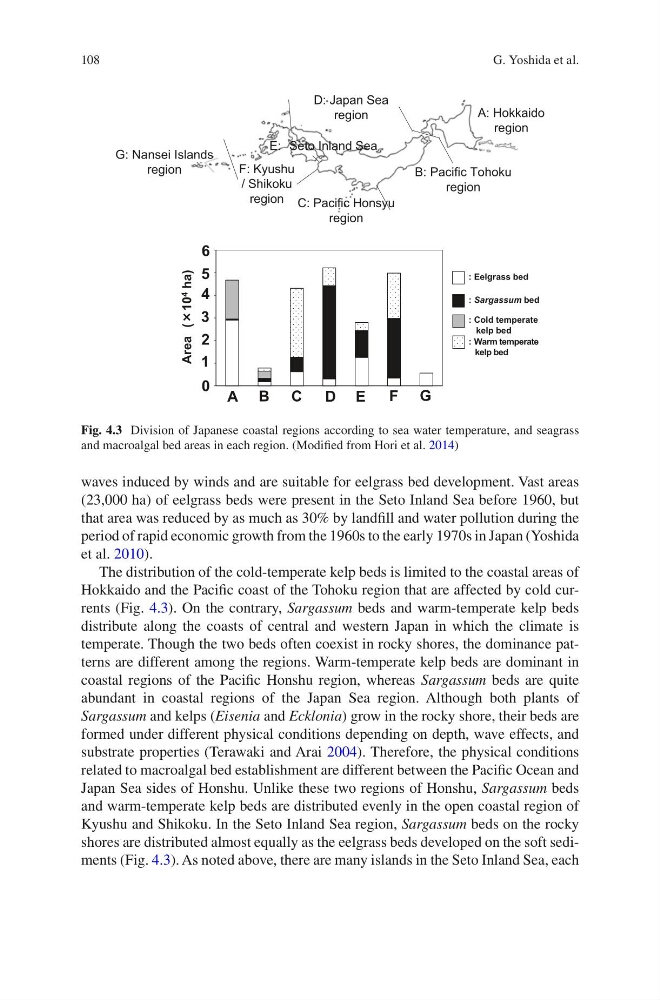
Hokkaido and the Pacific coast of the Tohoku region that are affected by cold currents (Fig. 4.3). On the contrary, Sargassum beds and warm-temperate kelp beds
distribute along the coasts of central and western Japan in which the climate is
temperate. Though the two beds often coexist in rocky shores, the dominance patterns are different among the regions. Warm-temperate kelp beds are dominant in
coastal regions of the Pacific Honshu region, whereas Sargassum beds are quite
abundant in coastal regions of the Japan Sea region. Although both plants of
Sargassum and kelps (Eisenia and Ecklonia) grow in the rocky shore, their beds are
formed under different physical conditions depending on depth, wave effects, and
substrate properties (Terawaki and Arai 2004). Therefore, the physical conditions
related to macroalgal bed establishment are different between the Pacific Ocean and
Japan Sea sides of Honshu. Unlike these two regions of Honshu, Sargassum beds
and warm-temperate kelp beds are distributed evenly in the open coastal region of
Kyushu and Shikoku. In the Seto Inland Sea region, Sargassum beds on the rocky
shores are distributed almost equally as the eelgrass beds developed on the soft sediments (Fig. 4.3). As noted above, there are many islands in the Seto Inland Sea, each
: Eelgrass bed
: Sargassum bed
: Cold temperate
kelp bed
: Warm temperate
kelp bed
A: Hokkaido
region
B: Pacific Tohoku
region
D: Japan Sea
region
C: Pacific Honsyu
region
E: Seto Inland Sea
G: Nansei Islands
region
F: Kyushu
/ Shikoku
region
0
1
2
3
4
5
6
Area ( 10 4
ha)
A B C
D E
F G
Fig. 4.3 Division of Japanese coastal regions according to sea water temperature, and seagrass
and macroalgal bed areas in each region. (Modified from Hori et al. 2014)
G. Yoshida et al.
waves induced by winds and are suitable for eelgrass bed development. Vast areas
(23,000 ha) of eelgrass beds were present in the Seto Inland Sea before 1960, but
that area was reduced by as much as 30% by landfill and water pollution during the
period of rapid economic growth from the 1960s to the early 1970s in Japan (Yoshida
et al. 2010).
The distribution of the cold-temperate kelp beds is limited to the coastal areas of
Hokkaido and the Pacific coast of the Tohoku region that are affected by cold currents (Fig. 4.3). On the contrary, Sargassum beds and warm-temperate kelp beds
distribute along the coasts of central and western Japan in which the climate is
temperate. Though the two beds often coexist in rocky shores, the dominance patterns are different among the regions. Warm-temperate kelp beds are dominant in
coastal regions of the Pacific Honshu region, whereas Sargassum beds are quite
abundant in coastal regions of the Japan Sea region. Although both plants of
Sargassum and kelps (Eisenia and Ecklonia) grow in the rocky shore, their beds are
formed under different physical conditions depending on depth, wave effects, and
substrate properties (Terawaki and Arai 2004). Therefore, the physical conditions
related to macroalgal bed establishment are different between the Pacific Ocean and
Japan Sea sides of Honshu. Unlike these two regions of Honshu, Sargassum beds
and warm-temperate kelp beds are distributed evenly in the open coastal region of
Kyushu and Shikoku. In the Seto Inland Sea region, Sargassum beds on the rocky
shores are distributed almost equally as the eelgrass beds developed on the soft sediments (Fig. 4.3). As noted above, there are many islands in the Seto Inland Sea, each
: Eelgrass bed
: Sargassum bed
: Cold temperate
kelp bed
: Warm temperate
kelp bed
A: Hokkaido
region
B: Pacific Tohoku
region
D: Japan Sea
region
C: Pacific Honsyu
region
E: Seto Inland Sea
G: Nansei Islands
region
F: Kyushu
/ Shikoku
region
0
1
2
3
4
5
6
Area ( 10 4
ha)
A B C
D E
F G
Fig. 4.3 Division of Japanese coastal regions according to sea water temperature, and seagrass
and macroalgal bed areas in each region. (Modified from Hori et al. 2014)
G. Yoshida et al.