

105
beds: Garamo-ba, Arame-ba, Kombu-ba, Tengusa-ba, Wakame-ba, Aosa-Aonori-ba,
and other macroalgal bed, according to their main constituent macroalgal species
(Environmental Agency, Marine Parks Center of Japan 1994). The classification
type depends on taxa levels higher than species, so the constituents of a bed type
generally include several species that are taxonomically closely related. Because
these constituent species exhibit similar morphology, life cycles, and other ecological properties characterized by the taxa, each bed has characteristic landscapes and
specific functions in coastal ecosystems.
In general, of these eight types of seagrass and macroalgal beds, Amamo-ba,
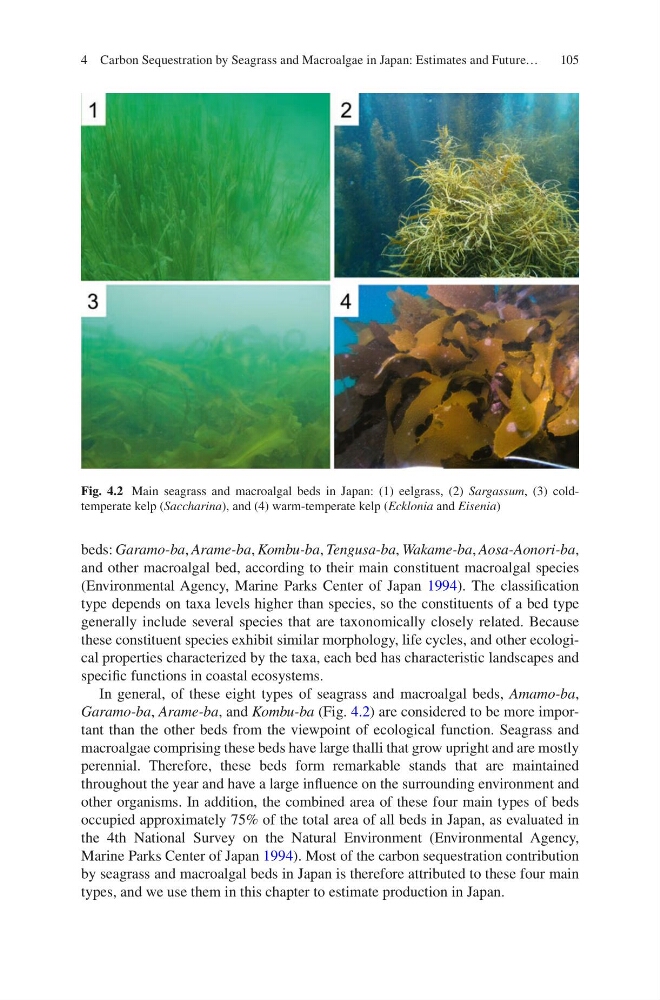
Garamo-ba, Arame-ba, and Kombu-ba (Fig. 4.2) are considered to be more important than the other beds from the viewpoint of ecological function. Seagrass and
macroalgae comprising these beds have large thalli that grow upright and are mostly
perennial. Therefore, these beds form remarkable stands that are maintained
throughout the year and have a large influence on the surrounding environment and
other organisms. In addition, the combined area of these four main types of beds
occupied approximately 75% of the total area of all beds in Japan, as evaluated in
the 4th National Survey on the Natural Environment (Environmental Agency,
Marine Parks Center of Japan 1994). Most of the carbon sequestration contribution
by seagrass and macroalgal beds in Japan is therefore attributed to these four main
types, and we use them in this chapter to estimate production in Japan.
Fig. 4.2 Main seagrass and macroalgal beds in Japan: (1) eelgrass, (2) Sargassum, (3) coldtemperate kelp (Saccharina), and (4) warm-temperate kelp (Ecklonia and Eisenia)
4 Carbon Sequestration by Seagrass and Macroalgae in Japan: Estimates and Future…
beds: Garamo-ba, Arame-ba, Kombu-ba, Tengusa-ba, Wakame-ba, Aosa-Aonori-ba,
and other macroalgal bed, according to their main constituent macroalgal species
(Environmental Agency, Marine Parks Center of Japan 1994). The classification
type depends on taxa levels higher than species, so the constituents of a bed type
generally include several species that are taxonomically closely related. Because
these constituent species exhibit similar morphology, life cycles, and other ecological properties characterized by the taxa, each bed has characteristic landscapes and
specific functions in coastal ecosystems.
In general, of these eight types of seagrass and macroalgal beds, Amamo-ba,
Garamo-ba, Arame-ba, and Kombu-ba (Fig. 4.2) are considered to be more important than the other beds from the viewpoint of ecological function. Seagrass and
macroalgae comprising these beds have large thalli that grow upright and are mostly
perennial. Therefore, these beds form remarkable stands that are maintained
throughout the year and have a large influence on the surrounding environment and
other organisms. In addition, the combined area of these four main types of beds
occupied approximately 75% of the total area of all beds in Japan, as evaluated in
the 4th National Survey on the Natural Environment (Environmental Agency,
Marine Parks Center of Japan 1994). Most of the carbon sequestration contribution
by seagrass and macroalgal beds in Japan is therefore attributed to these four main
types, and we use them in this chapter to estimate production in Japan.
Fig. 4.2 Main seagrass and macroalgal beds in Japan: (1) eelgrass, (2) Sargassum, (3) coldtemperate kelp (Saccharina), and (4) warm-temperate kelp (Ecklonia and Eisenia)
4 Carbon Sequestration by Seagrass and Macroalgae in Japan: Estimates and Future…