

103
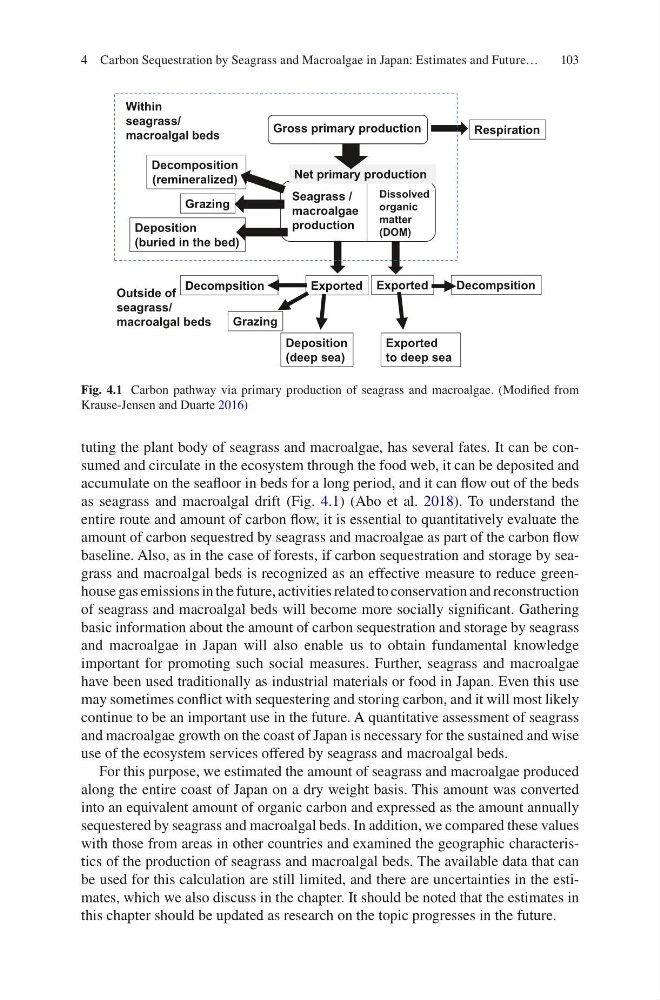
tuting the plant body of seagrass and macroalgae, has several fates. It can be consumed and circulate in the ecosystem through the food web, it can be deposited and
accumulate on the seafloor in beds for a long period, and it can flow out of the beds
as seagrass and macroalgal drift (Fig. 4.1) (Abo et al. 2018). To understand the
entire route and amount of carbon flow, it is essential to quantitatively evaluate the
amount of carbon sequestred by seagrass and macroalgae as part of the carbon flow
baseline. Also, as in the case of forests, if carbon sequestration and storage by seagrass and macroalgal beds is recognized as an effective measure to reduce greenhouse gas emissions in the future, activities related to conservation and reconstruction
of seagrass and macroalgal beds will become more socially significant. Gathering
basic information about the amount of carbon sequestration and storage by seagrass
and macroalgae in Japan will also enable us to obtain fundamental knowledge
important for promoting such social measures. Further, seagrass and macroalgae
have been used traditionally as industrial materials or food in Japan. Even this use
may sometimes conflict with sequestering and storing carbon, and it will most likely
continue to be an important use in the future. A quantitative assessment of seagrass
and macroalgae growth on the coast of Japan is necessary for the sustained and wise
use of the ecosystem services offered by seagrass and macroalgal beds.
For this purpose, we estimated the amount of seagrass and macroalgae produced
along the entire coast of Japan on a dry weight basis. This amount was converted
into an equivalent amount of organic carbon and expressed as the amount annually
sequestered by seagrass and macroalgal beds. In addition, we compared these values
with those from areas in other countries and examined the geographic characteristics of the production of seagrass and macroalgal beds. The available data that can
be used for this calculation are still limited, and there are uncertainties in the estimates, which we also discuss in the chapter. It should be noted that the estimates in
this chapter should be updated as research on the topic progresses in the future.
Gross primary production
Net primary production
Respiration
Decomposition
(remineralized)
Grazing
Deposition
(buried in the bed)
Exported
Decompsition
Grazing
Deposition
(deep sea)
Exported
to deep sea
Within
seagrass/
macroalgal beds
Seagrass /
macroalgae
production
Dissolved
organic
matter
(DOM)
Outside of
seagrass/
macroalgal beds
Exported
Decompsition
Fig. 4.1 Carbon pathway via primary production of seagrass and macroalgae. (Modified from
Krause-Jensen and Duarte 2016)
4 Carbon Sequestration by Seagrass and Macroalgae in Japan: Estimates and Future…
tuting the plant body of seagrass and macroalgae, has several fates. It can be consumed and circulate in the ecosystem through the food web, it can be deposited and
accumulate on the seafloor in beds for a long period, and it can flow out of the beds
as seagrass and macroalgal drift (Fig. 4.1) (Abo et al. 2018). To understand the
entire route and amount of carbon flow, it is essential to quantitatively evaluate the
amount of carbon sequestred by seagrass and macroalgae as part of the carbon flow
baseline. Also, as in the case of forests, if carbon sequestration and storage by seagrass and macroalgal beds is recognized as an effective measure to reduce greenhouse gas emissions in the future, activities related to conservation and reconstruction
of seagrass and macroalgal beds will become more socially significant. Gathering
basic information about the amount of carbon sequestration and storage by seagrass
and macroalgae in Japan will also enable us to obtain fundamental knowledge
important for promoting such social measures. Further, seagrass and macroalgae
have been used traditionally as industrial materials or food in Japan. Even this use
may sometimes conflict with sequestering and storing carbon, and it will most likely
continue to be an important use in the future. A quantitative assessment of seagrass
and macroalgae growth on the coast of Japan is necessary for the sustained and wise
use of the ecosystem services offered by seagrass and macroalgal beds.
For this purpose, we estimated the amount of seagrass and macroalgae produced
along the entire coast of Japan on a dry weight basis. This amount was converted
into an equivalent amount of organic carbon and expressed as the amount annually
sequestered by seagrass and macroalgal beds. In addition, we compared these values
with those from areas in other countries and examined the geographic characteristics of the production of seagrass and macroalgal beds. The available data that can
be used for this calculation are still limited, and there are uncertainties in the estimates, which we also discuss in the chapter. It should be noted that the estimates in
this chapter should be updated as research on the topic progresses in the future.
Gross primary production
Net primary production
Respiration
Decomposition
(remineralized)
Grazing
Deposition
(buried in the bed)
Exported
Decompsition
Grazing
Deposition
(deep sea)
Exported
to deep sea
Within
seagrass/
macroalgal beds
Seagrass /
macroalgae
production
Dissolved
organic
matter
(DOM)
Outside of
seagrass/
macroalgal beds
Exported
Decompsition
Fig. 4.1 Carbon pathway via primary production of seagrass and macroalgae. (Modified from
Krause-Jensen and Duarte 2016)
4 Carbon Sequestration by Seagrass and Macroalgae in Japan: Estimates and Future…