

72
et al. 2016; Vaz et al. 2015; Wang et al. 2016). The open-source packages are advantageous and helpful as they provide more flexibility and state-of-the-art methods for
data interpretation, and the software can be tailored or extended to the specific needs
of the researcher (Maciel et al. 2016; Vaz et al. 2015). Recently, Metabolon and
SCIEX together developed the first lipidomic analysis system providing quantitative, specific, and complete information on complex lipids from biological samples,
the Lipidyzer™ Platform (https://sciex.com/lipidyzer-platform) that produces accurate data on more than 1000 individual lipid species, and the results can be mapped
to pathways at the level of FA metabolism, complex lipid metabolism, and lipid
class metabolism. Metabolon’s TrueMass™ Complex Lipid Panel technology helps
the Lipidyzer Platform to achieve such specificity by using an innovative differential ion mobility spectroscopy-mass spectrometry platform (DMS-MS/MS) that
allows only one class of lipid into the MS at a time and thus eliminating cross-class
isomers in the analysis.
In addition, there are a series of websites and lipidomic consortia such as Lipid
Library (http://lipidlibrary.co.uk), Cyberlipids (http://www.cyberlipid.org), LIPID
MAPS (www.lipidmaps.org) and its affiliated sphinGOMAP (http://sphingolab.biology.gatech.edu/), LIPIDAT (www.lipidat.chemystry.ohio-state.edu/home.stm), and
Lipidomics Expertise Platform (www.lipidomics-expertise), and similar communitywide efforts in Japan (www.lipidbank.jp) and Europe (www.lipidomics.net) that provide useful information about lipids structure, their functions, and detailed protocols
to extract and separate the lipids, lipid standards, and lipidomic expertise.
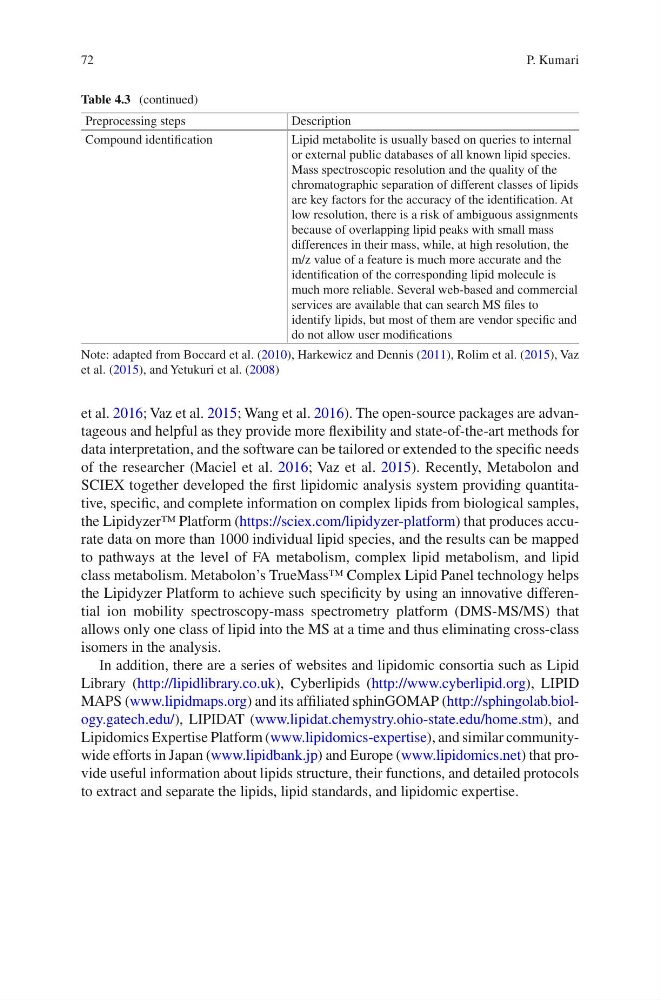
Table 4.3 (continued)
Preprocessing steps
Description
Compound identification
Lipid metabolite is usually based on queries to internal
or external public databases of all known lipid species.
Mass spectroscopic resolution and the quality of the
chromatographic separation of different classes of lipids
are key factors for the accuracy of the identification. At
low resolution, there is a risk of ambiguous assignments
because of overlapping lipid peaks with small mass
differences in their mass, while, at high resolution, the
m/z value of a feature is much more accurate and the
identification of the corresponding lipid molecule is
much more reliable. Several web-based and commercial
services are available that can search MS files to
identify lipids, but most of them are vendor specific and
do not allow user modifications
Note: adapted from Boccard et al. (2010), Harkewicz and Dennis (2011), Rolim et al. (2015), Vaz
et al. (2015), and Yetukuri et al. (2008)
P. Kumari
et al. 2016; Vaz et al. 2015; Wang et al. 2016). The open-source packages are advantageous and helpful as they provide more flexibility and state-of-the-art methods for
data interpretation, and the software can be tailored or extended to the specific needs
of the researcher (Maciel et al. 2016; Vaz et al. 2015). Recently, Metabolon and
SCIEX together developed the first lipidomic analysis system providing quantitative, specific, and complete information on complex lipids from biological samples,
the Lipidyzer™ Platform (https://sciex.com/lipidyzer-platform) that produces accurate data on more than 1000 individual lipid species, and the results can be mapped
to pathways at the level of FA metabolism, complex lipid metabolism, and lipid
class metabolism. Metabolon’s TrueMass™ Complex Lipid Panel technology helps
the Lipidyzer Platform to achieve such specificity by using an innovative differential ion mobility spectroscopy-mass spectrometry platform (DMS-MS/MS) that
allows only one class of lipid into the MS at a time and thus eliminating cross-class
isomers in the analysis.
In addition, there are a series of websites and lipidomic consortia such as Lipid
Library (http://lipidlibrary.co.uk), Cyberlipids (http://www.cyberlipid.org), LIPID
MAPS (www.lipidmaps.org) and its affiliated sphinGOMAP (http://sphingolab.biology.gatech.edu/), LIPIDAT (www.lipidat.chemystry.ohio-state.edu/home.stm), and
Lipidomics Expertise Platform (www.lipidomics-expertise), and similar communitywide efforts in Japan (www.lipidbank.jp) and Europe (www.lipidomics.net) that provide useful information about lipids structure, their functions, and detailed protocols
to extract and separate the lipids, lipid standards, and lipidomic expertise.
Table 4.3 (continued)
Preprocessing steps
Description
Compound identification
Lipid metabolite is usually based on queries to internal
or external public databases of all known lipid species.
Mass spectroscopic resolution and the quality of the
chromatographic separation of different classes of lipids
are key factors for the accuracy of the identification. At
low resolution, there is a risk of ambiguous assignments
because of overlapping lipid peaks with small mass
differences in their mass, while, at high resolution, the
m/z value of a feature is much more accurate and the
identification of the corresponding lipid molecule is
much more reliable. Several web-based and commercial
services are available that can search MS files to
identify lipids, but most of them are vendor specific and
do not allow user modifications
Note: adapted from Boccard et al. (2010), Harkewicz and Dennis (2011), Rolim et al. (2015), Vaz
et al. (2015), and Yetukuri et al. (2008)
P. Kumari