

41
Metal complexes with sulfate, fluoride, chloride, and phosphate are the most
stable and, importantly, present at pH levels below 7, whereas metal carbonate
( CO 3
2− ) and hydroxide (OH
−
) complexes are notably more unstable and present at
pH levels above pH 6–8 (Millero et al. 2009). Metals that form complexes with
CO 3
2− and OH
−
have a higher fraction in their free form at a lower pH. This directly
affects metal speciation and, thus, metal bioavailability and toxic effects. For example, at the current pH of seawater (ca. 8.1), Fe(III) is at its minimum solubility, and
solubility is further influenced by organic matter (Liu and Millero 2002). A decrease
in pH would increase Fe(III) solubility by ~40%, which could have a large impact
on biogeochemical cycles. Increased solubility would make iron more available to
marine autotrophs, leading to an increased primary production (Martin 1990).
Likewise, copper is an important nutrient for all organisms, and its bioavailability
influences several cellular functions. A low pH decreases the strength of natural
organic matter/Cu
2+
interactions, driving affinities to negligible levels at a lower
pH. Thus, the proportion of non-complexed free Cu
2+
ranges from less than 0.1%
above pH 8 or higher to 30% at pH 7.0 (Zirino and Yamamoto 1972; Millero et al.
2009). Like copper, cadmium is strongly associated with chloride ions, but at a low
pH, metal carbonate complexes increase, therefore reducing the bioavailability of
carbonate and bicarbonate molecules.
Ocean acidification is consistently related to reduced growth rates in calcareous
algae (e.g., planktonic coccolithophores and benthic calcifying macroalgae), and
reduced calcification rates have been recorded in crustose and articulated coralline
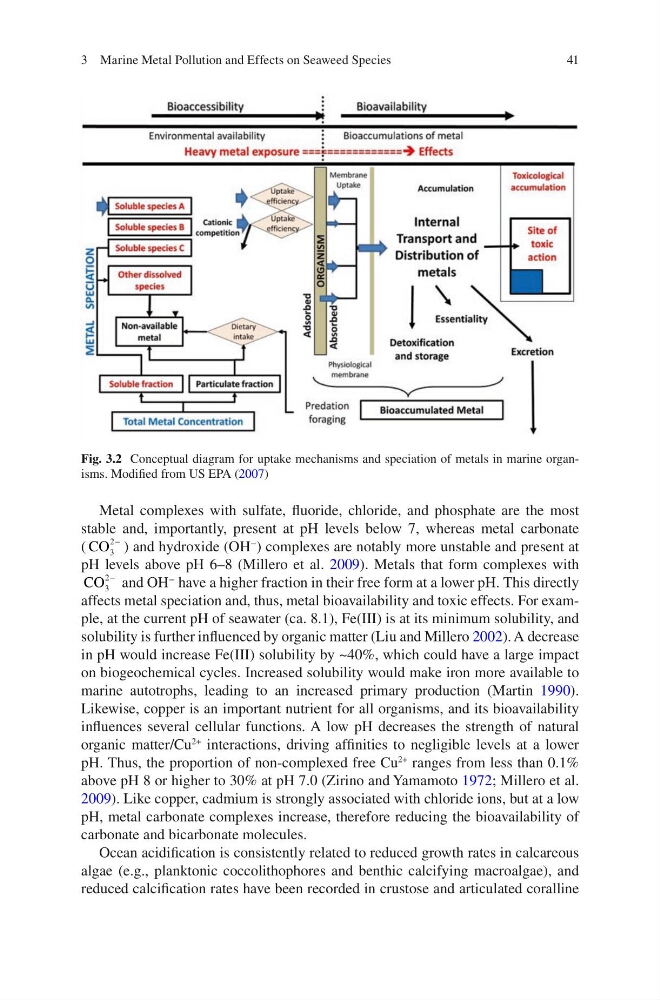
Fig. 3.2 Conceptual diagram for uptake mechanisms and speciation of metals in marine organisms. Modified from US EPA (2007)
3 Marine Metal Pollution and Effects on Seaweed Species
Metal complexes with sulfate, fluoride, chloride, and phosphate are the most
stable and, importantly, present at pH levels below 7, whereas metal carbonate
( CO 3
2− ) and hydroxide (OH
−
) complexes are notably more unstable and present at
pH levels above pH 6–8 (Millero et al. 2009). Metals that form complexes with
CO 3
2− and OH
−
have a higher fraction in their free form at a lower pH. This directly
affects metal speciation and, thus, metal bioavailability and toxic effects. For example, at the current pH of seawater (ca. 8.1), Fe(III) is at its minimum solubility, and
solubility is further influenced by organic matter (Liu and Millero 2002). A decrease
in pH would increase Fe(III) solubility by ~40%, which could have a large impact
on biogeochemical cycles. Increased solubility would make iron more available to
marine autotrophs, leading to an increased primary production (Martin 1990).
Likewise, copper is an important nutrient for all organisms, and its bioavailability
influences several cellular functions. A low pH decreases the strength of natural
organic matter/Cu
2+
interactions, driving affinities to negligible levels at a lower
pH. Thus, the proportion of non-complexed free Cu
2+
ranges from less than 0.1%
above pH 8 or higher to 30% at pH 7.0 (Zirino and Yamamoto 1972; Millero et al.
2009). Like copper, cadmium is strongly associated with chloride ions, but at a low
pH, metal carbonate complexes increase, therefore reducing the bioavailability of
carbonate and bicarbonate molecules.
Ocean acidification is consistently related to reduced growth rates in calcareous
algae (e.g., planktonic coccolithophores and benthic calcifying macroalgae), and
reduced calcification rates have been recorded in crustose and articulated coralline
Fig. 3.2 Conceptual diagram for uptake mechanisms and speciation of metals in marine organisms. Modified from US EPA (2007)
3 Marine Metal Pollution and Effects on Seaweed Species