

335
with the aid of ribotyping. Though it is a robust method for the determination of
molecular epidemiology of bacterial pathogens, the time requirement for blotting,
use of radioactivity in detection and its lengthiness, makes this technique less attractive and tedious as well (Kostman et al. 1992). But this technique is very less
explored for the study of coral-associated bacteria. Hence, ribotyping can be efficiently adapted for exploring the diversity of coral-associated bacteria and detection
of potentially pathogenic microbes.
16.5.3 Western Blot: A Protein-Based Molecular Technique
Proteins profiling in coral-bacterial ecology may provide us the information related to
the function of bacteria and their mechanism in coral holobiont. Western blot is the
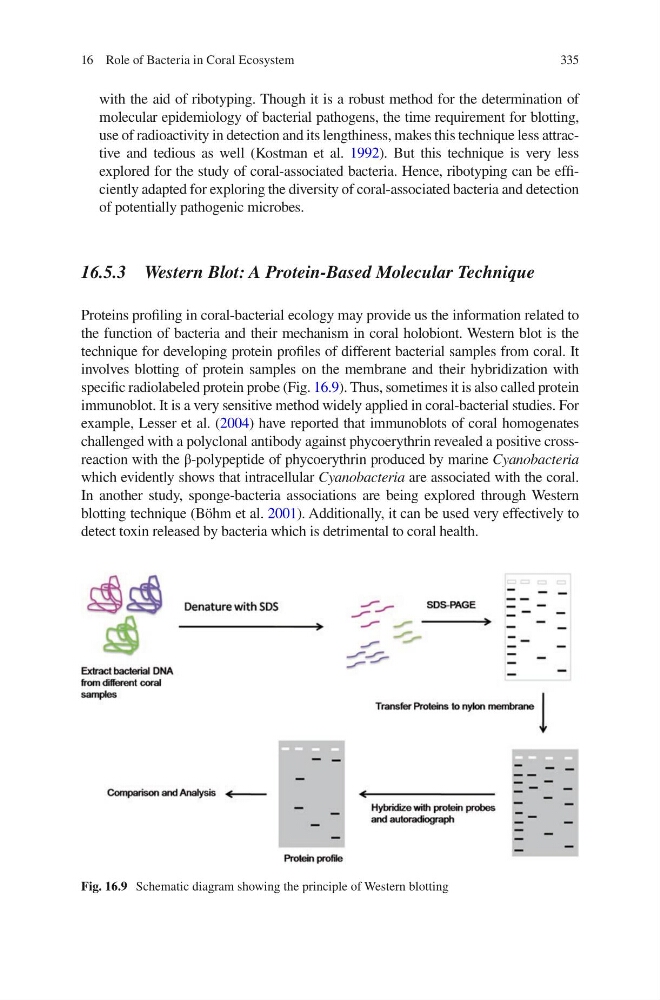
technique for developing protein profiles of different bacterial samples from coral. It
involves blotting of protein samples on the membrane and their hybridization with
specific radiolabeled protein probe (Fig. 16.9). Thus, sometimes it is also called protein
immunoblot. It is a very sensitive method widely applied in coral- bacterial studies. For
example, Lesser et al. (2004) have reported that immunoblots of coral homogenates
challenged with a polyclonal antibody against phycoerythrin revealed a positive crossreaction with the β-polypeptide of phycoerythrin produced by marine Cyanobacteria
which evidently shows that intracellular Cyanobacteria are associated with the coral.
In another study, sponge-bacteria associations are being explored through Western
blotting technique (Böhm et al. 2001). Additionally, it can be used very effectively to
detect toxin released by bacteria which is detrimental to coral health.
Fig. 16.9 Schematic diagram showing the principle of Western blotting
16 Role of Bacteria in Coral Ecosystem
with the aid of ribotyping. Though it is a robust method for the determination of
molecular epidemiology of bacterial pathogens, the time requirement for blotting,
use of radioactivity in detection and its lengthiness, makes this technique less attractive and tedious as well (Kostman et al. 1992). But this technique is very less
explored for the study of coral-associated bacteria. Hence, ribotyping can be efficiently adapted for exploring the diversity of coral-associated bacteria and detection
of potentially pathogenic microbes.
16.5.3 Western Blot: A Protein-Based Molecular Technique
Proteins profiling in coral-bacterial ecology may provide us the information related to
the function of bacteria and their mechanism in coral holobiont. Western blot is the
technique for developing protein profiles of different bacterial samples from coral. It
involves blotting of protein samples on the membrane and their hybridization with
specific radiolabeled protein probe (Fig. 16.9). Thus, sometimes it is also called protein
immunoblot. It is a very sensitive method widely applied in coral- bacterial studies. For
example, Lesser et al. (2004) have reported that immunoblots of coral homogenates
challenged with a polyclonal antibody against phycoerythrin revealed a positive crossreaction with the β-polypeptide of phycoerythrin produced by marine Cyanobacteria
which evidently shows that intracellular Cyanobacteria are associated with the coral.
In another study, sponge-bacteria associations are being explored through Western
blotting technique (Böhm et al. 2001). Additionally, it can be used very effectively to
detect toxin released by bacteria which is detrimental to coral health.
Fig. 16.9 Schematic diagram showing the principle of Western blotting
16 Role of Bacteria in Coral Ecosystem