

324
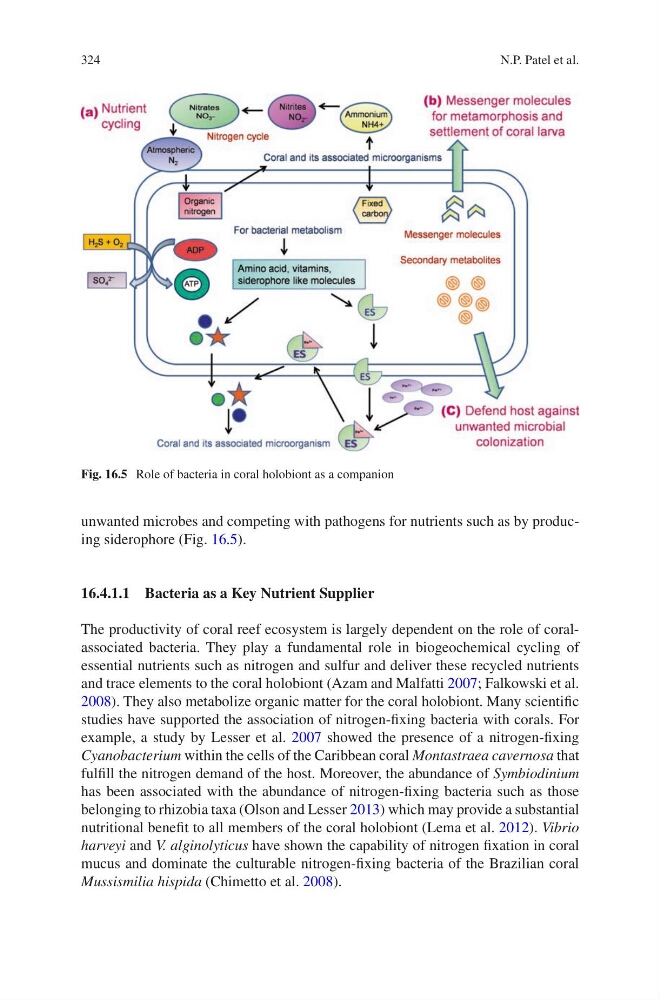
unwanted microbes and competing with pathogens for nutrients such as by producing siderophore (Fig. 16.5).
16.4.1.1 Bacteria as a Key Nutrient Supplier
The productivity of coral reef ecosystem is largely dependent on the role of coralassociated bacteria. They play a fundamental role in biogeochemical cycling of
essential nutrients such as nitrogen and sulfur and deliver these recycled nutrients
and trace elements to the coral holobiont (Azam and Malfatti 2007; Falkowski et al.
2008). They also metabolize organic matter for the coral holobiont. Many scientific
studies have supported the association of nitrogen-fixing bacteria with corals. For
example, a study by Lesser et al. 2007 showed the presence of a nitrogen-fixing
Cyanobacterium within the cells of the Caribbean coral Montastraea cavernosa that
fulfill the nitrogen demand of the host. Moreover, the abundance of Symbiodinium
has been associated with the abundance of nitrogen-fixing bacteria such as those
belonging to rhizobia taxa (Olson and Lesser 2013) which may provide a substantial
nutritional benefit to all members of the coral holobiont (Lema et al. 2012). Vibrio
harveyi and V. alginolyticus have shown the capability of nitrogen fixation in coral
mucus and dominate the culturable nitrogen-fixing bacteria of the Brazilian coral
Mussismilia hispida (Chimetto et al. 2008).
Fig. 16.5 Role of bacteria in coral holobiont as a companion
N.P. Patel et al.
unwanted microbes and competing with pathogens for nutrients such as by producing siderophore (Fig. 16.5).
16.4.1.1 Bacteria as a Key Nutrient Supplier
The productivity of coral reef ecosystem is largely dependent on the role of coralassociated bacteria. They play a fundamental role in biogeochemical cycling of
essential nutrients such as nitrogen and sulfur and deliver these recycled nutrients
and trace elements to the coral holobiont (Azam and Malfatti 2007; Falkowski et al.
2008). They also metabolize organic matter for the coral holobiont. Many scientific
studies have supported the association of nitrogen-fixing bacteria with corals. For
example, a study by Lesser et al. 2007 showed the presence of a nitrogen-fixing
Cyanobacterium within the cells of the Caribbean coral Montastraea cavernosa that
fulfill the nitrogen demand of the host. Moreover, the abundance of Symbiodinium
has been associated with the abundance of nitrogen-fixing bacteria such as those
belonging to rhizobia taxa (Olson and Lesser 2013) which may provide a substantial
nutritional benefit to all members of the coral holobiont (Lema et al. 2012). Vibrio
harveyi and V. alginolyticus have shown the capability of nitrogen fixation in coral
mucus and dominate the culturable nitrogen-fixing bacteria of the Brazilian coral
Mussismilia hispida (Chimetto et al. 2008).
Fig. 16.5 Role of bacteria in coral holobiont as a companion
N.P. Patel et al.