

303
the light organ of E. scolopes where, at high concentrations, it expresses the luciferase enzyme resulting in a visible bioluminescent phenotype (Visick et al. 2000).
Luciferase expression in the bacterium is controlled by the paradigm of QS, LuxI/
LuxR or the autoinducer 1 (AI1) system, in which the LuxI is responsible for the
production of the AHL signalling molecule (in this case a 3-oxo-C6-HSL) and
LuxR acts as the response regulator protein (Engebrecht and Silverman 1984). The
LuxI-LuxR type QS system is not restricted to A. fischeri, and this now classical QS
system has been described to control a variety of phenotypes in a range of Gramnegative bacteria (Whitehead et al. 2001; Galloway et al. 2011; Rutherford and
Bassler 2012).
In addition to controlling a range of bacterial phenotypes via cell-to-cell communication, QS signalling has been proposed to facilitate communication between
microorganisms and their hosts such as human, plant and algae (Hughes and
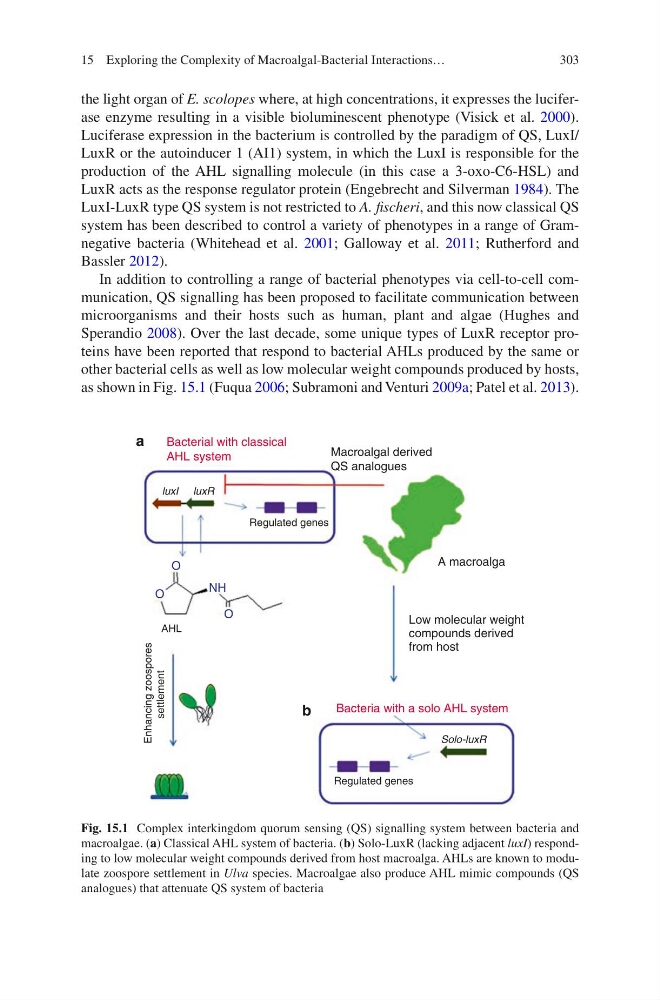
Sperandio 2008). Over the last decade, some unique types of LuxR receptor proteins have been reported that respond to bacterial AHLs produced by the same or
other bacterial cells as well as low molecular weight compounds produced by hosts,
as shown in Fig. 15.1 (Fuqua 2006; Subramoni and Venturi 2009a; Patel et al. 2013).
Macroalgal derived
QS analogues
a
b
Bacterial with classical
AHL system
Bacteria with a solo AHL system
A macroalga
Regulated genes
Solo-luxR
Enhancing zoospores
settlement
Regulated genes
O
O
O
NH
AHL
luxI luxR
Low molecular weight
compounds derived
from host
Fig. 15.1 Complex interkingdom quorum sensing (QS) signalling system between bacteria and
macroalgae. (a) Classical AHL system of bacteria. (b) Solo-LuxR (lacking adjacent luxI) responding to low molecular weight compounds derived from host macroalga. AHLs are known to modulate zoospore settlement in Ulva species. Macroalgae also produce AHL mimic compounds (QS
analogues) that attenuate QS system of bacteria
15 Exploring the Complexity of Macroalgal-Bacterial Interactions…
the light organ of E. scolopes where, at high concentrations, it expresses the luciferase enzyme resulting in a visible bioluminescent phenotype (Visick et al. 2000).
Luciferase expression in the bacterium is controlled by the paradigm of QS, LuxI/
LuxR or the autoinducer 1 (AI1) system, in which the LuxI is responsible for the
production of the AHL signalling molecule (in this case a 3-oxo-C6-HSL) and
LuxR acts as the response regulator protein (Engebrecht and Silverman 1984). The
LuxI-LuxR type QS system is not restricted to A. fischeri, and this now classical QS
system has been described to control a variety of phenotypes in a range of Gramnegative bacteria (Whitehead et al. 2001; Galloway et al. 2011; Rutherford and
Bassler 2012).
In addition to controlling a range of bacterial phenotypes via cell-to-cell communication, QS signalling has been proposed to facilitate communication between
microorganisms and their hosts such as human, plant and algae (Hughes and
Sperandio 2008). Over the last decade, some unique types of LuxR receptor proteins have been reported that respond to bacterial AHLs produced by the same or
other bacterial cells as well as low molecular weight compounds produced by hosts,
as shown in Fig. 15.1 (Fuqua 2006; Subramoni and Venturi 2009a; Patel et al. 2013).
Macroalgal derived
QS analogues
a
b
Bacterial with classical
AHL system
Bacteria with a solo AHL system
A macroalga
Regulated genes
Solo-luxR
Enhancing zoospores
settlement
Regulated genes
O
O
O
NH
AHL
luxI luxR
Low molecular weight
compounds derived
from host
Fig. 15.1 Complex interkingdom quorum sensing (QS) signalling system between bacteria and
macroalgae. (a) Classical AHL system of bacteria. (b) Solo-LuxR (lacking adjacent luxI) responding to low molecular weight compounds derived from host macroalga. AHLs are known to modulate zoospore settlement in Ulva species. Macroalgae also produce AHL mimic compounds (QS
analogues) that attenuate QS system of bacteria
15 Exploring the Complexity of Macroalgal-Bacterial Interactions…