

281
of the discovered marine natural products (Hu et al. 2011). All too often however,
novel natural products are sought for their therapeutic and antibiotic uses, while
their role in mediating chemical communication between microbes is considered
secondary (Yim et al. 2007; Bhatnagar and Kim 2010).
In terrestrial environments, plant-microbe interactions occurring within the plant
rhizosphere—the area immediately surrounding plant roots and surrounding bacteria—have been extensively explored (Jones 1998; van Loon et al. 1998; Doornbos
Angiosperms
Gymnosperms
Lycophytes
Bryophytes
Chlorophytes
Rhodophytes
Glaucophytes
Diatoms
Pelagophytes
Phaeophytes
Eustigmatophytes
Chrysophytes
Oomycetes
290
320
[6]
-
402
432
[6.7]
-
432
476
[3]
-
1180
1474
[1.2]
-
434
735
[5]
-
1679
1866
[1]
-
1510
1699
[1]
-
1240
1481
[1]
-
238
266
[8]
-
767
1072
[4]
-
1365
1577
[1]
-
1558
[2]
1200
[3]
Stramenopiles
Archaeplastids
Alveolates
Unikonts
Ciliates
Fungi
Animals
Amoebozoa
Bacteria
Rhizaria
Haptophytes
Cryptophytes
Excavates
Dinoflagellates
Apicomplexa
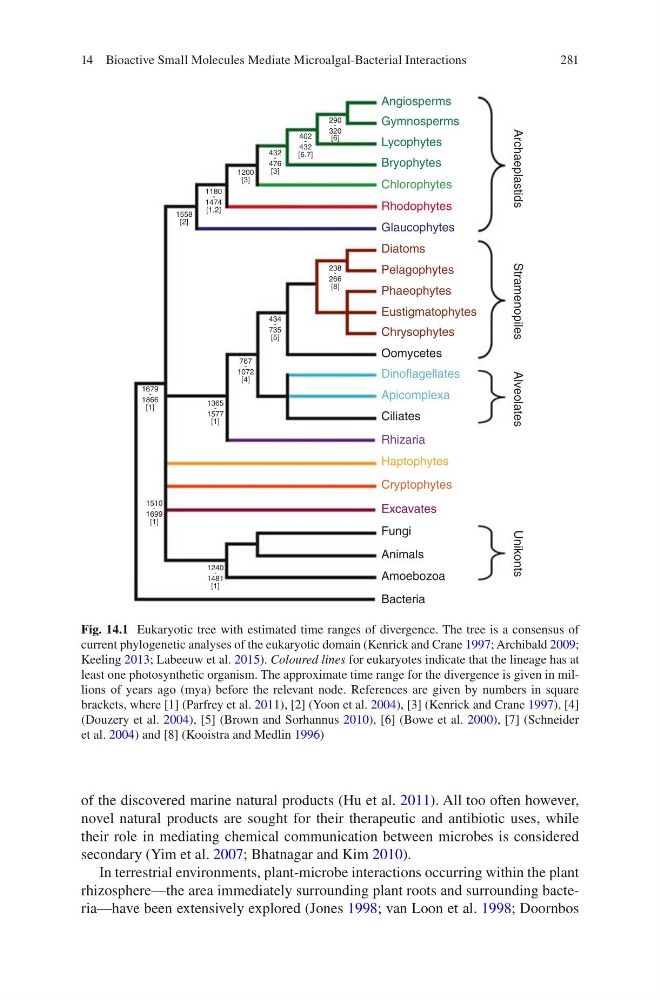
Fig. 14.1 Eukaryotic tree with estimated time ranges of divergence. The tree is a consensus of
current phylogenetic analyses of the eukaryotic domain (Kenrick and Crane 1997; Archibald 2009;
Keeling 2013; Labeeuw et al. 2015). Coloured lines for eukaryotes indicate that the lineage has at
least one photosynthetic organism. The approximate time range for the divergence is given in millions of years ago (mya) before the relevant node. References are given by numbers in square
brackets, where [1] (Parfrey et al. 2011), [2] (Yoon et al. 2004), [3] (Kenrick and Crane 1997), [4]
(Douzery et al. 2004), [5] (Brown and Sorhannus 2010), [6] (Bowe et al. 2000), [7] (Schneider
et al. 2004) and [8] (Kooistra and Medlin 1996)
14 Bioactive Small Molecules Mediate Microalgal-Bacterial Interactions
of the discovered marine natural products (Hu et al. 2011). All too often however,
novel natural products are sought for their therapeutic and antibiotic uses, while
their role in mediating chemical communication between microbes is considered
secondary (Yim et al. 2007; Bhatnagar and Kim 2010).
In terrestrial environments, plant-microbe interactions occurring within the plant
rhizosphere—the area immediately surrounding plant roots and surrounding bacteria—have been extensively explored (Jones 1998; van Loon et al. 1998; Doornbos
Angiosperms
Gymnosperms
Lycophytes
Bryophytes
Chlorophytes
Rhodophytes
Glaucophytes
Diatoms
Pelagophytes
Phaeophytes
Eustigmatophytes
Chrysophytes
Oomycetes
290
320
[6]
-
402
432
[6.7]
-
432
476
[3]
-
1180
1474
[1.2]
-
434
735
[5]
-
1679
1866
[1]
-
1510
1699
[1]
-
1240
1481
[1]
-
238
266
[8]
-
767
1072
[4]
-
1365
1577
[1]
-
1558
[2]
1200
[3]
Stramenopiles
Archaeplastids
Alveolates
Unikonts
Ciliates
Fungi
Animals
Amoebozoa
Bacteria
Rhizaria
Haptophytes
Cryptophytes
Excavates
Dinoflagellates
Apicomplexa
Fig. 14.1 Eukaryotic tree with estimated time ranges of divergence. The tree is a consensus of
current phylogenetic analyses of the eukaryotic domain (Kenrick and Crane 1997; Archibald 2009;
Keeling 2013; Labeeuw et al. 2015). Coloured lines for eukaryotes indicate that the lineage has at
least one photosynthetic organism. The approximate time range for the divergence is given in millions of years ago (mya) before the relevant node. References are given by numbers in square
brackets, where [1] (Parfrey et al. 2011), [2] (Yoon et al. 2004), [3] (Kenrick and Crane 1997), [4]
(Douzery et al. 2004), [5] (Brown and Sorhannus 2010), [6] (Bowe et al. 2000), [7] (Schneider
et al. 2004) and [8] (Kooistra and Medlin 1996)
14 Bioactive Small Molecules Mediate Microalgal-Bacterial Interactions