

181
In addition to the local processes described above, human activity is altering
fundamental biogeochemical processes through the combustion of fossil fuels
that increase the concentrations of CO 2 and other greenhouse gases in the atmosphere. Increasing temperature will have direct effects on seagrass respiration and
photosynthesis that determine metabolic carbon balance (Evans et al. 1986;
Zimmerman et al. 1989), and climate warming is already having an impact on
seagrass survival (Short and Neckles 1999; Moore and Jarvis 2008; Moore et al.
2012). However, as described above, increasing availability of CO 2 derived from
anthropogenic fossil fuel combustion may stimulate seagrass photosynthesis sufficiently to compensate for at least some of the temperature increase (Palacios and
Zimmerman 2007; Jiang et al. 2010; Campbell and Fourqurean 2013; Zimmerman
et al. 2017).
The impacts of a warmer climate on seagrass systems will depend on thermal
tolerance and temperature optima for photosynthesis, respiration, and growth of
individual species. A warmer climate is likely to accelerate microbial activity that
controls important processes including the redox state of the sedimentary pore
water, blue carbon storage, sulfide production, and carbonate dissolution.
Nutrients Nutrients
Suspended
Particles
Sucrose
Sucr
O2
Leaf
Biomass
Root &
Rhizome
Biomass
LHC
Rbc
Chloroplast
Nucleus
PS STRESS
FLOWER
SucTr
TP
Mito
Resp
CO2
ROS Redox ET
HXK
Inv
Sus
Inv Sus
STRESS SucTr
Nuc
HXK
Mito
Resp
Redox
Redox
Shoot
O2
Symbiotic
Clams
DOC, POC
Blue
Carbon
SO4 -2
HCO3 -
Alkalinity
CO2
Light
CaCO3
CO2
FeS &
Fe2S
Alkalinity
Fe
Sediment
Microbes
H2S
HCO3 -
Light
Small
Grazers
Small
Predators
Temp
Epiphytes
Large
Predators
Nutrients
CO 2
Fossil
Carbon
Nutrients
Human
Culture
Phyto
plankton
Suspended
Particles
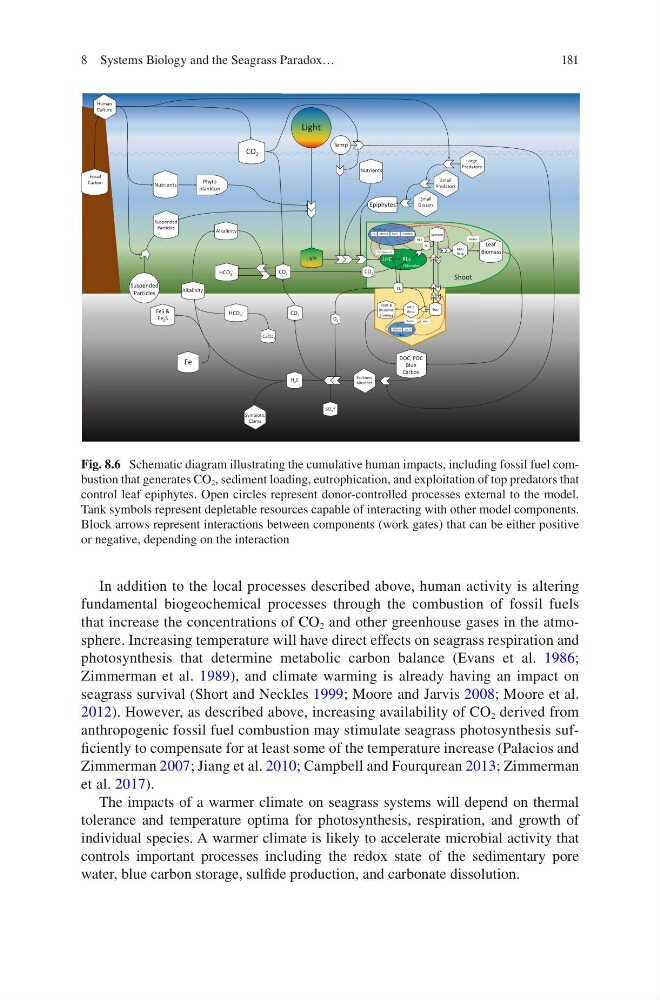
Fig. 8.6 Schematic diagram illustrating the cumulative human impacts, including fossil fuel combustion that generates CO 2 , sediment loading, eutrophication, and exploitation of top predators that
control leaf epiphytes. Open circles represent donor-controlled processes external to the model.
Tank symbols represent depletable resources capable of interacting with other model components.
Block arrows represent interactions between components (work gates) that can be either positive
or negative, depending on the interaction
8 Systems Biology and the Seagrass Paradox…
In addition to the local processes described above, human activity is altering
fundamental biogeochemical processes through the combustion of fossil fuels
that increase the concentrations of CO 2 and other greenhouse gases in the atmosphere. Increasing temperature will have direct effects on seagrass respiration and
photosynthesis that determine metabolic carbon balance (Evans et al. 1986;
Zimmerman et al. 1989), and climate warming is already having an impact on
seagrass survival (Short and Neckles 1999; Moore and Jarvis 2008; Moore et al.
2012). However, as described above, increasing availability of CO 2 derived from
anthropogenic fossil fuel combustion may stimulate seagrass photosynthesis sufficiently to compensate for at least some of the temperature increase (Palacios and
Zimmerman 2007; Jiang et al. 2010; Campbell and Fourqurean 2013; Zimmerman
et al. 2017).
The impacts of a warmer climate on seagrass systems will depend on thermal
tolerance and temperature optima for photosynthesis, respiration, and growth of
individual species. A warmer climate is likely to accelerate microbial activity that
controls important processes including the redox state of the sedimentary pore
water, blue carbon storage, sulfide production, and carbonate dissolution.
Nutrients Nutrients
Suspended
Particles
Sucrose
Sucr
O2
Leaf
Biomass
Root &
Rhizome
Biomass
LHC
Rbc
Chloroplast
Nucleus
PS STRESS
FLOWER
SucTr
TP
Mito
Resp
CO2
ROS Redox ET
HXK
Inv
Sus
Inv Sus
STRESS SucTr
Nuc
HXK
Mito
Resp
Redox
Redox
Shoot
O2
Symbiotic
Clams
DOC, POC
Blue
Carbon
SO4 -2
HCO3 -
Alkalinity
CO2
Light
CaCO3
CO2
FeS &
Fe2S
Alkalinity
Fe
Sediment
Microbes
H2S
HCO3 -
Light
Small
Grazers
Small
Predators
Temp
Epiphytes
Large
Predators
Nutrients
CO 2
Fossil
Carbon
Nutrients
Human
Culture
Phyto
plankton
Suspended
Particles
Fig. 8.6 Schematic diagram illustrating the cumulative human impacts, including fossil fuel combustion that generates CO 2 , sediment loading, eutrophication, and exploitation of top predators that
control leaf epiphytes. Open circles represent donor-controlled processes external to the model.
Tank symbols represent depletable resources capable of interacting with other model components.
Block arrows represent interactions between components (work gates) that can be either positive
or negative, depending on the interaction
8 Systems Biology and the Seagrass Paradox…