

176
Although the GrassLight model is capable of predicting population-level responses
to thermal stress and potential impacts of elevated CO 2 on whole-plant energy balance
and depth distribution in the coming century using static physiological properties
(Zimmerman et al. 2015), it does not presently allow for genetically controlled acclimation responses that introduce temporal variations into these properties. Flux balance analysis offers a potential mathematical approach for bridging this “top-down”
vs. “bottom-up” contrast by constraining the flow of metabolites through metabolic
networks defined by genomic analyses (Orth et al. 2010). The networks, constrained
by steady-state flux stoichiometry between subcellular compartments, can be driven
by ecological conditions (e.g., temperature, light, CO 2 , and external nutrient availability) to predict non-steady-state rates of growth and chemical composition resulting
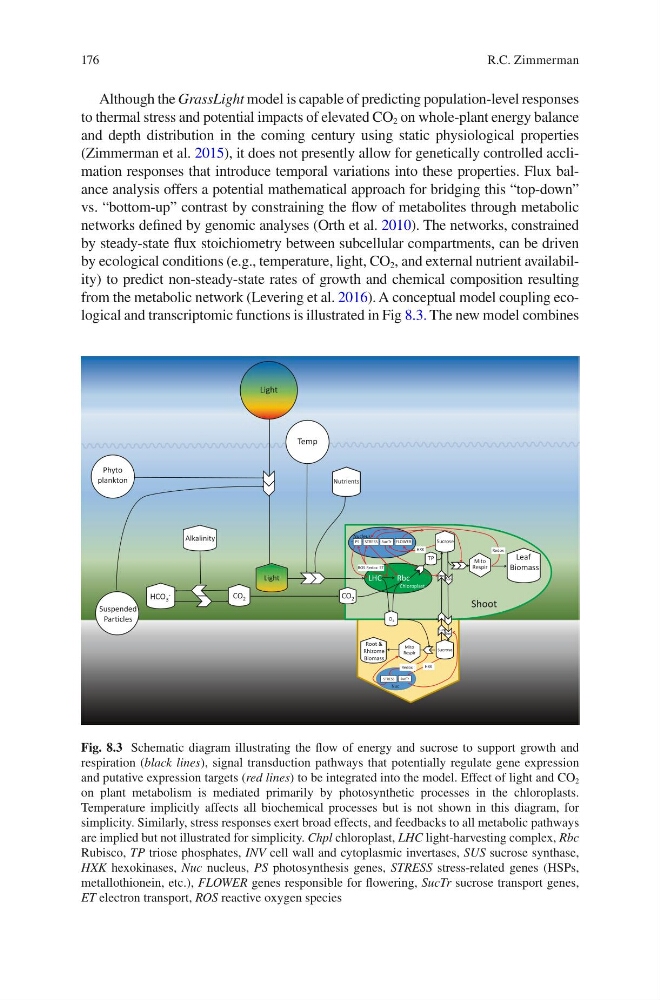
from the metabolic network (Levering et al. 2016). A conceptual model coupling ecological and transcriptomic functions is illustrated in Fig 8.3. The new model combines
Sucrose
Sucrose
O2
Leaf
Biomass
Root &
Rhizome
Biomass
Nutrients
Alkalinity
HCO 3
-
CO 2
LHC
Rbc
Chloroplast
Nucleus
PS STRESS
FLOWER
SucTr
TP
Mito
Respir
CO 2
ROS Redox ET
HXK
Inv
Sus
Inv Sus
STRESS
SucTr
Nuc
HXK
Mito
Respir
Redox
Redox
Shoot
Light
Suspended
ParƟcles
Phyto
plankton
Temp
Light
Fig. 8.3 Schematic diagram illustrating the flow of energy and sucrose to support growth and
respiration (black lines), signal transduction pathways that potentially regulate gene expression
and putative expression targets (red lines) to be integrated into the model. Effect of light and CO 2
on plant metabolism is mediated primarily by photosynthetic processes in the chloroplasts.
Temperature implicitly affects all biochemical processes but is not shown in this diagram, for
simplicity. Similarly, stress responses exert broad effects, and feedbacks to all metabolic pathways
are implied but not illustrated for simplicity. Chpl chloroplast, LHC light-harvesting complex, Rbc
Rubisco, TP triose phosphates, INV cell wall and cytoplasmic invertases, SUS sucrose synthase,
HXK hexokinases, Nuc nucleus, PS photosynthesis genes, STRESS stress-related genes (HSPs,
metallothionein, etc.), FLOWER genes responsible for flowering, SucTr sucrose transport genes,
ET electron transport, ROS reactive oxygen species
R.C. Zimmerman
Although the GrassLight model is capable of predicting population-level responses
to thermal stress and potential impacts of elevated CO 2 on whole-plant energy balance
and depth distribution in the coming century using static physiological properties
(Zimmerman et al. 2015), it does not presently allow for genetically controlled acclimation responses that introduce temporal variations into these properties. Flux balance analysis offers a potential mathematical approach for bridging this “top-down”
vs. “bottom-up” contrast by constraining the flow of metabolites through metabolic
networks defined by genomic analyses (Orth et al. 2010). The networks, constrained
by steady-state flux stoichiometry between subcellular compartments, can be driven
by ecological conditions (e.g., temperature, light, CO 2 , and external nutrient availability) to predict non-steady-state rates of growth and chemical composition resulting
from the metabolic network (Levering et al. 2016). A conceptual model coupling ecological and transcriptomic functions is illustrated in Fig 8.3. The new model combines
Sucrose
Sucrose
O2
Leaf
Biomass
Root &
Rhizome
Biomass
Nutrients
Alkalinity
HCO 3
-
CO 2
LHC
Rbc
Chloroplast
Nucleus
PS STRESS
FLOWER
SucTr
TP
Mito
Respir
CO 2
ROS Redox ET
HXK
Inv
Sus
Inv Sus
STRESS
SucTr
Nuc
HXK
Mito
Respir
Redox
Redox
Shoot
Light
Suspended
ParƟcles
Phyto
plankton
Temp
Light
Fig. 8.3 Schematic diagram illustrating the flow of energy and sucrose to support growth and
respiration (black lines), signal transduction pathways that potentially regulate gene expression
and putative expression targets (red lines) to be integrated into the model. Effect of light and CO 2
on plant metabolism is mediated primarily by photosynthetic processes in the chloroplasts.
Temperature implicitly affects all biochemical processes but is not shown in this diagram, for
simplicity. Similarly, stress responses exert broad effects, and feedbacks to all metabolic pathways
are implied but not illustrated for simplicity. Chpl chloroplast, LHC light-harvesting complex, Rbc
Rubisco, TP triose phosphates, INV cell wall and cytoplasmic invertases, SUS sucrose synthase,
HXK hexokinases, Nuc nucleus, PS photosynthesis genes, STRESS stress-related genes (HSPs,
metallothionein, etc.), FLOWER genes responsible for flowering, SucTr sucrose transport genes,
ET electron transport, ROS reactive oxygen species
R.C. Zimmerman