

170
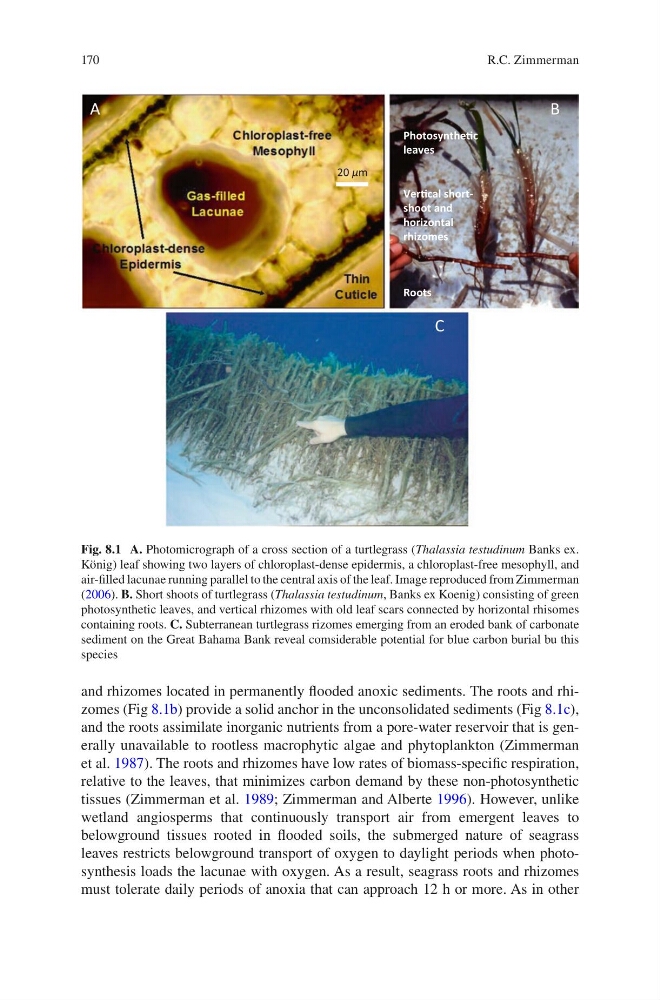
and rhizomes located in permanently flooded anoxic sediments. The roots and rhizomes (Fig 8.1b) provide a solid anchor in the unconsolidated sediments (Fig 8.1c),
and the roots assimilate inorganic nutrients from a pore-water reservoir that is generally unavailable to rootless macrophytic algae and phytoplankton (Zimmerman
et al. 1987). The roots and rhizomes have low rates of biomass-specific respiration,
relative to the leaves, that minimizes carbon demand by these non-photosynthetic
tissues (Zimmerman et al. 1989; Zimmerman and Alberte 1996). However, unlike
wetland angiosperms that continuously transport air from emergent leaves to
belowground tissues rooted in flooded soils, the submerged nature of seagrass
leaves restricts belowground transport of oxygen to daylight periods when photosynthesis loads the lacunae with oxygen. As a result, seagrass roots and rhizomes
must tolerate daily periods of anoxia that can approach 12 h or more. As in other
20 µm
A
PhotosyntheƟc
leaves
VerƟcal shortshoot and
horizontal
rhizomes
Roots
B
C
Fig. 8.1 A. Photomicrograph of a cross section of a turtlegrass (Thalassia testudinum Banks ex.
König) leaf showing two layers of chloroplast-dense epidermis, a chloroplast-free mesophyll, and
air-filled lacunae running parallel to the central axis of the leaf. Image reproduced from Zimmerman
(2006). B. Short shoots of turtlegrass (Thalassia testudinum, Banks ex Koenig) consisting of green
photosynthetic leaves, and vertical rhizomes with old leaf scars connected by horizontal rhisomes
containing roots. C. Subterranean turtlegrass rizomes emerging from an eroded bank of carbonate
sediment on the Great Bahama Bank reveal comsiderable potential for blue carbon burial bu this
species
R.C. Zimmerman
and rhizomes located in permanently flooded anoxic sediments. The roots and rhizomes (Fig 8.1b) provide a solid anchor in the unconsolidated sediments (Fig 8.1c),
and the roots assimilate inorganic nutrients from a pore-water reservoir that is generally unavailable to rootless macrophytic algae and phytoplankton (Zimmerman
et al. 1987). The roots and rhizomes have low rates of biomass-specific respiration,
relative to the leaves, that minimizes carbon demand by these non-photosynthetic
tissues (Zimmerman et al. 1989; Zimmerman and Alberte 1996). However, unlike
wetland angiosperms that continuously transport air from emergent leaves to
belowground tissues rooted in flooded soils, the submerged nature of seagrass
leaves restricts belowground transport of oxygen to daylight periods when photosynthesis loads the lacunae with oxygen. As a result, seagrass roots and rhizomes
must tolerate daily periods of anoxia that can approach 12 h or more. As in other
20 µm
A
PhotosyntheƟc
leaves
VerƟcal shortshoot and
horizontal
rhizomes
Roots
B
C
Fig. 8.1 A. Photomicrograph of a cross section of a turtlegrass (Thalassia testudinum Banks ex.
König) leaf showing two layers of chloroplast-dense epidermis, a chloroplast-free mesophyll, and
air-filled lacunae running parallel to the central axis of the leaf. Image reproduced from Zimmerman
(2006). B. Short shoots of turtlegrass (Thalassia testudinum, Banks ex Koenig) consisting of green
photosynthetic leaves, and vertical rhizomes with old leaf scars connected by horizontal rhisomes
containing roots. C. Subterranean turtlegrass rizomes emerging from an eroded bank of carbonate
sediment on the Great Bahama Bank reveal comsiderable potential for blue carbon burial bu this
species
R.C. Zimmerman