

144
However, such response was observed only at saturating CO 2 concentration
(274 μM) which is much higher than the predicted level in 2100 (~24 μM). It is also
possible that in high CO 2 condition, the costly HCO 3
− utilization systems will be
downregulated; thus the energy demand for carbon acquisition will be reduced
(Burnell et al. 2014). Although a positive growth response was observed in CO 2 -
enriched A. antarctica, there was no clear indication of a downregulation in HCO 3
−
utilization system (Burnell et al. 2014). On the contrary, a number of studies found
no significant or limited effect of increased CO 2 on seagrass photosynthesis and
primary production (Campbell and Fourqurean 2013a; Martínez-Crego et al. 2014;
Cox et al. 2016; Borum et al. 2016).
7.2.5 Phytotoxins
Due to its proximity to shores, seagrass meadows are highly exposed to contamination via industrial runoff, waste discharges, and leachates (Lin et al. 2016a). Previous
studies have shown that exposure to heavy metals (copper, cadmium, lead, and
zinc), herbicides, and petrochemical causes a decrease in photosynthetic activity
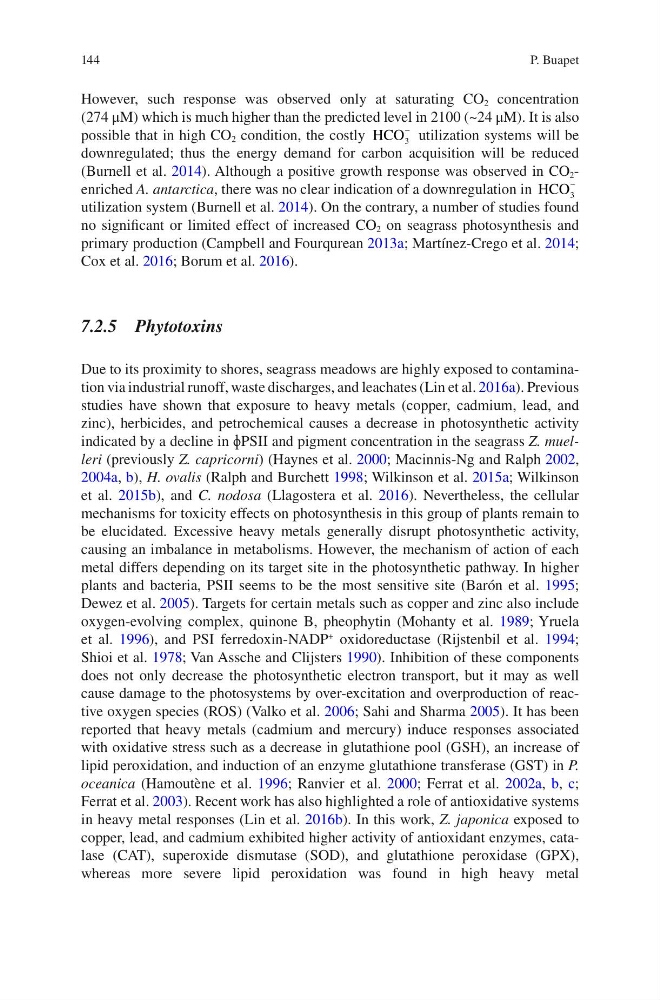
indicated by a decline in ɸPSII and pigment concentration in the seagrass Z. muelleri (previously Z. capricorni) (Haynes et al. 2000; Macinnis-Ng and Ralph 2002,
2004a, b), H. ovalis (Ralph and Burchett 1998; Wilkinson et al. 2015a; Wilkinson
et al. 2015b), and C. nodosa (Llagostera et al. 2016). Nevertheless, the cellular
mechanisms for toxicity effects on photosynthesis in this group of plants remain to
be elucidated. Excessive heavy metals generally disrupt photosynthetic activity,
causing an imbalance in metabolisms. However, the mechanism of action of each
metal differs depending on its target site in the photosynthetic pathway. In higher
plants and bacteria, PSII seems to be the most sensitive site (Barón et al. 1995;
Dewez et al. 2005). Targets for certain metals such as copper and zinc also include
oxygen-evolving complex, quinone B, pheophytin (Mohanty et al. 1989; Yruela
et al. 1996), and PSI ferredoxin-NADP
+
oxidoreductase (Rijstenbil et al. 1994;
Shioi et al. 1978; Van Assche and Clijsters 1990). Inhibition of these components
does not only decrease the photosynthetic electron transport, but it may as well
cause damage to the photosystems by over-excitation and overproduction of reactive oxygen species (ROS) (Valko et al. 2006; Sahi and Sharma 2005). It has been
reported that heavy metals (cadmium and mercury) induce responses associated
with oxidative stress such as a decrease in glutathione pool (GSH), an increase of
lipid peroxidation, and induction of an enzyme glutathione transferase (GST) in P.
oceanica (Hamoutène et al. 1996; Ranvier et al. 2000; Ferrat et al. 2002a, b, c;
Ferrat et al. 2003). Recent work has also highlighted a role of antioxidative systems
in heavy metal responses (Lin et al. 2016b). In this work, Z. japonica exposed to
copper, lead, and cadmium exhibited higher activity of antioxidant enzymes, catalase (CAT), superoxide dismutase (SOD), and glutathione peroxidase (GPX),
whereas more severe lipid peroxidation was found in high heavy metal
P. Buapet
However, such response was observed only at saturating CO 2 concentration
(274 μM) which is much higher than the predicted level in 2100 (~24 μM). It is also
possible that in high CO 2 condition, the costly HCO 3
− utilization systems will be
downregulated; thus the energy demand for carbon acquisition will be reduced
(Burnell et al. 2014). Although a positive growth response was observed in CO 2 -
enriched A. antarctica, there was no clear indication of a downregulation in HCO 3
−
utilization system (Burnell et al. 2014). On the contrary, a number of studies found
no significant or limited effect of increased CO 2 on seagrass photosynthesis and
primary production (Campbell and Fourqurean 2013a; Martínez-Crego et al. 2014;
Cox et al. 2016; Borum et al. 2016).
7.2.5 Phytotoxins
Due to its proximity to shores, seagrass meadows are highly exposed to contamination via industrial runoff, waste discharges, and leachates (Lin et al. 2016a). Previous
studies have shown that exposure to heavy metals (copper, cadmium, lead, and
zinc), herbicides, and petrochemical causes a decrease in photosynthetic activity
indicated by a decline in ɸPSII and pigment concentration in the seagrass Z. muelleri (previously Z. capricorni) (Haynes et al. 2000; Macinnis-Ng and Ralph 2002,
2004a, b), H. ovalis (Ralph and Burchett 1998; Wilkinson et al. 2015a; Wilkinson
et al. 2015b), and C. nodosa (Llagostera et al. 2016). Nevertheless, the cellular
mechanisms for toxicity effects on photosynthesis in this group of plants remain to
be elucidated. Excessive heavy metals generally disrupt photosynthetic activity,
causing an imbalance in metabolisms. However, the mechanism of action of each
metal differs depending on its target site in the photosynthetic pathway. In higher
plants and bacteria, PSII seems to be the most sensitive site (Barón et al. 1995;
Dewez et al. 2005). Targets for certain metals such as copper and zinc also include
oxygen-evolving complex, quinone B, pheophytin (Mohanty et al. 1989; Yruela
et al. 1996), and PSI ferredoxin-NADP
+
oxidoreductase (Rijstenbil et al. 1994;
Shioi et al. 1978; Van Assche and Clijsters 1990). Inhibition of these components
does not only decrease the photosynthetic electron transport, but it may as well
cause damage to the photosystems by over-excitation and overproduction of reactive oxygen species (ROS) (Valko et al. 2006; Sahi and Sharma 2005). It has been
reported that heavy metals (cadmium and mercury) induce responses associated
with oxidative stress such as a decrease in glutathione pool (GSH), an increase of
lipid peroxidation, and induction of an enzyme glutathione transferase (GST) in P.
oceanica (Hamoutène et al. 1996; Ranvier et al. 2000; Ferrat et al. 2002a, b, c;
Ferrat et al. 2003). Recent work has also highlighted a role of antioxidative systems
in heavy metal responses (Lin et al. 2016b). In this work, Z. japonica exposed to
copper, lead, and cadmium exhibited higher activity of antioxidant enzymes, catalase (CAT), superoxide dismutase (SOD), and glutathione peroxidase (GPX),
whereas more severe lipid peroxidation was found in high heavy metal
P. Buapet