

104
5.4 Profiling the Physiological Responses of Algae
to Volatiles
It seems surprising that in spite of the massive production of volatiles released by
algae, this has not been clearly related to any physiological events. In general terms,
the constitutive emissions of volatiles, as opposed to those induced as responses to
external attacks, could be due to specific changes during developmental stages,
although the origin of volatiles remains to be properly discerned. Marine brown
algae produce several C 11 hydrocarbons, some of which are recognised as sexual
pheromones that attract gametes (Müller 1989). Moreover, the emission of volatiles
has been involved in algal successions and in blooms of microalgae (Takamo et al.
2003). The question of whether the emissions lead to an adaptive advantage or, on
the contrary, it is merely to avoid toxic metabolites remains ambiguous. Hence, the
understanding of the synthesis routes of the volatile compounds and how far physiological factors influence volatile production are issues that must be resolved in
order to characterise algal response.
Most of the biosynthetic pathways for the production of the volatile compounds
rely on S-adenosylmethionine (SAM), either as a substrate for key enzyme reactions (as in the synthesis of ethylene and polyamines) or as a source of a methyl
group (as in the synthesis of jasmonates, salicylates or brassinosteroids) (Roje 2006;
Yang and Hoffmann 1984). The presence of transferase enzyme activity and the
production of halide forms would reflect its metabolic involvement as a means of
eliminating halogenated metabolites.
Apart from transferases, other strategies to trap halogens in organic molecules
have been reported through SAM-dependent enzymes and halogenation enzymes
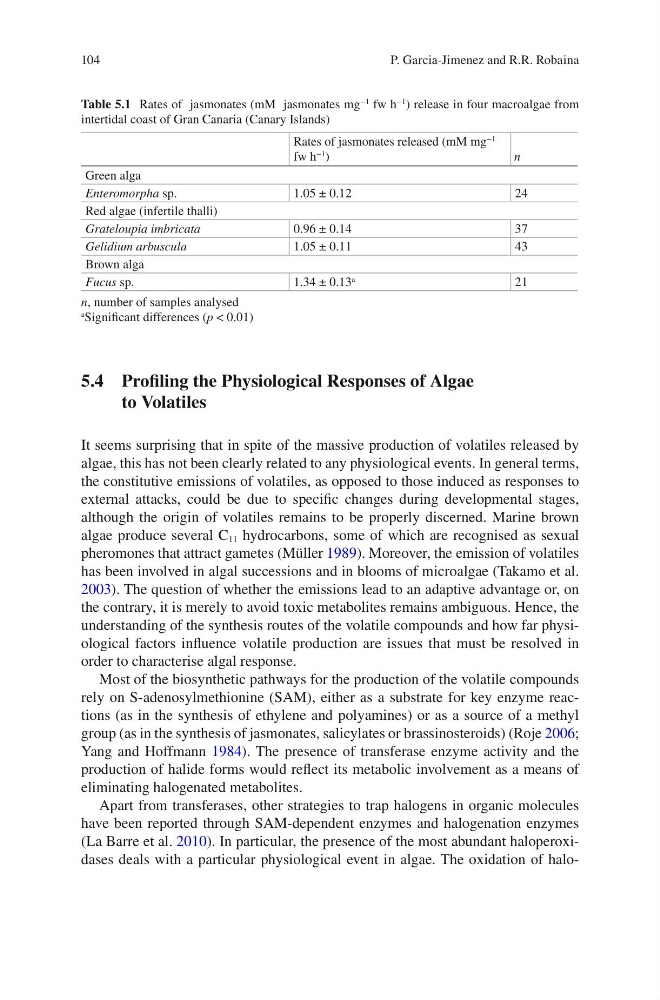
(La Barre et al. 2010). In particular, the presence of the most abundant haloperoxidases deals with a particular physiological event in algae. The oxidation of haloTable 5.1 Rates of jasmonates (mM jasmonates mg
−1 fw h
−1
) release in four macroalgae from
intertidal coast of Gran Canaria (Canary Islands)
Rates of jasmonates released (mM mg
−1
fw h
−1
)
n
Green alga
Enteromorpha sp.
1.05 ± 0.12
24
Red algae (infertile thalli)
Grateloupia imbricata
0.96 ± 0.14
37
Gelidium arbuscula
1.05 ± 0.11
43
Brown alga
Fucus sp.
1.34 ± 0.13
a
21
n, number of samples analysed
a
Significant differences (p < 0.01)
P. Garcia-Jimenez and R.R. Robaina
5.4 Profiling the Physiological Responses of Algae
to Volatiles
It seems surprising that in spite of the massive production of volatiles released by
algae, this has not been clearly related to any physiological events. In general terms,
the constitutive emissions of volatiles, as opposed to those induced as responses to
external attacks, could be due to specific changes during developmental stages,
although the origin of volatiles remains to be properly discerned. Marine brown
algae produce several C 11 hydrocarbons, some of which are recognised as sexual
pheromones that attract gametes (Müller 1989). Moreover, the emission of volatiles
has been involved in algal successions and in blooms of microalgae (Takamo et al.
2003). The question of whether the emissions lead to an adaptive advantage or, on
the contrary, it is merely to avoid toxic metabolites remains ambiguous. Hence, the
understanding of the synthesis routes of the volatile compounds and how far physiological factors influence volatile production are issues that must be resolved in
order to characterise algal response.
Most of the biosynthetic pathways for the production of the volatile compounds
rely on S-adenosylmethionine (SAM), either as a substrate for key enzyme reactions (as in the synthesis of ethylene and polyamines) or as a source of a methyl
group (as in the synthesis of jasmonates, salicylates or brassinosteroids) (Roje 2006;
Yang and Hoffmann 1984). The presence of transferase enzyme activity and the
production of halide forms would reflect its metabolic involvement as a means of
eliminating halogenated metabolites.
Apart from transferases, other strategies to trap halogens in organic molecules
have been reported through SAM-dependent enzymes and halogenation enzymes
(La Barre et al. 2010). In particular, the presence of the most abundant haloperoxidases deals with a particular physiological event in algae. The oxidation of haloTable 5.1 Rates of jasmonates (mM jasmonates mg
−1 fw h
−1
) release in four macroalgae from
intertidal coast of Gran Canaria (Canary Islands)
Rates of jasmonates released (mM mg
−1
fw h
−1
)
n
Green alga
Enteromorpha sp.
1.05 ± 0.12
24
Red algae (infertile thalli)
Grateloupia imbricata
0.96 ± 0.14
37
Gelidium arbuscula
1.05 ± 0.11
43
Brown alga
Fucus sp.
1.34 ± 0.13
a
21
n, number of samples analysed
a
Significant differences (p < 0.01)
P. Garcia-Jimenez and R.R. Robaina