

86
Selected pathway of interest
Hypothesis driven
Targeted biological scope
Large scale pathway analysis
Data driven
Extensive biological scope
Lipid profile of major lipid classes
Assessment of lipid homeostasis
Lipidomic data enrichment
Clustering of lipid profile
Network analysis
Biological data interpretation
Coordination/integration with available genomics, transcriptomics,
proteomics and metabolomics data
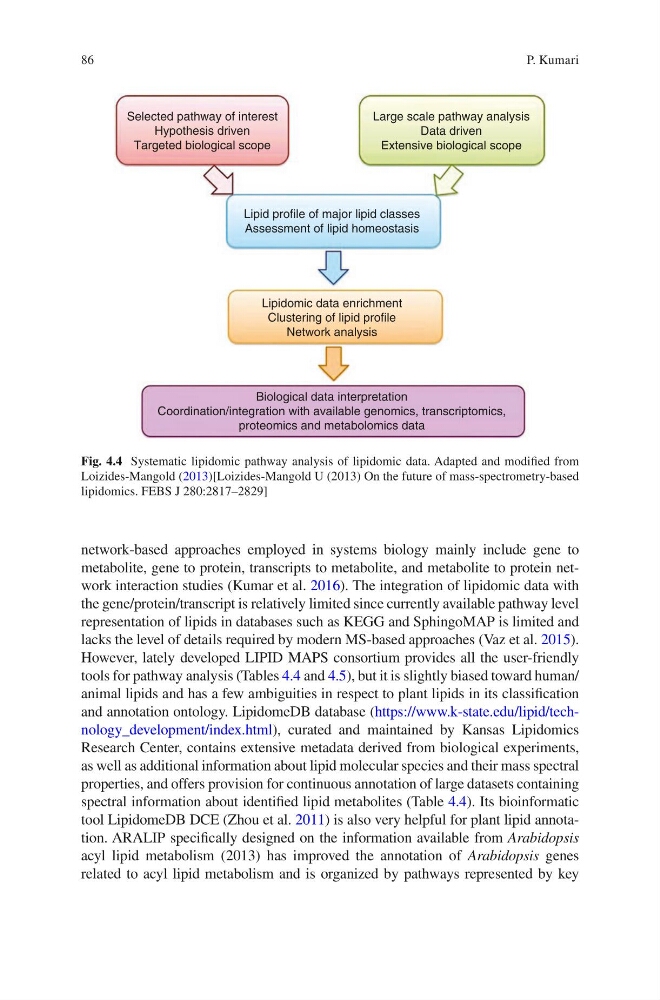
Fig. 4.4 Systematic lipidomic pathway analysis of lipidomic data. Adapted and modified from
Loizides-Mangold (2013)[Loizides-Mangold U (2013) On the future of mass-spectrometry-based
lipidomics. FEBS J 280:2817–2829]
network-based approaches employed in systems biology mainly include gene to
metabolite, gene to protein, transcripts to metabolite, and metabolite to protein network interaction studies (Kumar et al. 2016). The integration of lipidomic data with
the gene/protein/transcript is relatively limited since currently available pathway level
representation of lipids in databases such as KEGG and SphingoMAP is limited and
lacks the level of details required by modern MS-based approaches (Vaz et al. 2015).
However, lately developed LIPID MAPS consortium provides all the user-friendly
tools for pathway analysis (Tables 4.4 and 4.5), but it is slightly biased toward human/
animal lipids and has a few ambiguities in respect to plant lipids in its classification
and annotation ontology. LipidomeDB database (https://www.k-state.edu/lipid/technology_development/index.html), curated and maintained by Kansas Lipidomics
Research Center, contains extensive metadata derived from biological experiments,
as well as additional information about lipid molecular species and their mass spectral
properties, and offers provision for continuous annotation of large datasets containing
spectral information about identified lipid metabolites (Table 4.4). Its bioinformatic
tool LipidomeDB DCE (Zhou et al. 2011) is also very helpful for plant lipid annotation. ARALIP specifically designed on the information available from Arabidopsis
acyl lipid metabolism (2013) has improved the annotation of Arabidopsis genes
related to acyl lipid metabolism and is organized by pathways represented by key
P. Kumari
Selected pathway of interest
Hypothesis driven
Targeted biological scope
Large scale pathway analysis
Data driven
Extensive biological scope
Lipid profile of major lipid classes
Assessment of lipid homeostasis
Lipidomic data enrichment
Clustering of lipid profile
Network analysis
Biological data interpretation
Coordination/integration with available genomics, transcriptomics,
proteomics and metabolomics data
Fig. 4.4 Systematic lipidomic pathway analysis of lipidomic data. Adapted and modified from
Loizides-Mangold (2013)[Loizides-Mangold U (2013) On the future of mass-spectrometry-based
lipidomics. FEBS J 280:2817–2829]
network-based approaches employed in systems biology mainly include gene to
metabolite, gene to protein, transcripts to metabolite, and metabolite to protein network interaction studies (Kumar et al. 2016). The integration of lipidomic data with
the gene/protein/transcript is relatively limited since currently available pathway level
representation of lipids in databases such as KEGG and SphingoMAP is limited and
lacks the level of details required by modern MS-based approaches (Vaz et al. 2015).
However, lately developed LIPID MAPS consortium provides all the user-friendly
tools for pathway analysis (Tables 4.4 and 4.5), but it is slightly biased toward human/
animal lipids and has a few ambiguities in respect to plant lipids in its classification
and annotation ontology. LipidomeDB database (https://www.k-state.edu/lipid/technology_development/index.html), curated and maintained by Kansas Lipidomics
Research Center, contains extensive metadata derived from biological experiments,
as well as additional information about lipid molecular species and their mass spectral
properties, and offers provision for continuous annotation of large datasets containing
spectral information about identified lipid metabolites (Table 4.4). Its bioinformatic
tool LipidomeDB DCE (Zhou et al. 2011) is also very helpful for plant lipid annotation. ARALIP specifically designed on the information available from Arabidopsis
acyl lipid metabolism (2013) has improved the annotation of Arabidopsis genes
related to acyl lipid metabolism and is organized by pathways represented by key
P. Kumari