

Hawaiian lobehads
DNA-sequence phylogeny
86
69·
'0
'" 7
110
I
!Ii
..
100
81
32
5
25
.00
II
23
311
13
61
SO
,S
66
la
10<1
50
18
5. Adaptive Radiation
73
BrighamJa insIgms
Dellssea subcOrriala
Clermot'ltla amorescens
Cyanea conaces
Haws,',
Lobelia gloria-monffs
TremB loiobella maClOSlachys
Lhypo/8UCS
L nlihauenSIS
Sclero/h8C8 jayorum
J Society Islands
L. """'nen ...
J Bonin Islands
L co'umnnris
] Africa
LpeUOlal8
L. nicollanllolia
J Soulll.1n Asia
Jsotoma ulNa/is
J Australia
L. exceJsa
Burmelstef8 gutlerre:nl
] Sou th and
Central America
C.ntropogon crisp/lobs
L cardlnalis
J North Amenca
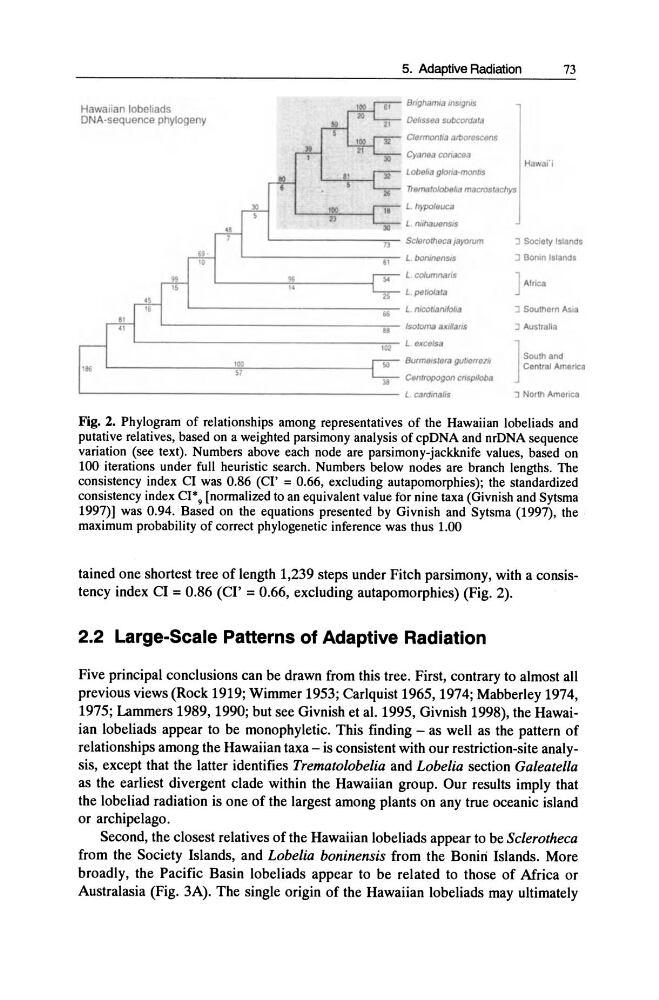
Fig. 2. Phylogram of relationships among representatives of the Hawaiian lobeliads and
putative relatives, based on a weighted parsimony analysis of cpDNA and nrDNA sequence
variation (see text). Numbers above each node are parsimony-jackknife values, based on
100 iterations under full heuristic search. Numbers below nodes are branch lengths. The
consistency index CI was 0.86 (CI' = 0.66, excluding autapomorphies); the standardized
consistency index CI* 9 [normalized to an equivalent value for nine taxa (Givnish and Sytsma
1997)] was 0.94. Based on the equations presented by Givnish and Sytsma (1997), the
maximum probability of correct phylogenetic inference was thus 1.00
tained one shortest tree of length 1,239 steps under Fitch parsimony, with a consistency index CI = 0.86 (CI' = 0.66, excluding autapomorphies) (Fig. 2).
2.2 Large-Scale Patterns of Adaptive Radiation
Five principal conclusions can be drawn from this tree. First, contrary to almost all
previous views (Rock 1919; Wimmer 1953; Carlquist 1965, 1974; Mabberley 1974,
1975; Lammers 1989, 1990; but see Givnish et al. 1995, Givnish 1998), the Hawaiian lobeliads appear to be monophyletic. This finding - as well as the pattern of
relationships among the Hawaiian taxa - is consistent with our restriction-site analysis, except that the latter identifies Trematolobelia and Lobelia section Galeatella
as the earliest divergent clade within the Hawaiian group. Our results imply that
the lobeliad radiation is one of the largest among plants on any true oceanic island
or archipelago.
Second, the closest relatives of the Hawaiian lobeliads appear to be Sclerotheca
from the Society Islands, and Lobelia boninensis from the Bonin Islands. More
broadly, the Pacific Basin lobeliads appear to be related to those of Africa or
Australasia (Fig. 3A). The single origin of the Hawaiian lobeliads may ultimately
DNA-sequence phylogeny
86
69·
'0
'" 7
110
I
!Ii
..
100
81
32
5
25
.00
II
23
311
13
61
SO
,S
66
la
10<1
50
18
5. Adaptive Radiation
73
BrighamJa insIgms
Dellssea subcOrriala
Clermot'ltla amorescens
Cyanea conaces
Haws,',
Lobelia gloria-monffs
TremB loiobella maClOSlachys
Lhypo/8UCS
L nlihauenSIS
Sclero/h8C8 jayorum
J Society Islands
L. """'nen ...
J Bonin Islands
L co'umnnris
] Africa
LpeUOlal8
L. nicollanllolia
J Soulll.1n Asia
Jsotoma ulNa/is
J Australia
L. exceJsa
Burmelstef8 gutlerre:nl
] Sou th and
Central America
C.ntropogon crisp/lobs
L cardlnalis
J North Amenca
Fig. 2. Phylogram of relationships among representatives of the Hawaiian lobeliads and
putative relatives, based on a weighted parsimony analysis of cpDNA and nrDNA sequence
variation (see text). Numbers above each node are parsimony-jackknife values, based on
100 iterations under full heuristic search. Numbers below nodes are branch lengths. The
consistency index CI was 0.86 (CI' = 0.66, excluding autapomorphies); the standardized
consistency index CI* 9 [normalized to an equivalent value for nine taxa (Givnish and Sytsma
1997)] was 0.94. Based on the equations presented by Givnish and Sytsma (1997), the
maximum probability of correct phylogenetic inference was thus 1.00
tained one shortest tree of length 1,239 steps under Fitch parsimony, with a consistency index CI = 0.86 (CI' = 0.66, excluding autapomorphies) (Fig. 2).
2.2 Large-Scale Patterns of Adaptive Radiation
Five principal conclusions can be drawn from this tree. First, contrary to almost all
previous views (Rock 1919; Wimmer 1953; Carlquist 1965, 1974; Mabberley 1974,
1975; Lammers 1989, 1990; but see Givnish et al. 1995, Givnish 1998), the Hawaiian lobeliads appear to be monophyletic. This finding - as well as the pattern of
relationships among the Hawaiian taxa - is consistent with our restriction-site analysis, except that the latter identifies Trematolobelia and Lobelia section Galeatella
as the earliest divergent clade within the Hawaiian group. Our results imply that
the lobeliad radiation is one of the largest among plants on any true oceanic island
or archipelago.
Second, the closest relatives of the Hawaiian lobeliads appear to be Sclerotheca
from the Society Islands, and Lobelia boninensis from the Bonin Islands. More
broadly, the Pacific Basin lobeliads appear to be related to those of Africa or
Australasia (Fig. 3A). The single origin of the Hawaiian lobeliads may ultimately