

60
N. Murakami et al.
54
55
70
80
98
100
97
97
74
A.griffithianum
JP-Amami
VN-Concuong3
VN-Concuong1
HalimunC , Gede
TH-Suthep
JP-Okinawa * 1
JP-Daitoh * 1
8ogor
*2
New Caledonia * 2
.-----JP-yakushima * 3
Gede (2,400 malt.)
VN-Dalat
L-.-----VN-Sapa
(1,400 malt.)
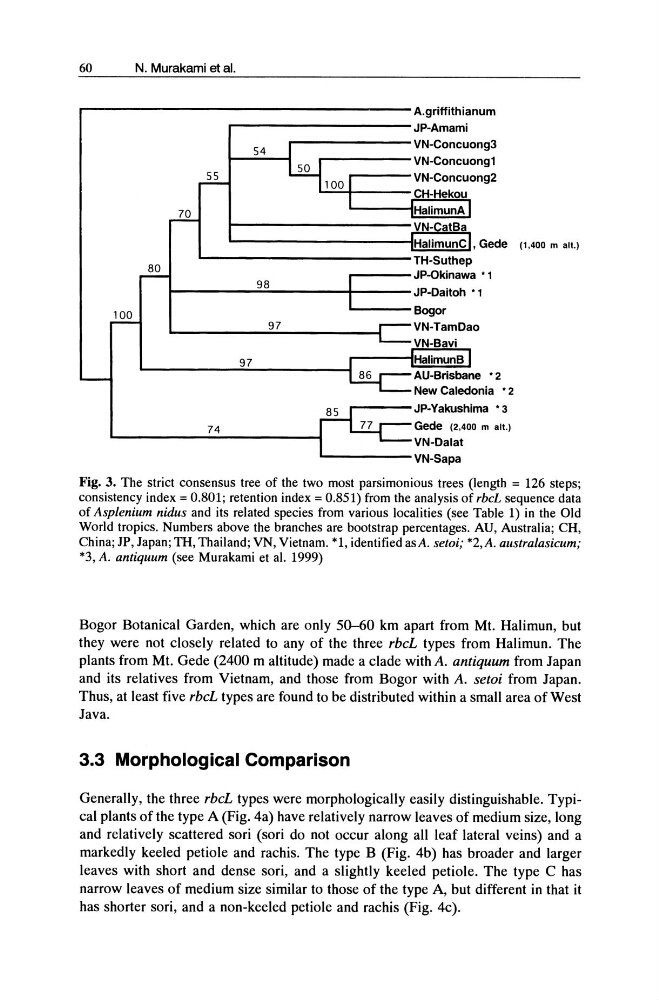
Fig. 3. The strict consensus tree of the two most parsimonious trees (length = 126 steps;
consistency index = 0.801; retention index = 0.851) from the analysis of rbeL sequence data
of Asplenium nidus and its related species from various localities (see Table 1) in the Old
World tropics. Numbers above the branches are bootstrap percentages. AU, Australia; CR,
China; JP, Japan; TH, Thailand; VN, Vietnam. *1, identified asA. setai; *2,A. altstralasieum;
*3, A. antiquum (see Murakami et al. 1999)
Bogor Botanical Garden, which are only 50-60 km apart from Mt. Halimun, but
they were not closely related to any of the three rbcL types from Halimun. The
plants from Mt. Gede (2400 m altitude) made a clade with A. antiquum from Japan
and its relatives from Vietnam, and those from Bogor with A. setoi from Japan.
Thus, at least five rbcL types are found to be distributed within a small area of West
Java.
3.3 Morphological Comparison
Generally, the three rbcL types were morphologically easily distinguishable. Typical plants of the type A (Fig. 4a) have relatively narrow leaves of medium size, long
and relatively scattered sori (sori do not occur along all leaf lateral veins) and a
markedly keeled petiole and rachis. The type B (Fig. 4b) has broader and larger
leaves with short and dense sori, and a slightly keeled petiole. The type C has
narrow leaves of medium size similar to those of the type A, but different in that it
has shorter sori, and a non-keeled petiole and rachis (Fig. 4c).
N. Murakami et al.
54
55
70
80
98
100
97
97
74
A.griffithianum
JP-Amami
VN-Concuong3
VN-Concuong1
HalimunC , Gede
TH-Suthep
JP-Okinawa * 1
JP-Daitoh * 1
8ogor
*2
New Caledonia * 2
.-----JP-yakushima * 3
Gede (2,400 malt.)
VN-Dalat
L-.-----VN-Sapa
(1,400 malt.)
Fig. 3. The strict consensus tree of the two most parsimonious trees (length = 126 steps;
consistency index = 0.801; retention index = 0.851) from the analysis of rbeL sequence data
of Asplenium nidus and its related species from various localities (see Table 1) in the Old
World tropics. Numbers above the branches are bootstrap percentages. AU, Australia; CR,
China; JP, Japan; TH, Thailand; VN, Vietnam. *1, identified asA. setai; *2,A. altstralasieum;
*3, A. antiquum (see Murakami et al. 1999)
Bogor Botanical Garden, which are only 50-60 km apart from Mt. Halimun, but
they were not closely related to any of the three rbcL types from Halimun. The
plants from Mt. Gede (2400 m altitude) made a clade with A. antiquum from Japan
and its relatives from Vietnam, and those from Bogor with A. setoi from Japan.
Thus, at least five rbcL types are found to be distributed within a small area of West
Java.
3.3 Morphological Comparison
Generally, the three rbcL types were morphologically easily distinguishable. Typical plants of the type A (Fig. 4a) have relatively narrow leaves of medium size, long
and relatively scattered sori (sori do not occur along all leaf lateral veins) and a
markedly keeled petiole and rachis. The type B (Fig. 4b) has broader and larger
leaves with short and dense sori, and a slightly keeled petiole. The type C has
narrow leaves of medium size similar to those of the type A, but different in that it
has shorter sori, and a non-keeled petiole and rachis (Fig. 4c).