

4. Molecular a-taxonomy of Asplenium nidus
57
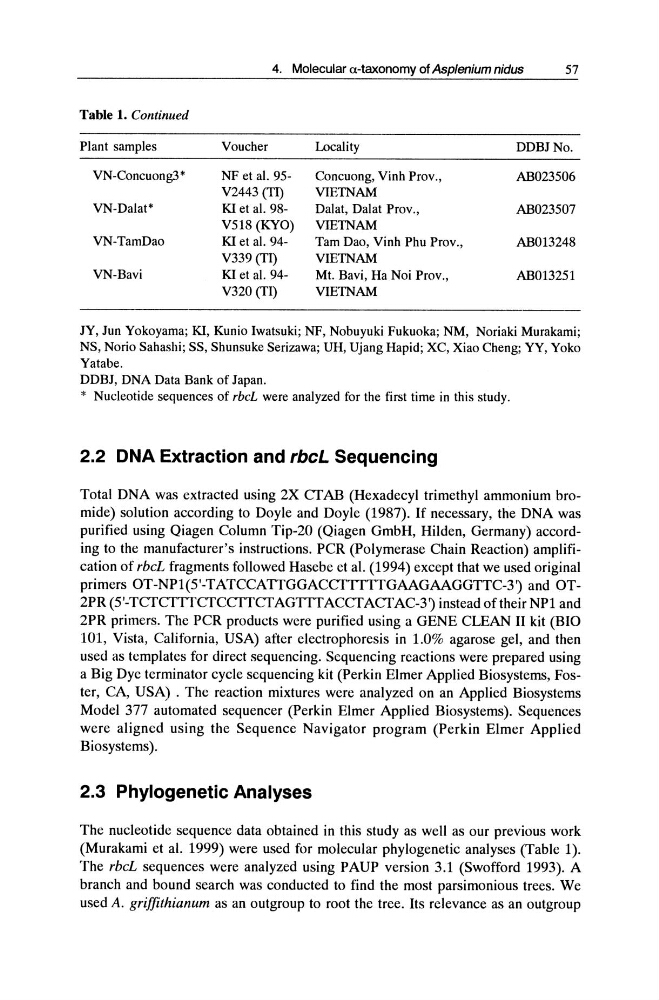
Table 1. Continued
Plant samples
Voucher
Locality
DDBJNo.
VN -Concuong3 *
NF et al. 95Concuong, Vinh Prov.,
AB023506
V2443 (TI)
VIETNAM
VN-Dalat*
KI et al. 98Dalat, Dalat Prov.,
AB023507
V518 (KYO)
VIETNAM
VN-TamDao
KI et al. 94Tam Dao, Vinh Phu Prov.,
AB013248
V339 (TI)
VIETNAM
VN-Bavi
KI et al. 94Mt. Bavi, Ra Noi Prov.,
AB013251
V320 (TI)
VIETNAM
JY, Jun Yokoyama; KI, Kunio Iwatsuki; NF, Nobuyuki Fukuoka; NM, Noriaki Murakami;
NS, Norio Sahashi; SS, Shunsuke Serizawa; UR, Ujang Rapid; XC, Xiao Cheng; YY, Yoko
Yatabe.
DDBJ, DNA Data Bank of Japan.
* Nucleotide sequences of rbeL were analyzed for the first time in this study.
2.2 DNA Extraction and rbeL Sequencing
Total DNA was extracted using 2X CT AB (Hexadecyl trimethyl ammonium bromide) solution according to Doyle and Doyle (1987). If necessary, the DNA was
purified using Qiagen Column Tip-20 (Qiagen GmbH, Hilden, Germany) according to the manufacturer's instructions. PCR (Polymerase Chain Reaction) amplification of rbeL fragments followed Hasebe et al. (1994) except that we used original
primers OT-NP1(5'-TATCCATTGGACCTITITGAAGAAGGTTC-3') and OT2PR (5'-TCTCTTTCTCCTTCT AGTTT ACCT ACT AC-3) instead of their NPl and
2PR primers. The PCR products were purified using a GENE CLEAN II kit (BIO
101, Vista, California, USA) after electrophoresis in 1.0% agarose gel, and then
used as templates for direct sequencing. Sequencing reactions were prepared using
a Big Dye terminator cycle sequencing kit (Perkin Elmer Applied Biosystems, Foster, CA, USA) . The reaction mixtures were analyzed on an Applied Biosystems
Model 377 automated sequencer (Perkin Elmer Applied Biosystems). Sequences
were aligned using the Sequence Navigator program (Perkin Elmer Applied
Biosystems).
2.3 Phylogenetic Analyses
The nucleotide sequence data obtained in this study as well as our previous work
(Murakami et al. 1999) were used for molecular phylogenetic analyses (Table 1).
The rbeL sequences were analyzed using PAUP version 3.1 (Swofford 1993). A
branch and bound search was conducted to find the most parsimonious trees. We
used A. griffithianum as an outgroup to root the tree. Its relevance as an out group
57
Table 1. Continued
Plant samples
Voucher
Locality
DDBJNo.
VN -Concuong3 *
NF et al. 95Concuong, Vinh Prov.,
AB023506
V2443 (TI)
VIETNAM
VN-Dalat*
KI et al. 98Dalat, Dalat Prov.,
AB023507
V518 (KYO)
VIETNAM
VN-TamDao
KI et al. 94Tam Dao, Vinh Phu Prov.,
AB013248
V339 (TI)
VIETNAM
VN-Bavi
KI et al. 94Mt. Bavi, Ra Noi Prov.,
AB013251
V320 (TI)
VIETNAM
JY, Jun Yokoyama; KI, Kunio Iwatsuki; NF, Nobuyuki Fukuoka; NM, Noriaki Murakami;
NS, Norio Sahashi; SS, Shunsuke Serizawa; UR, Ujang Rapid; XC, Xiao Cheng; YY, Yoko
Yatabe.
DDBJ, DNA Data Bank of Japan.
* Nucleotide sequences of rbeL were analyzed for the first time in this study.
2.2 DNA Extraction and rbeL Sequencing
Total DNA was extracted using 2X CT AB (Hexadecyl trimethyl ammonium bromide) solution according to Doyle and Doyle (1987). If necessary, the DNA was
purified using Qiagen Column Tip-20 (Qiagen GmbH, Hilden, Germany) according to the manufacturer's instructions. PCR (Polymerase Chain Reaction) amplification of rbeL fragments followed Hasebe et al. (1994) except that we used original
primers OT-NP1(5'-TATCCATTGGACCTITITGAAGAAGGTTC-3') and OT2PR (5'-TCTCTTTCTCCTTCT AGTTT ACCT ACT AC-3) instead of their NPl and
2PR primers. The PCR products were purified using a GENE CLEAN II kit (BIO
101, Vista, California, USA) after electrophoresis in 1.0% agarose gel, and then
used as templates for direct sequencing. Sequencing reactions were prepared using
a Big Dye terminator cycle sequencing kit (Perkin Elmer Applied Biosystems, Foster, CA, USA) . The reaction mixtures were analyzed on an Applied Biosystems
Model 377 automated sequencer (Perkin Elmer Applied Biosystems). Sequences
were aligned using the Sequence Navigator program (Perkin Elmer Applied
Biosystems).
2.3 Phylogenetic Analyses
The nucleotide sequence data obtained in this study as well as our previous work
(Murakami et al. 1999) were used for molecular phylogenetic analyses (Table 1).
The rbeL sequences were analyzed using PAUP version 3.1 (Swofford 1993). A
branch and bound search was conducted to find the most parsimonious trees. We
used A. griffithianum as an outgroup to root the tree. Its relevance as an out group