

54
N. Murakami et al.
1 Introduction
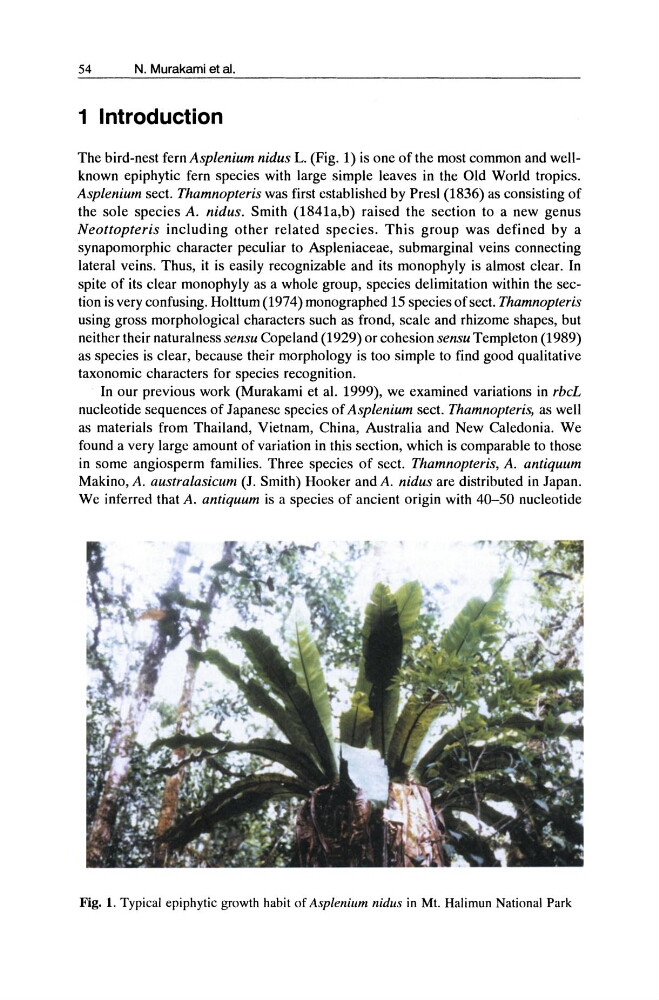
The bird-nest fern Asplenium nidus L. (Fig. 1) is one of the most common and wellknown epiphytic fern species with large simple leaves in the Old World tropics.
Asplenium sect. Thamnopteris was first established by Presl (1836) as consisting of
the sole species A. nidus. Smith (1841a,b) raised the section to a new genus
Neottopteris including other related species. This group was defined by a
synapomorphic character peculiar to A,>pleniaceae, submarginal veins connecting
lateral veins. Thus, it is easily recognizable and its monophyly is almost clear. In
spite of its clear monophyly as a whole group, species delimitation within the section is very confusing. Holttum (1974) monographed 15 species of sect. Thamnopteris
using gross morphological characters such as frond, scale and rhizome shapes, but
neither their naturalness sensu Copeland (1929) or cohesion sensu Templeton (1989)
as species is clear, because their morphology is too simple to find good qualitative
taxonomic characters for species recognition.
In our previous work (Murakami et al. 1999), we examined variations in rbeL
nucleotide sequences of Japanese species of Asplenium sect. Thamnopteris, as well
as materials from Thailand, Vietnam, China, Australia and New Caledonia. We
found a very large amount of variation in this section, which is comparable to those
in some angiosperm families. Three species of sect. Thamnopteris, A. antiquum
Makino, A. australasieum (J. Smith) Hooker and A. nidus are distributed in Japan.
We inferred that A. antiquum is a species of ancient origin with 40--50 nucleotide
Fig. 1. Typical epiphytic growth habit of Asplenium nidus in Mt. Halimun National Park
N. Murakami et al.
1 Introduction
The bird-nest fern Asplenium nidus L. (Fig. 1) is one of the most common and wellknown epiphytic fern species with large simple leaves in the Old World tropics.
Asplenium sect. Thamnopteris was first established by Presl (1836) as consisting of
the sole species A. nidus. Smith (1841a,b) raised the section to a new genus
Neottopteris including other related species. This group was defined by a
synapomorphic character peculiar to A,>pleniaceae, submarginal veins connecting
lateral veins. Thus, it is easily recognizable and its monophyly is almost clear. In
spite of its clear monophyly as a whole group, species delimitation within the section is very confusing. Holttum (1974) monographed 15 species of sect. Thamnopteris
using gross morphological characters such as frond, scale and rhizome shapes, but
neither their naturalness sensu Copeland (1929) or cohesion sensu Templeton (1989)
as species is clear, because their morphology is too simple to find good qualitative
taxonomic characters for species recognition.
In our previous work (Murakami et al. 1999), we examined variations in rbeL
nucleotide sequences of Japanese species of Asplenium sect. Thamnopteris, as well
as materials from Thailand, Vietnam, China, Australia and New Caledonia. We
found a very large amount of variation in this section, which is comparable to those
in some angiosperm families. Three species of sect. Thamnopteris, A. antiquum
Makino, A. australasieum (J. Smith) Hooker and A. nidus are distributed in Japan.
We inferred that A. antiquum is a species of ancient origin with 40--50 nucleotide
Fig. 1. Typical epiphytic growth habit of Asplenium nidus in Mt. Halimun National Park