

44
Y. Kumazawa et al.
causing clear incompatibility with the other calibration points (see the light-shaded
area in Fig. 3C).
The molecular evolutionary rate for bony fishes was thus calibrated using both
internal and external data points. The rate calibrated at 100 MYA (Fig. 3C) is
nearly the same as or only slightly faster than that for sharks (Fig. 3B), which is in
agreement with the results of the two-cluster test mentioned above. It should be
noted that, due to slower rates of molecular evolution in fishes than in mammals
(Thomas and Beckenbach 1989; Martin et al. 1992; Adachi et al. 1993; Cantatore
et al. 1994; Fig. 3 of this study), pairwise distances among bony fishes used in this
study are within a range «0.71) where linearity in calibration was observed for
mammals (Fig. 3A).
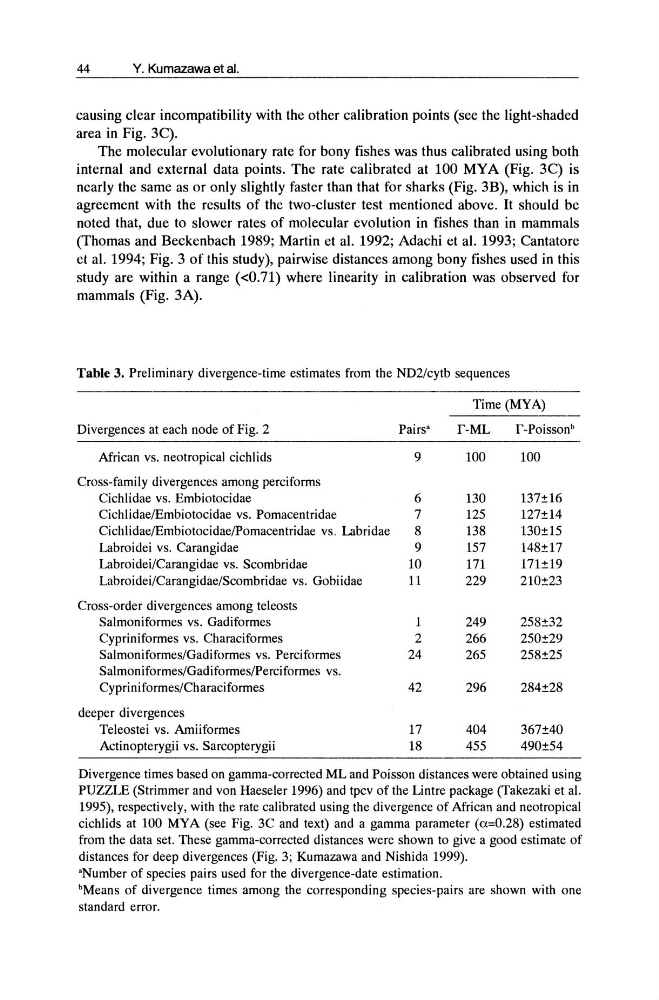
Table 3. Preliminary divergence-time estimates from the ND2/cytb sequences
Time (MYA)
Divergences at each node of Fig. 2
Pairs'
r-ML
r-Poisson b
African vs. neotropical cichlids
9
100
100
Cross-family divergences among perciforms
Cichlidae vs. Embiotocidae
6
130
137±16
Cichlidae/Embiotocidae vs. Pomacentridae
7
125
127±14
CichlidaelEmbiotocidaelPomacentridae vs. Labridae
8
138
130±15
Labroidei vs. Carangidae
9
157
148±17
LabroideilCarangidae vs. Scombridae
10
171
171±19
Labroidei/Carangidae/Scombridae vs. Gobiidae
11
229
21O±23
Cross-order divergences among teleosts
Salmoniformes vs. Gadiformes
1
249
258±32
Cypriniformes vs. Characiformes
2
266
250±29
Salmoniformes/Gadiformes vs. Perciformes
24
265
258±25
Salmoniformes/Gadiformes/Perciformes vs.
Cypriniformes/Characiformes
42
296
284±28
deeper divergences
Teleostei vs. Amiiformes
17
404
367±40
Actinopterygii vs. Sarcopterygii
18
455
490±54
Divergence times based on gamma-corrected ML and Poisson distances were obtained using
PUZZLE (Strimmer and von Haeseler 1996) and tpcv of the Lintre package (Takezaki et al.
1995), respectively, with the rate calibrated using the divergence of African and neotropical
cichlids at 100 MYA (see Fig. 3C and text) and a gamma parameter (a=0.28) estimated
from the data set. These gamma-corrected distances were shown to give a good estimate of
distances for deep divergences (Fig. 3; Kumazawa and Nishida 1999).
'Number of species pairs used for the divergence-date estimation.
bMeans of divergence times among the corresponding species-pairs are shown with one
standard error.
Y. Kumazawa et al.
causing clear incompatibility with the other calibration points (see the light-shaded
area in Fig. 3C).
The molecular evolutionary rate for bony fishes was thus calibrated using both
internal and external data points. The rate calibrated at 100 MYA (Fig. 3C) is
nearly the same as or only slightly faster than that for sharks (Fig. 3B), which is in
agreement with the results of the two-cluster test mentioned above. It should be
noted that, due to slower rates of molecular evolution in fishes than in mammals
(Thomas and Beckenbach 1989; Martin et al. 1992; Adachi et al. 1993; Cantatore
et al. 1994; Fig. 3 of this study), pairwise distances among bony fishes used in this
study are within a range «0.71) where linearity in calibration was observed for
mammals (Fig. 3A).
Table 3. Preliminary divergence-time estimates from the ND2/cytb sequences
Time (MYA)
Divergences at each node of Fig. 2
Pairs'
r-ML
r-Poisson b
African vs. neotropical cichlids
9
100
100
Cross-family divergences among perciforms
Cichlidae vs. Embiotocidae
6
130
137±16
Cichlidae/Embiotocidae vs. Pomacentridae
7
125
127±14
CichlidaelEmbiotocidaelPomacentridae vs. Labridae
8
138
130±15
Labroidei vs. Carangidae
9
157
148±17
LabroideilCarangidae vs. Scombridae
10
171
171±19
Labroidei/Carangidae/Scombridae vs. Gobiidae
11
229
21O±23
Cross-order divergences among teleosts
Salmoniformes vs. Gadiformes
1
249
258±32
Cypriniformes vs. Characiformes
2
266
250±29
Salmoniformes/Gadiformes vs. Perciformes
24
265
258±25
Salmoniformes/Gadiformes/Perciformes vs.
Cypriniformes/Characiformes
42
296
284±28
deeper divergences
Teleostei vs. Amiiformes
17
404
367±40
Actinopterygii vs. Sarcopterygii
18
455
490±54
Divergence times based on gamma-corrected ML and Poisson distances were obtained using
PUZZLE (Strimmer and von Haeseler 1996) and tpcv of the Lintre package (Takezaki et al.
1995), respectively, with the rate calibrated using the divergence of African and neotropical
cichlids at 100 MYA (see Fig. 3C and text) and a gamma parameter (a=0.28) estimated
from the data set. These gamma-corrected distances were shown to give a good estimate of
distances for deep divergences (Fig. 3; Kumazawa and Nishida 1999).
'Number of species pairs used for the divergence-date estimation.
bMeans of divergence times among the corresponding species-pairs are shown with one
standard error.