

30
C. Moritz
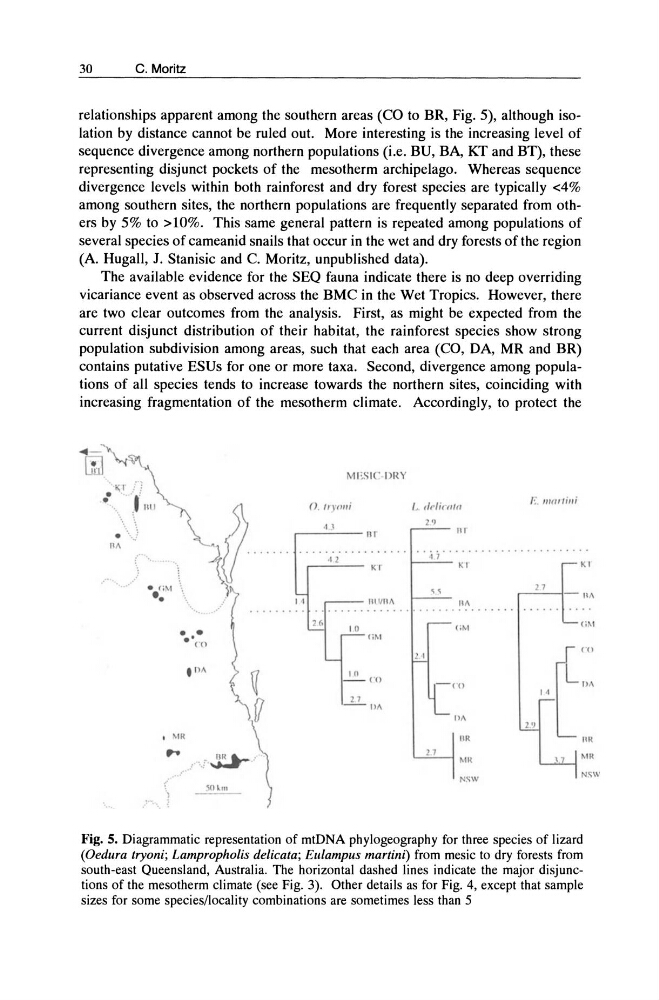
relationships apparent among the southern areas (CO to BR, Fig. 5), although isolation by distance cannot be ruled out. More interesting is the increasing level of
sequence divergence among northern populations (i.e. BU, BA, KT and BT), these
representing disjunct pockets of the mesotherm archipelago. Whereas sequence
divergence levels within both rainforest and dry forest species are typically <4%
among southern sites, the northern populations are frequently separated from others by 5% to >10%. This same general pattern is repeated among populations of
several species of cameanid snails that occur in the wet and dry forests of the region
(A. Hugall, J. Stanisic and C. Moritz, unpublished data).
The available evidence for the SEQ fauna indicate there is no deep overriding
vicariance event as observed across the BMC in the Wet Tropics. However, there
are two clear outcomes from the analysis. First, as might be expected from the
current disjunct distribution of their habitat, the rainforest species show strong
population subdivision among areas, such that each area (CO, DA, MR and BR)
contains putative ESUs for one or more taxa. Second, divergence among populations of all species tends to increase towards the northern sites, coinciding with
increasing fragmentation of the mesotherm climate. Accordingly, to protect the
( ......... .
• (; 1
e.
.,- · ( '()
t " A
I
\tR
~ .. ,.~ . ,
.... .: '.,'
-:'
\
.......... {
MESIC· I)IlY
O. "'Yolli
. - - _' .:.,;U=--_ Il I'
, ~
.--_~",2__ K r
III ''''A
'0 (j ,
_'_ II ('0
27
-''''
.. ~ 7
2. I
2.7
F.. w(lll;lI;
Ill'
- - - - - . . . . . . , . . . . . . . . . . .
K'
"A
"A
IIR
NSW
KI
.--..:. 2,;,, ' -1_ "A
2 'J
(iM
rC::, ~
' 1
IIR
MR
NSW
Fig. 5. Diagrammatic representation of mtDNA phylogeography for three species of lizard
(Oedura tryoni; Lampropholis delicata; Elliamplls martini) from mesic to dry forests from
south-east Queensland, Australia. The horizontal dashed lines indicate the major disjunctions of the mesotherm climate (see Fig. 3). Other details as for Fig. 4, except that sample
sizes for some species/locality combinations are sometimes less than 5
C. Moritz
relationships apparent among the southern areas (CO to BR, Fig. 5), although isolation by distance cannot be ruled out. More interesting is the increasing level of
sequence divergence among northern populations (i.e. BU, BA, KT and BT), these
representing disjunct pockets of the mesotherm archipelago. Whereas sequence
divergence levels within both rainforest and dry forest species are typically <4%
among southern sites, the northern populations are frequently separated from others by 5% to >10%. This same general pattern is repeated among populations of
several species of cameanid snails that occur in the wet and dry forests of the region
(A. Hugall, J. Stanisic and C. Moritz, unpublished data).
The available evidence for the SEQ fauna indicate there is no deep overriding
vicariance event as observed across the BMC in the Wet Tropics. However, there
are two clear outcomes from the analysis. First, as might be expected from the
current disjunct distribution of their habitat, the rainforest species show strong
population subdivision among areas, such that each area (CO, DA, MR and BR)
contains putative ESUs for one or more taxa. Second, divergence among populations of all species tends to increase towards the northern sites, coinciding with
increasing fragmentation of the mesotherm climate. Accordingly, to protect the
( ......... .
• (; 1
e.
.,- · ( '()
t " A
I
\tR
~ .. ,.~ . ,
.... .: '.,'
-:'
\
.......... {
MESIC· I)IlY
O. "'Yolli
. - - _' .:.,;U=--_ Il I'
, ~
.--_~",2__ K r
III ''''A
'0 (j ,
_'_ II ('0
27
-''''
.. ~ 7
2. I
2.7
F.. w(lll;lI;
Ill'
- - - - - . . . . . . , . . . . . . . . . . .
K'
"A
"A
IIR
NSW
KI
.--..:. 2,;,, ' -1_ "A
2 'J
(iM
rC::, ~
' 1
IIR
MR
NSW
Fig. 5. Diagrammatic representation of mtDNA phylogeography for three species of lizard
(Oedura tryoni; Lampropholis delicata; Elliamplls martini) from mesic to dry forests from
south-east Queensland, Australia. The horizontal dashed lines indicate the major disjunctions of the mesotherm climate (see Fig. 3). Other details as for Fig. 4, except that sample
sizes for some species/locality combinations are sometimes less than 5