

28
C. Moritz
4.2 Forest Fauna from South-East Queensland
The wet tropics represents the major area of species diversity within a chain of high
elevation, mesic "islands" located along the east coast of Queensland (Nix 1991).
Rainforests are distributed within and across this "mesotherm archipelago"
(mesotherm = 18-21°C mean annual temperature, Nix 1982), depending on the
presence of a combination of relatively fertile (mostly basaltic) soils, high rainfall
and appropriate temperature regimes (Adam 1992). Towards south-east Queensland
(SEQ), and into northern New South Wales (NSW), subtropical rainforest occurs
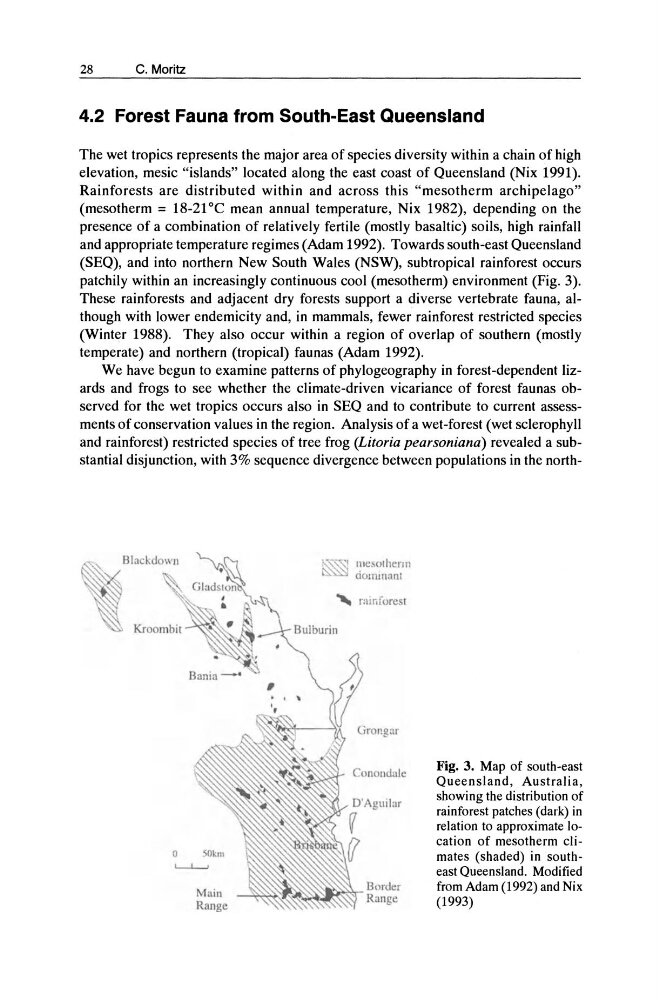
patchily within an increasingly continuous cool (mesotherm) environment (Fig. 3).
These rainforests and adjacent dry forests support a diverse vertebrate fauna, although with lower endemicity and, in mammals, fewer rainforest restricted species
(Winter 1988). They also occur within a region of overlap of southern (mostly
temperate) and northern (tropical) faunas (Adam 1992).
We have begun to examine patterns of phylogeography in forest-dependent lizards and frogs to see whether the climate-driven vicariance of forest faunas observed for the wet tropics occurs also in SEQ and to contribute to current assessments of conservation values in the region. Analysis of a wet-forest (wet sclerophyll
and rainforest) restricted species of tree frog (Litoria pearsoniana) revealed a substantial disjunction, with 3% sequence divergence between populations in the northo
50km
'---L...J
Main
Range
~ 1~le."olherm
.
OOIl11l1anl
,
rainfurest
Conondale
Border
Range
Fig. 3. Map of south-east
Queensland, Australia,
showing the distribution of
rainforest patches (dark) in
relation to approximate location of mesotherm climates (shaded) in southeast Queensland. Modified
from Adam (1992) and Nix
(1993)
C. Moritz
4.2 Forest Fauna from South-East Queensland
The wet tropics represents the major area of species diversity within a chain of high
elevation, mesic "islands" located along the east coast of Queensland (Nix 1991).
Rainforests are distributed within and across this "mesotherm archipelago"
(mesotherm = 18-21°C mean annual temperature, Nix 1982), depending on the
presence of a combination of relatively fertile (mostly basaltic) soils, high rainfall
and appropriate temperature regimes (Adam 1992). Towards south-east Queensland
(SEQ), and into northern New South Wales (NSW), subtropical rainforest occurs
patchily within an increasingly continuous cool (mesotherm) environment (Fig. 3).
These rainforests and adjacent dry forests support a diverse vertebrate fauna, although with lower endemicity and, in mammals, fewer rainforest restricted species
(Winter 1988). They also occur within a region of overlap of southern (mostly
temperate) and northern (tropical) faunas (Adam 1992).
We have begun to examine patterns of phylogeography in forest-dependent lizards and frogs to see whether the climate-driven vicariance of forest faunas observed for the wet tropics occurs also in SEQ and to contribute to current assessments of conservation values in the region. Analysis of a wet-forest (wet sclerophyll
and rainforest) restricted species of tree frog (Litoria pearsoniana) revealed a substantial disjunction, with 3% sequence divergence between populations in the northo
50km
'---L...J
Main
Range
~ 1~le."olherm
.
OOIl11l1anl
,
rainfurest
Conondale
Border
Range
Fig. 3. Map of south-east
Queensland, Australia,
showing the distribution of
rainforest patches (dark) in
relation to approximate location of mesotherm climates (shaded) in southeast Queensland. Modified
from Adam (1992) and Nix
(1993)