

26
C. Moritz
a
b
BM % divergence
15
r
11
" Q.
10
~
-E I
.0
0
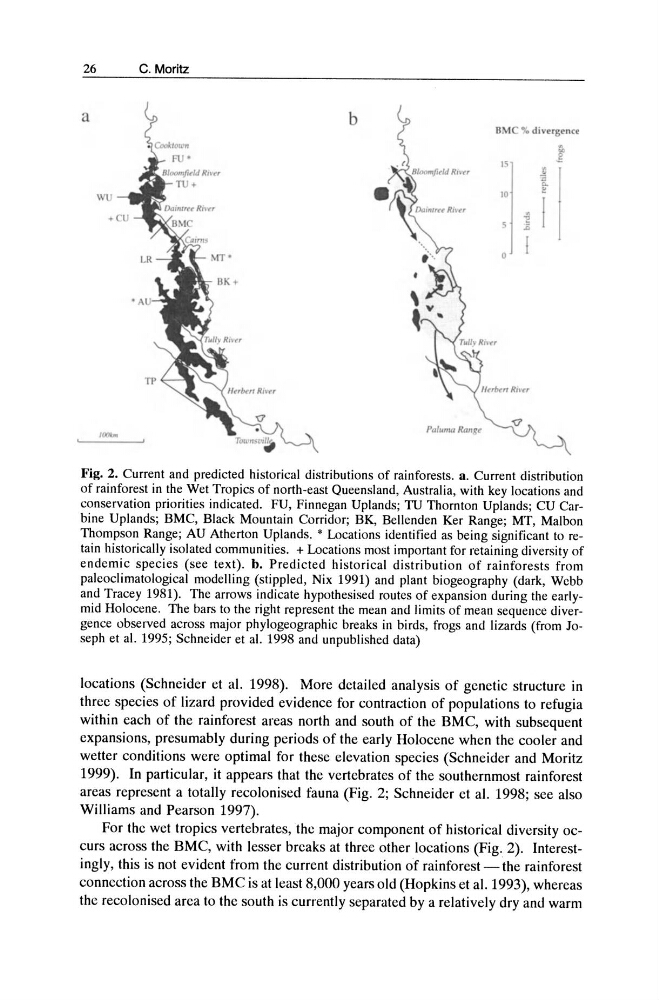
Fig. 2. Current and predicted historical distributions of rainforests. a. Current distribution
of rainforest in the Wet Tropics of north-east Queensland, Australia, with key locations and
conservation priorities indicated. FU, Finnegan Uplands; TU Thornton Uplands; CU Carbine Uplands; BMC, Black Mountain Corridor; BK, Bellenden Ker Range; MT, Malbon
Thompson Range; AU Atherton Uplands. * Locations identified as being significant to retain historically isolated communities. + Locations most important for retaining diversity of
endemic species (see text). b. Predicted historical distribution of rainforests from
paleoclimatological modelling (stippled, Nix 1991) and plant biogeography (dark, Webb
and Tracey 1981). The arrows indicate hypothesised routes of expansion during the earlymid Holocene. The bars to the right represent the mean and limits of mean sequence divergence observed across major phylogeographic breaks in birds, frogs and lizards (from Joseph et al. 1995; Schneider et al. 1998 and unpublished data)
locations (Schneider et al. 1998). More detailed analysis of genetic structure in
three species of lizard provided evidence for contraction of populations to refugia
within each of the rainforest areas north and south of the BMC, with subsequent
expansions, presumably during periods of the early Holocene when the cooler and
wetter conditions were optimal for these elevation species (Schneider and Moritz
1999). In particular, it appears that the vertebrates of the southernmost rainforest
areas represent a totally recolonised fauna (Fig. 2; Schneider et al. 1998; see also
Williams and Pearson 1997).
For the wet tropics vertebrates, the major component of historical diversity occurs across the BMC, with lesser breaks at three other locations (Fig. 2). Interestingly, this is not evident from the current distribution of rainforest - the rainforest
connection across the BMC is at least 8,000 years old (Hopkins et al. 1993), whereas
the recolonised area to the south is currently separated by a relatively dry and warm
C. Moritz
a
b
BM % divergence
15
r
11
" Q.
10
~
-E I
.0
0
Fig. 2. Current and predicted historical distributions of rainforests. a. Current distribution
of rainforest in the Wet Tropics of north-east Queensland, Australia, with key locations and
conservation priorities indicated. FU, Finnegan Uplands; TU Thornton Uplands; CU Carbine Uplands; BMC, Black Mountain Corridor; BK, Bellenden Ker Range; MT, Malbon
Thompson Range; AU Atherton Uplands. * Locations identified as being significant to retain historically isolated communities. + Locations most important for retaining diversity of
endemic species (see text). b. Predicted historical distribution of rainforests from
paleoclimatological modelling (stippled, Nix 1991) and plant biogeography (dark, Webb
and Tracey 1981). The arrows indicate hypothesised routes of expansion during the earlymid Holocene. The bars to the right represent the mean and limits of mean sequence divergence observed across major phylogeographic breaks in birds, frogs and lizards (from Joseph et al. 1995; Schneider et al. 1998 and unpublished data)
locations (Schneider et al. 1998). More detailed analysis of genetic structure in
three species of lizard provided evidence for contraction of populations to refugia
within each of the rainforest areas north and south of the BMC, with subsequent
expansions, presumably during periods of the early Holocene when the cooler and
wetter conditions were optimal for these elevation species (Schneider and Moritz
1999). In particular, it appears that the vertebrates of the southernmost rainforest
areas represent a totally recolonised fauna (Fig. 2; Schneider et al. 1998; see also
Williams and Pearson 1997).
For the wet tropics vertebrates, the major component of historical diversity occurs across the BMC, with lesser breaks at three other locations (Fig. 2). Interestingly, this is not evident from the current distribution of rainforest - the rainforest
connection across the BMC is at least 8,000 years old (Hopkins et al. 1993), whereas
the recolonised area to the south is currently separated by a relatively dry and warm