

20. Human Diversity and Its History
309
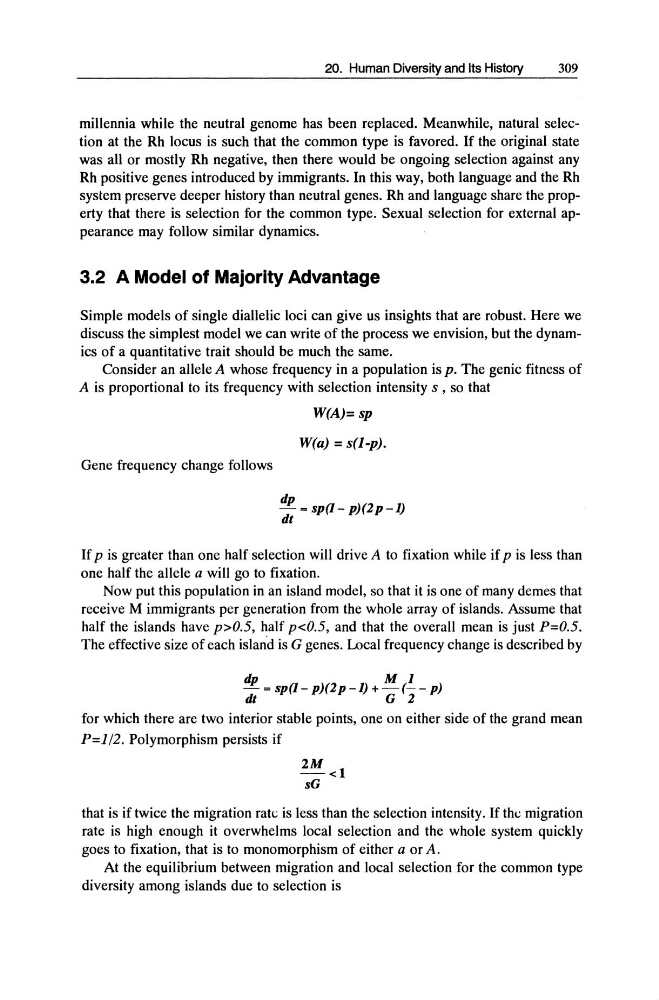
millennia while the neutral genome has been replaced. Meanwhile, natural selection at the Rh locus is such that the common type is favored. If the original state
was all or mostly Rh negative, then there would be ongoing selection against any
Rh positive genes introduced by immigrants. In this way, both language and the Rh
system preserve deeper history than neutral genes. Rh and language share the property that there is selection for the common type. Sexual selection for external appearance may follow similar dynamics.
3.2 A Model of Majority Advantage
Simple models of single diallelic loci can give us insights that are robust. Here we
discuss the simplest model we can write of the process we envision, but the dynamics of a quantitative trait should be much the same.
Consider an allele A whose frequency in a population is p. The genic fitness of
A is proportional to its frequency with selection intensity s , so that
Gene frequency change follows
W(A)= sp
W(a) = s(1-p).
dp
-
= sp(l- p)(2 P -1)
dt
If p is greater than one half selection will drive A to fixation while if p is less than
one half the allele a will go to fixation.
Now put this population in an island model, so that it is one of many demes that
receive M immigrants per generation from the whole array of islands. Assume that
half the islands have p>O.5, half p
The effective size of each island is G genes. Local frequency change is described by
dp = sp(l- p)(2p -1) + M (~_ p)
dt
G 2
for which there are two interior stable points, one on either side of the grand mean
P=1/2. Polymorphism persists if
2M <1
sG
that is if twice the migration ratc is less than the selection intensity. If the migration
rate is high enough it overwhelms local selection and the whole system quickly
goes to fixation, that is to monomorphism of either a or A.
At the equilibrium between migration and local selection for the common type
diversity among islands due to selection is
309
millennia while the neutral genome has been replaced. Meanwhile, natural selection at the Rh locus is such that the common type is favored. If the original state
was all or mostly Rh negative, then there would be ongoing selection against any
Rh positive genes introduced by immigrants. In this way, both language and the Rh
system preserve deeper history than neutral genes. Rh and language share the property that there is selection for the common type. Sexual selection for external appearance may follow similar dynamics.
3.2 A Model of Majority Advantage
Simple models of single diallelic loci can give us insights that are robust. Here we
discuss the simplest model we can write of the process we envision, but the dynamics of a quantitative trait should be much the same.
Consider an allele A whose frequency in a population is p. The genic fitness of
A is proportional to its frequency with selection intensity s , so that
Gene frequency change follows
W(A)= sp
W(a) = s(1-p).
dp
-
= sp(l- p)(2 P -1)
dt
If p is greater than one half selection will drive A to fixation while if p is less than
one half the allele a will go to fixation.
Now put this population in an island model, so that it is one of many demes that
receive M immigrants per generation from the whole array of islands. Assume that
half the islands have p>O.5, half p
dp = sp(l- p)(2p -1) + M (~_ p)
dt
G 2
for which there are two interior stable points, one on either side of the grand mean
P=1/2. Polymorphism persists if
2M <1
sG
that is if twice the migration ratc is less than the selection intensity. If the migration
rate is high enough it overwhelms local selection and the whole system quickly
goes to fixation, that is to monomorphism of either a or A.
At the equilibrium between migration and local selection for the common type
diversity among islands due to selection is