

20. Human Diversity and Its History
307
2.5 Problems
The rich new data that have become available support two general conclusions.
First, Fst' a standard measure of heterogeneity among populations, is about ten
percent among major continental groups. Essentially the same number has been
known since 1972 or so. Second, there is a cline in neutral genetic diversity outward from Africa. This is a new finding that relies on microsatellite loci. With their
large number of alleles they are not subject to the ascertainment bias that affects
classical polymorphisms and SNPs. Older studies, summarized in Cavalli-Sforza et
al. (1994), did not show any clear diversity gradient because most ofthem had been
found in Europeans, thus selecting for markers most diverse in Europeans.
Any account of the expansion of modern humans must account for the ten percent difference among continental areas as well as the diversity cline away from
Africa. A popular idea in anthropology is that these race differences developed in
situ as a consequence of geographically restricted gene flow, but this does not seem
possible. In a collection of completely isolated populations, each of size N, drawn
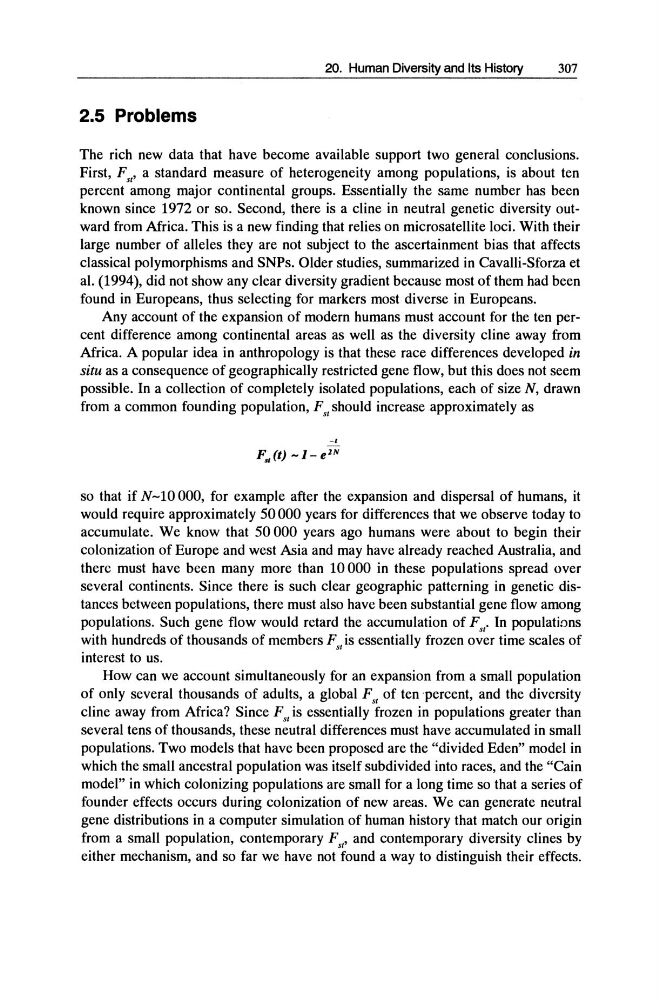
from a common founding population, F st should increase approximately as
-,
so that if N-lO 000, for example after the expansion and dispersal of humans, it
would require approximately 50000 years for differences that we observe today to
accumulate. We know that 50000 years ago humans were about to begin their
colonization of Europe and west Asia and may have already reached Australia, and
there must have been many more than 10 000 in these populations spread over
several continents. Since there is such clear geographic patterning in genetic distances between populations, there must also have been substantial gene flow among
popUlations. Such gene flow would retard the accumulation of F st ' In populations
with hundreds of thousands of members F.,is essentially frozen over time scales of
interest to us.
How can we account simultaneously for an expansion from a small population
of only several thousands of adults, a global Fs' of ten percent, and the diversity
cline away from Africa? Since Fs' is essentially frozen in populations greater than
several tens of thousands, these neutral differences must have accumulated in small
populations. Two models that have been proposed are the "divided Eden" model in
which the small ancestral population was itself subdivided into races, and the "Cain
model" in which colonizing populations are small for a long time so that a series of
founder effects occurs during colonization of new areas. We can generate neutral
gene distributions in a computer simulation of human history that match our origin
from a small popUlation, contemporary F s, ' and contemporary diversity clines by
either mechanism, and so far we have not found a way to distinguish their effects.
307
2.5 Problems
The rich new data that have become available support two general conclusions.
First, Fst' a standard measure of heterogeneity among populations, is about ten
percent among major continental groups. Essentially the same number has been
known since 1972 or so. Second, there is a cline in neutral genetic diversity outward from Africa. This is a new finding that relies on microsatellite loci. With their
large number of alleles they are not subject to the ascertainment bias that affects
classical polymorphisms and SNPs. Older studies, summarized in Cavalli-Sforza et
al. (1994), did not show any clear diversity gradient because most ofthem had been
found in Europeans, thus selecting for markers most diverse in Europeans.
Any account of the expansion of modern humans must account for the ten percent difference among continental areas as well as the diversity cline away from
Africa. A popular idea in anthropology is that these race differences developed in
situ as a consequence of geographically restricted gene flow, but this does not seem
possible. In a collection of completely isolated populations, each of size N, drawn
from a common founding population, F st should increase approximately as
-,
so that if N-lO 000, for example after the expansion and dispersal of humans, it
would require approximately 50000 years for differences that we observe today to
accumulate. We know that 50000 years ago humans were about to begin their
colonization of Europe and west Asia and may have already reached Australia, and
there must have been many more than 10 000 in these populations spread over
several continents. Since there is such clear geographic patterning in genetic distances between populations, there must also have been substantial gene flow among
popUlations. Such gene flow would retard the accumulation of F st ' In populations
with hundreds of thousands of members F.,is essentially frozen over time scales of
interest to us.
How can we account simultaneously for an expansion from a small population
of only several thousands of adults, a global Fs' of ten percent, and the diversity
cline away from Africa? Since Fs' is essentially frozen in populations greater than
several tens of thousands, these neutral differences must have accumulated in small
populations. Two models that have been proposed are the "divided Eden" model in
which the small ancestral population was itself subdivided into races, and the "Cain
model" in which colonizing populations are small for a long time so that a series of
founder effects occurs during colonization of new areas. We can generate neutral
gene distributions in a computer simulation of human history that match our origin
from a small popUlation, contemporary F s, ' and contemporary diversity clines by
either mechanism, and so far we have not found a way to distinguish their effects.