

17. Genetic Diversity of Primate Color Vision
269
1 2 2 2 2
8 2 3 7 8
0 9 3 7 5
II
P545 Galago
AVSYA
P543 Marmo. at
A X SYA
F277yl
P543 Tamarin
A X S Y A
XllZEj
P535 Squirrel m. A X SPA
P535 Capuchin
A X SPA
77
P535 Saki m.
A X SPA
P530 Bowler m.
A X SPA
r - -
I229F
P556 Marmo.et
A P S Y T
, 1229FI
F277Y
P556 Tamarin
A F S Y T
,
,
,
-
~.
P550 Squirrel m. A X S F T
P550 Capuchin
A X S P T
Y277F
P550 Saki m.
A X S P T
,
..Yll2L
A285T
' - - -
P562 Marmoset
S P G Y T
A285T
,
V2291
Y277F
I
P562 Tamarin
S P G Y T
A180S
I229F
-1
S233G
P562 Squirrel m. S F G Y T
-
P562 Capuchin
S F G Y T
A180S
1229F
S233GY
F277Y
P562 Saki m.
S F G Y T
P562 Bowler tn.
S P G Y T
Y277F
-1 A180S S233A
A285T
P530 Human
AXSPA
P562 Human
S X A Y T
A1.80S
S233A
F277Y
A285T
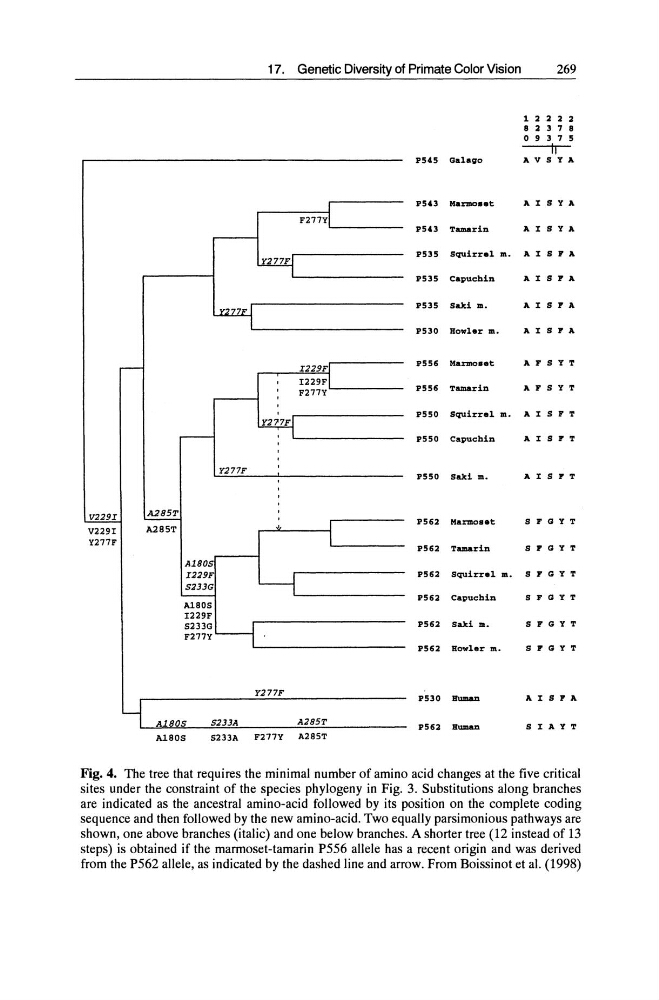
Fig. 4. The tree that requires the minimal number of amino acid changes at the five critical
sites under the constraint of the species phylogeny in Fig. 3. Substitutions along branches
are indicated as the ancestral amino-acid followed by its position on the complete coding
sequence and then followed by the new amino-acid. Two equally parsimonious pathways are
shown, one above branches (italic) and one below branches. A shorter tree (12 instead of 13
steps) is obtained if the marmoset-tamarin P556 allele has a recent origin and was derived
from the P562 allele, as indicated by the dashed line and arrow. From Boissinot et al. (1998)
269
1 2 2 2 2
8 2 3 7 8
0 9 3 7 5
II
P545 Galago
AVSYA
P543 Marmo. at
A X SYA
F277yl
P543 Tamarin
A X S Y A
XllZEj
P535 Squirrel m. A X SPA
P535 Capuchin
A X SPA
77
P535 Saki m.
A X SPA
P530 Bowler m.
A X SPA
r - -
I229F
P556 Marmo.et
A P S Y T
, 1229FI
F277Y
P556 Tamarin
A F S Y T
,
,
,
-
~.
P550 Squirrel m. A X S F T
P550 Capuchin
A X S P T
Y277F
P550 Saki m.
A X S P T
,
..Yll2L
A285T
' - - -
P562 Marmoset
S P G Y T
A285T
,
V2291
Y277F
I
P562 Tamarin
S P G Y T
A180S
I229F
-1
S233G
P562 Squirrel m. S F G Y T
-
P562 Capuchin
S F G Y T
A180S
1229F
S233GY
F277Y
P562 Saki m.
S F G Y T
P562 Bowler tn.
S P G Y T
Y277F
-1 A180S S233A
A285T
P530 Human
AXSPA
P562 Human
S X A Y T
A1.80S
S233A
F277Y
A285T
Fig. 4. The tree that requires the minimal number of amino acid changes at the five critical
sites under the constraint of the species phylogeny in Fig. 3. Substitutions along branches
are indicated as the ancestral amino-acid followed by its position on the complete coding
sequence and then followed by the new amino-acid. Two equally parsimonious pathways are
shown, one above branches (italic) and one below branches. A shorter tree (12 instead of 13
steps) is obtained if the marmoset-tamarin P556 allele has a recent origin and was derived
from the P562 allele, as indicated by the dashed line and arrow. From Boissinot et al. (1998)