

17. Genetic Diversity of Primate Color Vision
263
opsin gene in the bushbaby (0. crassicaudatus) has accumulated deleterious mutations and become nonfunctional (Jacobs et at. 1996b; Jacobs 1996). However, unexpectedly, sequencing work revealed that the X-linked opsin gene in both Galago
senegalensis and o. garnettii, which is closely related to O. crassicaudatus, has
been well conserved (Zhou et at. 1997); in fact, it has been even better conserved
than the X-linked pigment genes in higher primates. It is possible that this opsin in
combination with rhodopsin can provide the bushbaby with a wider light spectrum
at dusk, during which the animal is active, than can rhodopsin alone (Deegan and
Jacobs 1996). Moreover, since rhodopsin is saturated by daylight, the X-linked
opsin might be the only functional opsin for the animal during daylight. Although
bushbabies are usually not active in the daytime, they will occasionally need to
move (e.g., in order to escape predation) and thus need to use the X-linked opsin.
Furthermore, it has been suggested that this opsin gene might playa role in the
circadian rhythm of mammals (Nei et at. 1997).
4 Critical Amino Acid Residues
for Spectral Tuning
The phenotype of a pigment is commonly characterized by its spectral sensitivity
peak (Amax)' which is usually estimated by electroretinogram or microspectrophotometry. Since the exact Amax is very difficult to determine, only approximate values
are obtained. For example, the Amax values for the three alleles in squirrel monkeys
were previously given as 538, 551, and 561 nm, respectively (Jacobs and Neitz
1987), but were estimated to be 535, 550, and 562 nm in a recent reanalysis of
previous data (Jacobs 1996). These alleles are commonly denoted as P535, P550,
and P562. The most common green and red pigments in humans have the Amax
values of -530 and -562 nm and are denoted as P530 and P562, respectively. Note
that two pigments with the same Amax value, e.g., human P562 and squirrel monkey
P562, may have different origins and different amino acid sequences.
There has been much interest in knowing the amino acid residue sites that are
involved in spectral tuning. One way to study this problem is to compare the amino
acid sequences of closely related pigments with known Amax values (Neitz et at.
1991; Shyue et at. 1998). Another way is to introduce mutations, singly or in combination, in an opsin cDNA by site-directed mutagenesis, express the mutant cDNA
in animal cells, and measure the spectral sensitivity of each mutant sequence by
spectrophotometry (Merbs and Nathans 1992, 1993; Asenjo et at. 1994). These
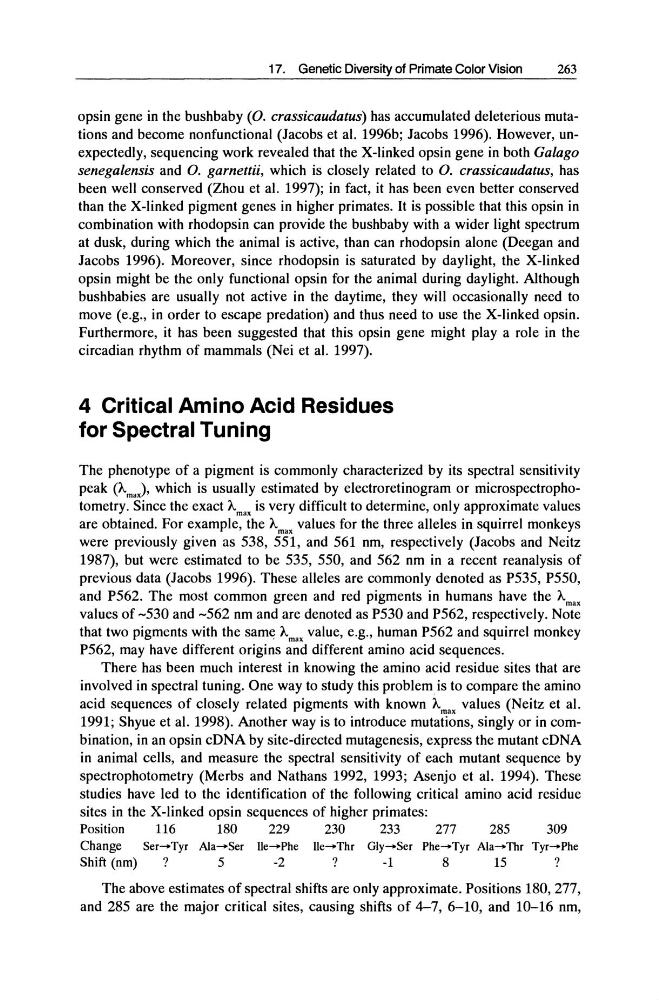
studies have led to the identification of the following critical amino acid residue
sites in the X-linked opsin sequences of higher primates:
Position
116
180
229
230
233
277
285
309
Change
Ser~Tyr A1a-Ser Ue~Phe Ue-Thr Gly~Ser Phe-+Tyr Ala-+Thr Tyr~Phe
Shift (nm)?
5
-2
?
-1
8
15
?
The above estimates of spectral shifts are only approximate. Positions 180, 277,
and 285 are the major critical sites, causing shifts of 4-7, 6-10, and 10-16 nm,
263
opsin gene in the bushbaby (0. crassicaudatus) has accumulated deleterious mutations and become nonfunctional (Jacobs et at. 1996b; Jacobs 1996). However, unexpectedly, sequencing work revealed that the X-linked opsin gene in both Galago
senegalensis and o. garnettii, which is closely related to O. crassicaudatus, has
been well conserved (Zhou et at. 1997); in fact, it has been even better conserved
than the X-linked pigment genes in higher primates. It is possible that this opsin in
combination with rhodopsin can provide the bushbaby with a wider light spectrum
at dusk, during which the animal is active, than can rhodopsin alone (Deegan and
Jacobs 1996). Moreover, since rhodopsin is saturated by daylight, the X-linked
opsin might be the only functional opsin for the animal during daylight. Although
bushbabies are usually not active in the daytime, they will occasionally need to
move (e.g., in order to escape predation) and thus need to use the X-linked opsin.
Furthermore, it has been suggested that this opsin gene might playa role in the
circadian rhythm of mammals (Nei et at. 1997).
4 Critical Amino Acid Residues
for Spectral Tuning
The phenotype of a pigment is commonly characterized by its spectral sensitivity
peak (Amax)' which is usually estimated by electroretinogram or microspectrophotometry. Since the exact Amax is very difficult to determine, only approximate values
are obtained. For example, the Amax values for the three alleles in squirrel monkeys
were previously given as 538, 551, and 561 nm, respectively (Jacobs and Neitz
1987), but were estimated to be 535, 550, and 562 nm in a recent reanalysis of
previous data (Jacobs 1996). These alleles are commonly denoted as P535, P550,
and P562. The most common green and red pigments in humans have the Amax
values of -530 and -562 nm and are denoted as P530 and P562, respectively. Note
that two pigments with the same Amax value, e.g., human P562 and squirrel monkey
P562, may have different origins and different amino acid sequences.
There has been much interest in knowing the amino acid residue sites that are
involved in spectral tuning. One way to study this problem is to compare the amino
acid sequences of closely related pigments with known Amax values (Neitz et at.
1991; Shyue et at. 1998). Another way is to introduce mutations, singly or in combination, in an opsin cDNA by site-directed mutagenesis, express the mutant cDNA
in animal cells, and measure the spectral sensitivity of each mutant sequence by
spectrophotometry (Merbs and Nathans 1992, 1993; Asenjo et at. 1994). These
studies have led to the identification of the following critical amino acid residue
sites in the X-linked opsin sequences of higher primates:
Position
116
180
229
230
233
277
285
309
Change
Ser~Tyr A1a-Ser Ue~Phe Ue-Thr Gly~Ser Phe-+Tyr Ala-+Thr Tyr~Phe
Shift (nm)?
5
-2
?
-1
8
15
?
The above estimates of spectral shifts are only approximate. Positions 180, 277,
and 285 are the major critical sites, causing shifts of 4-7, 6-10, and 10-16 nm,