

17. Genetic Diversity of Primate Color Vision
261
I
I
-
I
I
~
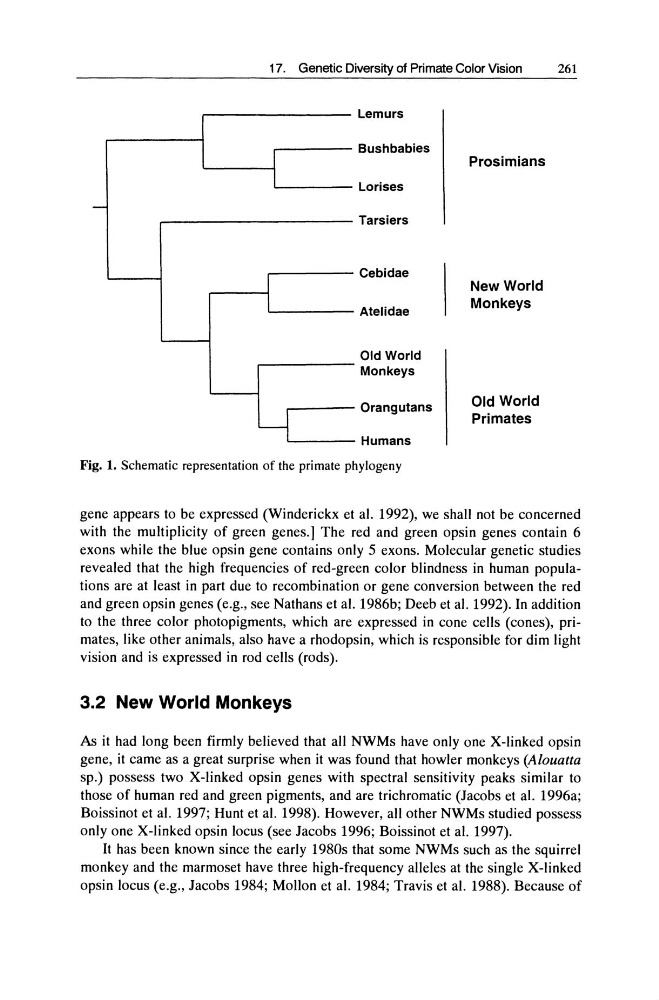
Fig.!. Schematic representation of the primate phylogeny
gene appears to be expressed (Winderickx et al. 1992), we shall not be concerned
with the multiplicity of green genes.] The red and green opsin genes contain 6
exons while the blue opsin gene contains only 5 exons. Molecular genetic studies
revealed that the high frequencies of red-green color blindness in human populations are at least in part due to recombination or gene conversion between the red
and green opsin genes (e.g., see Nathans et al. 1986b; Deeb et al. 1992). In addition
to the three color photopigments, which are expressed in cone cells (cones), primates, like other animals, also have a rhodopsin, which is responsible for dim light
vision and is expressed in rod cells (rods).
3.2 New World Monkeys
As it had long been firmly believed that all NWMs have only one X-linked opsin
gene, it came as a great surprise when it was found that howler monkeys (Alouatta
sp.) possess two X-linked opsin genes with spectral sensitivity peaks similar to
those of human red and green pigments, and are trichromatic (Jacobs et al. 1996a;
Boissinot et al. 1997; Hunt et al. 1998). However, all other NWMs studied possess
only one X-linked opsin locus (see Jacobs 1996; Boissinot et al. 1997).
It has been known since the early 1980s that some NWMs such as the squirrel
monkey and the marmoset have three high-frequency alleles at the single X-linked
opsin locus (e.g., Jacobs 1984; Mollon et al. 1984; Travis et al. 1988). Because of
261
I
I
-
I
I
~
Fig.!. Schematic representation of the primate phylogeny
gene appears to be expressed (Winderickx et al. 1992), we shall not be concerned
with the multiplicity of green genes.] The red and green opsin genes contain 6
exons while the blue opsin gene contains only 5 exons. Molecular genetic studies
revealed that the high frequencies of red-green color blindness in human populations are at least in part due to recombination or gene conversion between the red
and green opsin genes (e.g., see Nathans et al. 1986b; Deeb et al. 1992). In addition
to the three color photopigments, which are expressed in cone cells (cones), primates, like other animals, also have a rhodopsin, which is responsible for dim light
vision and is expressed in rod cells (rods).
3.2 New World Monkeys
As it had long been firmly believed that all NWMs have only one X-linked opsin
gene, it came as a great surprise when it was found that howler monkeys (Alouatta
sp.) possess two X-linked opsin genes with spectral sensitivity peaks similar to
those of human red and green pigments, and are trichromatic (Jacobs et al. 1996a;
Boissinot et al. 1997; Hunt et al. 1998). However, all other NWMs studied possess
only one X-linked opsin locus (see Jacobs 1996; Boissinot et al. 1997).
It has been known since the early 1980s that some NWMs such as the squirrel
monkey and the marmoset have three high-frequency alleles at the single X-linked
opsin locus (e.g., Jacobs 1984; Mollon et al. 1984; Travis et al. 1988). Because of