

244
M. Hasebe and M. Ito
rangium (a pollen sac) composed of multi-layered cells. Megaspores develop in a
nucellus (a megasporangium) covered with two integuments. Lower vascular plants
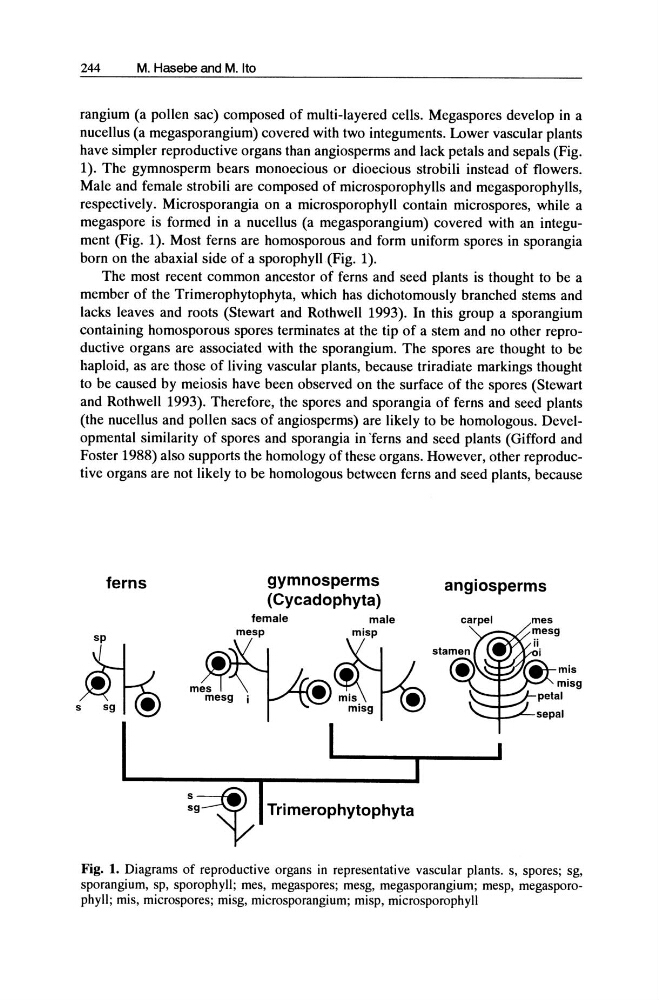
have simpler reproductive organs than angiosperms and lack petals and sepals (Fig.
1). The gymnosperm bears monoecious or dioecious strobili instead of flowers.
Male and female strobili are composed of microsporophylls and megasporophylls,
respectively. Microsporangia on a microsporophyll contain microspores, while a
megaspore is formed in a nucellus (a megasporangium) covered with an integument (Fig. 1). Most ferns are homosporous and form uniform spores in sporangia
born on the abaxial side of a sporophyll (Fig. 1).
The most recent common ancestor of ferns and seed plants is thought to be a
member of the Trimerophytophyta, which has dichotomously branched stems and
lacks leaves and roots (Stewart and Rothwell 1993). In this group a sporangium
containing homosporous spores terminates at the tip of a stem and no other reproductive organs are associated with the sporangium. The spores are thought to be
haploid, as are those of living vascular plants, because triradiate markings thought
to be caused by meiosis have been observed on the surface of the spores (Stewart
and Rothwell 1993). Therefore, the spores and sporangia of ferns and seed plants
(the nucellus and pollen sacs of angiosperms) are likely to be homologous. Developmental similarity of spores and sporangia in 'ferns and seed plants (Gifford and
Foster 1988) also supports the homology of these organs. However, other reproductive organs are not likely to be homologous between ferns and seed plants, because
ferns
gymnosperms
(Cycadophyta)
:-=t Trimerophylophyla
angiosperms
Fig. 1. Diagrams of reproductive organs in representative vascular plants. s, spores; sg,
sporangium, sp, sporophyll; mes, megaspores; mesg, megasporangium; mesp, megasporophyll; mis, microspores; misg, microsporangium; misp, microsporophyll
M. Hasebe and M. Ito
rangium (a pollen sac) composed of multi-layered cells. Megaspores develop in a
nucellus (a megasporangium) covered with two integuments. Lower vascular plants
have simpler reproductive organs than angiosperms and lack petals and sepals (Fig.
1). The gymnosperm bears monoecious or dioecious strobili instead of flowers.
Male and female strobili are composed of microsporophylls and megasporophylls,
respectively. Microsporangia on a microsporophyll contain microspores, while a
megaspore is formed in a nucellus (a megasporangium) covered with an integument (Fig. 1). Most ferns are homosporous and form uniform spores in sporangia
born on the abaxial side of a sporophyll (Fig. 1).
The most recent common ancestor of ferns and seed plants is thought to be a
member of the Trimerophytophyta, which has dichotomously branched stems and
lacks leaves and roots (Stewart and Rothwell 1993). In this group a sporangium
containing homosporous spores terminates at the tip of a stem and no other reproductive organs are associated with the sporangium. The spores are thought to be
haploid, as are those of living vascular plants, because triradiate markings thought
to be caused by meiosis have been observed on the surface of the spores (Stewart
and Rothwell 1993). Therefore, the spores and sporangia of ferns and seed plants
(the nucellus and pollen sacs of angiosperms) are likely to be homologous. Developmental similarity of spores and sporangia in 'ferns and seed plants (Gifford and
Foster 1988) also supports the homology of these organs. However, other reproductive organs are not likely to be homologous between ferns and seed plants, because
ferns
gymnosperms
(Cycadophyta)
:-=t Trimerophylophyla
angiosperms
Fig. 1. Diagrams of reproductive organs in representative vascular plants. s, spores; sg,
sporangium, sp, sporophyll; mes, megaspores; mesg, megasporangium; mesp, megasporophyll; mis, microspores; misg, microsporangium; misp, microsporophyll