

15. The Regulation of Dorsiventral Symmetry in Plants
231
From the evidence of developmental studies it remains unclear how thickening
growth ultimately leads to the loss of adaxial and marginal identity. According to
Kaplan (1975), adaxial meristem activity rounds out the initially flattened organ of
a unifacial petiole, and may leave the margins cryptically present along the flanks
of the mature petiole. However, in this case a cross zone should not occur at the
border between a bifacial and a unifacial sector; instead, the margins (e.g., at the
leaf base-petiole border) are expected to fade out laterally. According to Hagemann
(1970), extensive thickening growth may completely interrupt the continuity of the
margins in prospective unifacial leaf segments. This would allow the free ends of
the marginal ridges (called marginal blastozones if they exhibit organogenetic competence) to fuse across the adaxial surface, forming cross zones.
A third possibility is indicated by petioles where the abaxial surface comprises
most of the circumference, while the adaxial surface is narrowly wedged between
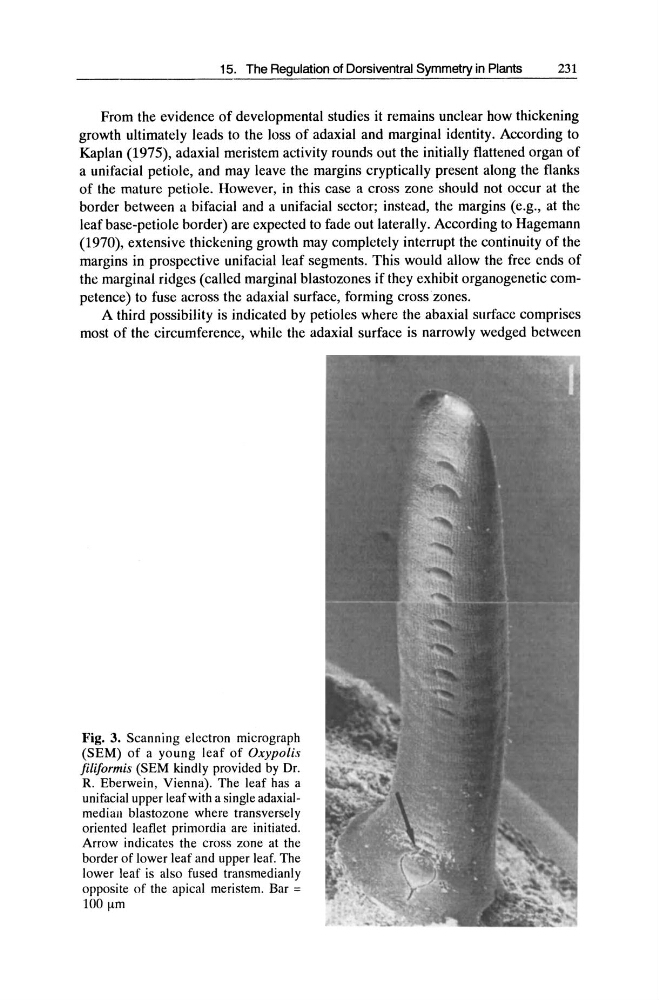
J<'ig. 3. Scanning electron micrograph
(SEM) of a young leaf of Oxypolis
filiformis (SEM kindly provided by Dr.
R. Eberwein, Vienna). The leaf has a
unifacial upper leaf with a single adaxialmedian blastozone where transversely
oriented leaflet primordia are initiated.
Arrow indicates the cross zone at the
border of lower leaf and upper leaf. The
lower leaf is also fused transmedianly
opposite of the apical meristem. Bar ==
100 flm
231
From the evidence of developmental studies it remains unclear how thickening
growth ultimately leads to the loss of adaxial and marginal identity. According to
Kaplan (1975), adaxial meristem activity rounds out the initially flattened organ of
a unifacial petiole, and may leave the margins cryptically present along the flanks
of the mature petiole. However, in this case a cross zone should not occur at the
border between a bifacial and a unifacial sector; instead, the margins (e.g., at the
leaf base-petiole border) are expected to fade out laterally. According to Hagemann
(1970), extensive thickening growth may completely interrupt the continuity of the
margins in prospective unifacial leaf segments. This would allow the free ends of
the marginal ridges (called marginal blastozones if they exhibit organogenetic competence) to fuse across the adaxial surface, forming cross zones.
A third possibility is indicated by petioles where the abaxial surface comprises
most of the circumference, while the adaxial surface is narrowly wedged between
J<'ig. 3. Scanning electron micrograph
(SEM) of a young leaf of Oxypolis
filiformis (SEM kindly provided by Dr.
R. Eberwein, Vienna). The leaf has a
unifacial upper leaf with a single adaxialmedian blastozone where transversely
oriented leaflet primordia are initiated.
Arrow indicates the cross zone at the
border of lower leaf and upper leaf. The
lower leaf is also fused transmedianly
opposite of the apical meristem. Bar ==
100 flm