

14. Developmental Mechanisms for Chordate Evolution
219
Ci-Bra (Cion a intertinalir)
u (1I)
E-Box
~------------~----~c::J== ~ I---~~-----r1 ~
-434 bp
-299 bp
- 188 bp
·22 bp
Ectopic Repression Notochord
Activation
Ectopic Activation
As-T (HaiocYllthia roretzi)
No Expre sion
Notochord Expression
..
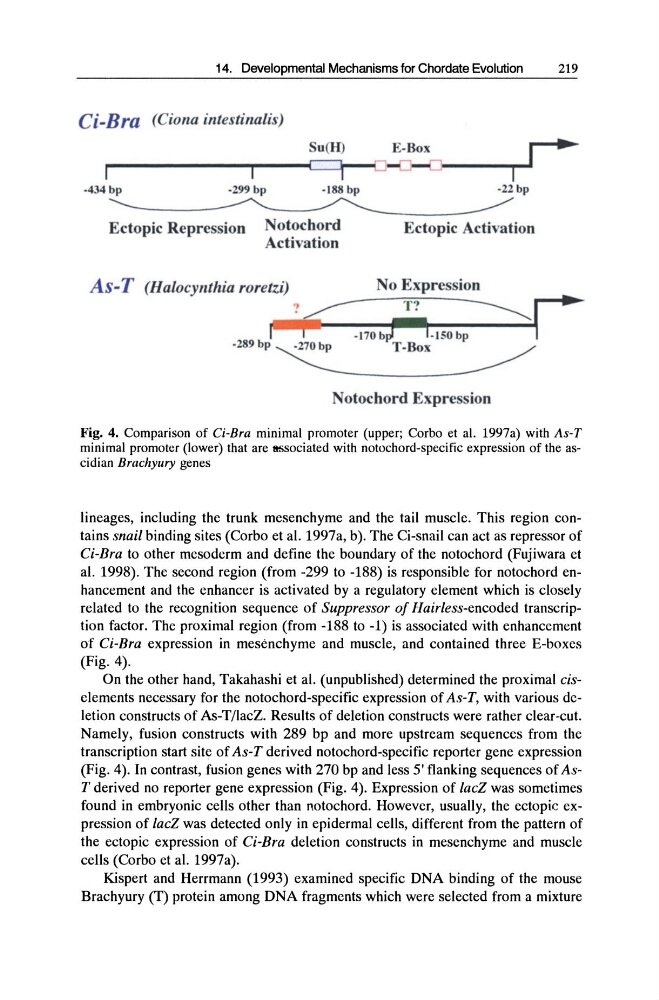
Fig. 4. Comparison of Ci·Bra minimal promoter (upper; Corbo et al. 1997a) with As-T
minimal promoter (lower) that are ltSsociated with notochord-specific expression of the ascidian Brachyury genes
lineages, including the trunk mesenchyme and the tail muscle. This region contains snail binding sites (Corbo et al. 1997a, b). The Ci-snail can act as repressor of
Ci-Bra to other mesoderm and define the boundary of the notochord (Fujiwara et
al. 1998). The second region (from -299 to -188) is responsible for notochord enhancement and the enhancer is activated by a regulatory element which is closely
related to the recognition sequence of Suppressor of Hairless-encoded transcription factor. The proximal region (from -188 to -1) is associated with enhancement
of Ci-Bra expression in mesenchyme and muscle, and contained three E-boxes
(Fig. 4).
On the other hand, Takahashi et a1. (unpublished) determined the proximal ciselements necessary for the notochord-specific expression of As-T, with various dcletion constructs of As-T/lacZ. Results of deletion constructs were rather clear-cut.
Namely, fusion constructs with 289 bp and more upstream sequences from the
transcription start site of As-T derived notochord-specific reporter gene expression
(Fig. 4). In contrast, fusion genes with 270 bp and less 5' flanking sequences of AsT derived no reporter gene expression (Fig. 4). Exprcssion of lacZ was sometimes
found in embryonic cells other than notochord. However, usually, the ectopic expression of lacZ was detected only in epidermal cells, different from the pattern of
the ectopic expression of Ci-Bra deletion constructs in mesenchyme and muscle
cells (Corbo et a1. 1997a).
Kispert and Herrmann (1993) examined specific DNA binding of the mouse
Brachyury (T) protein among DNA fragments which were selected from a mixture
219
Ci-Bra (Cion a intertinalir)
u (1I)
E-Box
~------------~----~c::J== ~ I---~~-----r1 ~
-434 bp
-299 bp
- 188 bp
·22 bp
Ectopic Repression Notochord
Activation
Ectopic Activation
As-T (HaiocYllthia roretzi)
No Expre sion
Notochord Expression
..
Fig. 4. Comparison of Ci·Bra minimal promoter (upper; Corbo et al. 1997a) with As-T
minimal promoter (lower) that are ltSsociated with notochord-specific expression of the ascidian Brachyury genes
lineages, including the trunk mesenchyme and the tail muscle. This region contains snail binding sites (Corbo et al. 1997a, b). The Ci-snail can act as repressor of
Ci-Bra to other mesoderm and define the boundary of the notochord (Fujiwara et
al. 1998). The second region (from -299 to -188) is responsible for notochord enhancement and the enhancer is activated by a regulatory element which is closely
related to the recognition sequence of Suppressor of Hairless-encoded transcription factor. The proximal region (from -188 to -1) is associated with enhancement
of Ci-Bra expression in mesenchyme and muscle, and contained three E-boxes
(Fig. 4).
On the other hand, Takahashi et a1. (unpublished) determined the proximal ciselements necessary for the notochord-specific expression of As-T, with various dcletion constructs of As-T/lacZ. Results of deletion constructs were rather clear-cut.
Namely, fusion constructs with 289 bp and more upstream sequences from the
transcription start site of As-T derived notochord-specific reporter gene expression
(Fig. 4). In contrast, fusion genes with 270 bp and less 5' flanking sequences of AsT derived no reporter gene expression (Fig. 4). Exprcssion of lacZ was sometimes
found in embryonic cells other than notochord. However, usually, the ectopic expression of lacZ was detected only in epidermal cells, different from the pattern of
the ectopic expression of Ci-Bra deletion constructs in mesenchyme and muscle
cells (Corbo et a1. 1997a).
Kispert and Herrmann (1993) examined specific DNA binding of the mouse
Brachyury (T) protein among DNA fragments which were selected from a mixture