

202
M.Akam
Insect
Chelicerate
"*
"B
0
I
I
~
~
;E
I
;E
Cl
Cl
I
....
....
u
u
C/J
C/J
~
&
0:
~
~
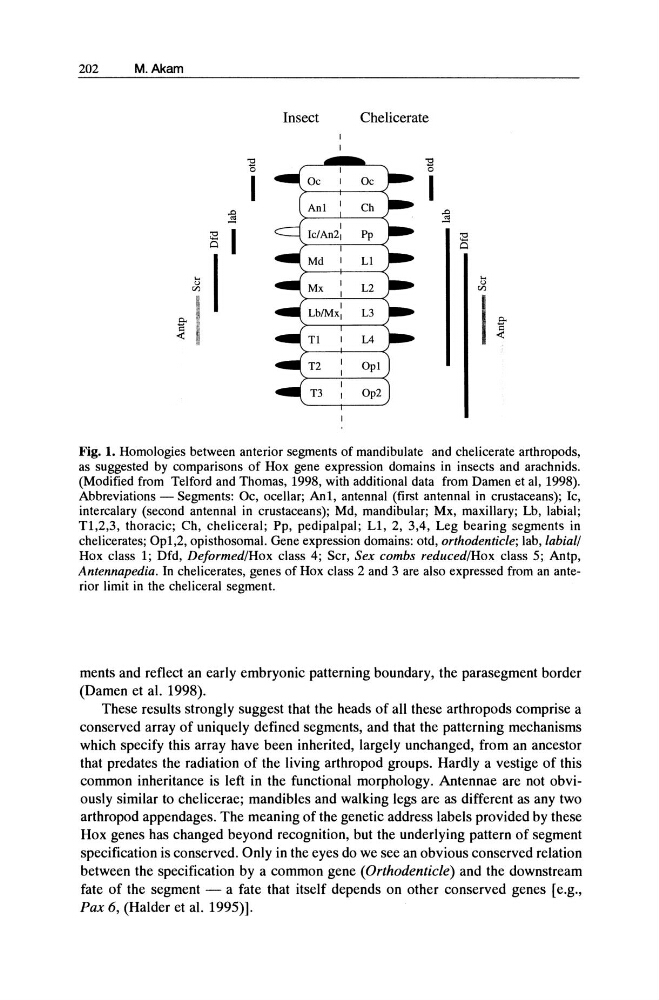
Fig. 1. Homologies between anterior segments of mandibulate and chelicerate arthropods,
as suggested by comparisons of Hox gene expression domains in insects and arachnids.
(Modified from Telford and Thomas, 1998, with additional data from Damen et ai, 1998).
Abbreviations - Segments: Oc, ocellar; AnI, antennal (first antennal in crustaceans); Ie,
intercalary (second antennal in crustaceans); Md, mandibular; Mx, maxillary; Lb, labial;
Tl,2,3, thoracic; Ch, cheliceral; Pp, pedipalpal; Ll, 2, 3,4, Leg bearing segments in
chelicerates; Opl,2, opisthosomal. Gene expression domains: otd, orthodenticle; lab, labial/
Hox class 1; Dfd, Deformed/Hox class 4; Scr, Sex combs reducedlHox class 5; Antp,
Antennapedia. In chelicerates, genes of Hox class 2 and 3 are also expressed from an anterior limit in the cheliceral segment.
ments and reflect an early embryonic patterning boundary, the parasegment border
(Damen et al. 1998).
These results strongly suggest that the heads of all these arthropods comprise a
conserved array of uniquely defined segments, and that the patterning mechanisms
which specify this array have been inherited, largely unchanged, from an ancestor
that predates the radiation of the living arthropod groups. Hardly a vestige of this
common inheritance is left in the functional morphology. Antennae are not obviously similar to chelicerae; mandibles and walking legs are as different as any two
arthropod appendages. The meaning of the genetic address labels provided by these
Hox genes has changed beyond recognition, but the underlying pattern of segment
specification is conserved. Only in the eyes do we see an obvious conserved relation
between the specification by a common gene (Orthodenticle) and the downstream
fate of the segment - a fate that itself depends on other conserved genes [e.g.,
Pax 6, (Halder et al. 1995)].
M.Akam
Insect
Chelicerate
"*
"B
0
I
I
~
~
;E
I
;E
Cl
Cl
I
....
....
u
u
C/J
C/J
~
&
0:
~
~
Fig. 1. Homologies between anterior segments of mandibulate and chelicerate arthropods,
as suggested by comparisons of Hox gene expression domains in insects and arachnids.
(Modified from Telford and Thomas, 1998, with additional data from Damen et ai, 1998).
Abbreviations - Segments: Oc, ocellar; AnI, antennal (first antennal in crustaceans); Ie,
intercalary (second antennal in crustaceans); Md, mandibular; Mx, maxillary; Lb, labial;
Tl,2,3, thoracic; Ch, cheliceral; Pp, pedipalpal; Ll, 2, 3,4, Leg bearing segments in
chelicerates; Opl,2, opisthosomal. Gene expression domains: otd, orthodenticle; lab, labial/
Hox class 1; Dfd, Deformed/Hox class 4; Scr, Sex combs reducedlHox class 5; Antp,
Antennapedia. In chelicerates, genes of Hox class 2 and 3 are also expressed from an anterior limit in the cheliceral segment.
ments and reflect an early embryonic patterning boundary, the parasegment border
(Damen et al. 1998).
These results strongly suggest that the heads of all these arthropods comprise a
conserved array of uniquely defined segments, and that the patterning mechanisms
which specify this array have been inherited, largely unchanged, from an ancestor
that predates the radiation of the living arthropod groups. Hardly a vestige of this
common inheritance is left in the functional morphology. Antennae are not obviously similar to chelicerae; mandibles and walking legs are as different as any two
arthropod appendages. The meaning of the genetic address labels provided by these
Hox genes has changed beyond recognition, but the underlying pattern of segment
specification is conserved. Only in the eyes do we see an obvious conserved relation
between the specification by a common gene (Orthodenticle) and the downstream
fate of the segment - a fate that itself depends on other conserved genes [e.g.,
Pax 6, (Halder et al. 1995)].