

11. Patterns of Tree Species Diversity
173
•••• Contours of species richness
in plant communities
- - Contours of species richness
in animal diversity
GI
U
c:
ca
JJ
.. :::I
-;;
:s ... o
1:
'iii
c:
!
c:
~ c:
CII
:::I
C"
e
u.
General pattern of species richness in animal communities
••
••
... .. . ..
. ............ " .l·· •.•... ;' ..
• ••••
•
• •
• •
i
•
, ..
•
• •••••••••
••
•
•
-
-TILMAN
Pattern of species richness in plant communities
Maximum plant growth rate/resource availability
)
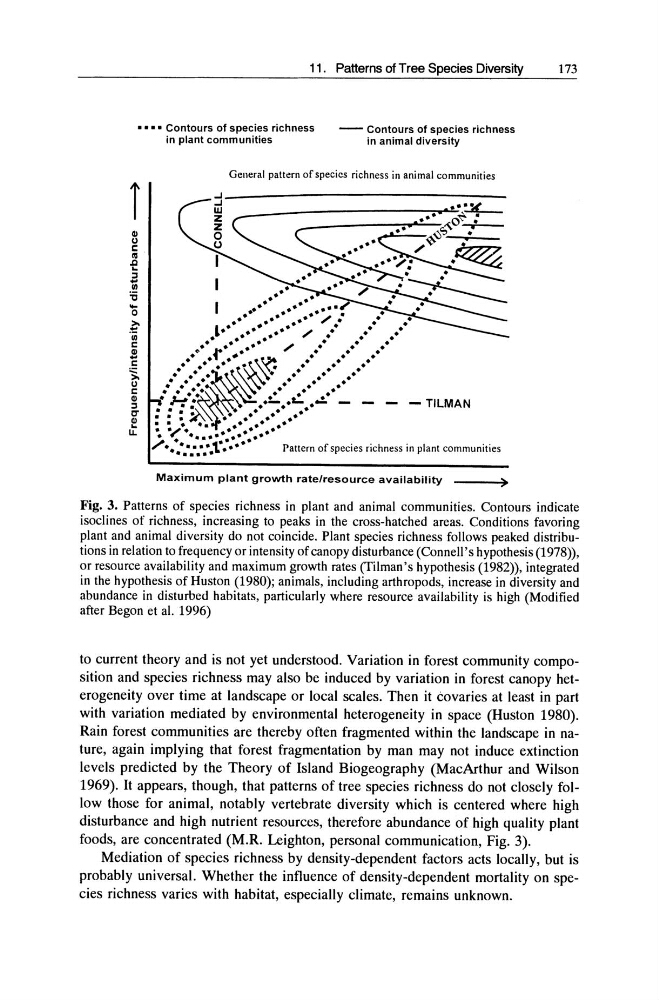
Fig. 3. Patterns of species richness in plant and animal communities. Contours indicate
isoclines of richness, increasing to peaks in the cross-hatched areas. Conditions favoring
plant and animal diversity do not coincide. Plant species richness follows peaked distributions in relation to frequency or intensity of canopy disturbance (Connell's hypothesis (1978»,
or resource availability and maximum growth rates (filman's hypothesis (1982», integrated
in the hypothesis of Huston (1980); animals, including arthropods, increase in diversity and
abundance in disturbed habitats, particularly where resource availability is high (Modified
after Begon et al. 1996)
to current theory and is not yet understood. Variation in forest community composition and species richness may also be induced by variation in forest canopy heterogeneity over time at landscape or local scales. Then it covaries at least in part
with variation mediated by environmental heterogeneity in space (Huston 1980).
Rain forest communities are thereby often fragmented within the landscape in nature, again implying that forest fragmentation by man may not induce extinction
levels predicted by the Theory of Island Biogeography (MacArthur and Wilson
1969). It appears, though, that patterns of tree species richness do not closely follow those for animal, notably vertebrate diversity which is centered where high
disturbance and high nutrient resources, therefore abundance of high quality plant
foods, are concentrated (M.R. Leighton, personal communication, Fig. 3).
Mediation of species richness by density-dependent factors acts locally, but is
probably universal. Whether the influence of density-dependent mortality on species richness varies with habitat, especially climate, remains unknown.
173
•••• Contours of species richness
in plant communities
- - Contours of species richness
in animal diversity
GI
U
c:
ca
JJ
.. :::I
-;;
:s ... o
1:
'iii
c:
!
c:
~ c:
CII
:::I
C"
e
u.
General pattern of species richness in animal communities
••
••
... .. . ..
. ............ " .l·· •.•... ;' ..
• ••••
•
• •
• •
i
•
, ..
•
• •••••••••
••
•
•
-
-TILMAN
Pattern of species richness in plant communities
Maximum plant growth rate/resource availability
)
Fig. 3. Patterns of species richness in plant and animal communities. Contours indicate
isoclines of richness, increasing to peaks in the cross-hatched areas. Conditions favoring
plant and animal diversity do not coincide. Plant species richness follows peaked distributions in relation to frequency or intensity of canopy disturbance (Connell's hypothesis (1978»,
or resource availability and maximum growth rates (filman's hypothesis (1982», integrated
in the hypothesis of Huston (1980); animals, including arthropods, increase in diversity and
abundance in disturbed habitats, particularly where resource availability is high (Modified
after Begon et al. 1996)
to current theory and is not yet understood. Variation in forest community composition and species richness may also be induced by variation in forest canopy heterogeneity over time at landscape or local scales. Then it covaries at least in part
with variation mediated by environmental heterogeneity in space (Huston 1980).
Rain forest communities are thereby often fragmented within the landscape in nature, again implying that forest fragmentation by man may not induce extinction
levels predicted by the Theory of Island Biogeography (MacArthur and Wilson
1969). It appears, though, that patterns of tree species richness do not closely follow those for animal, notably vertebrate diversity which is centered where high
disturbance and high nutrient resources, therefore abundance of high quality plant
foods, are concentrated (M.R. Leighton, personal communication, Fig. 3).
Mediation of species richness by density-dependent factors acts locally, but is
probably universal. Whether the influence of density-dependent mortality on species richness varies with habitat, especially climate, remains unknown.