

5. The Measurement of Primary Production in Aquatic Ecosystems
73
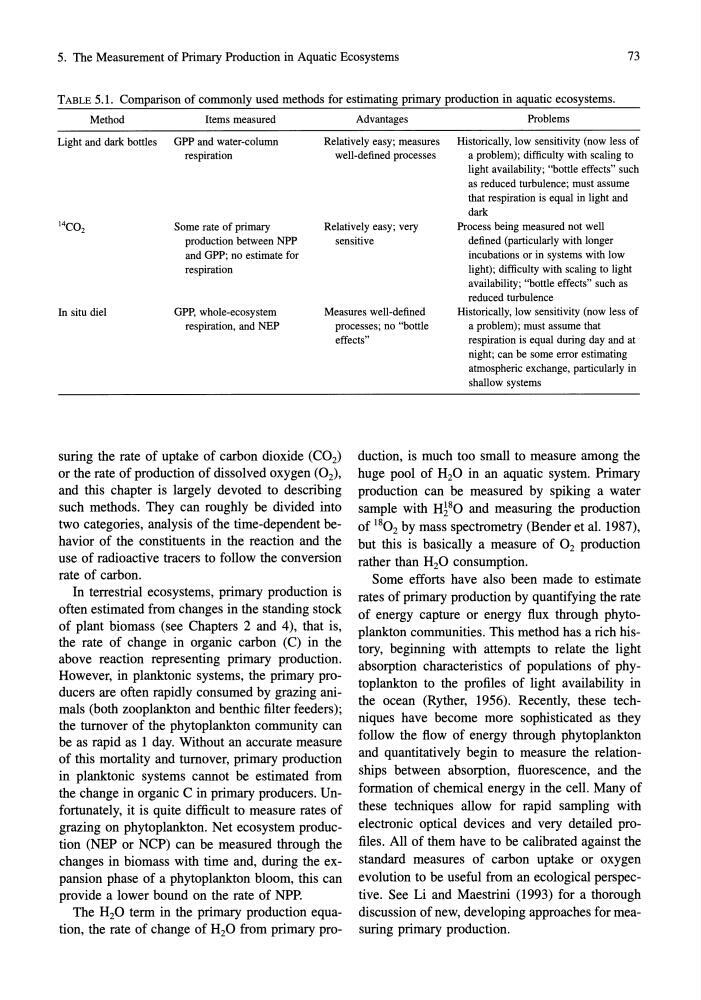
TABLE 5.1. Comparison of commonly used methods for estimating primary production in aquatic ecosystems.
Method
Items measured
Advantages
Problems
Light and dark bottles
GPP and water-column
respiration
Relatively easy; measures
well-defined processes
Historically, low sensitivity (now less of
a problem); difficulty with scaling to
light availability; "bottle effects" such
as reduced turbulence; must assume
that respiration is equal in light and
dark
14C02
Some rate of primary
production between NPP
and GPP; no estimate for
respiration
Relatively easy; very
sensitive
Process being measured not well
defined (particularly with longer
incubations or in systems with low
light); difficulty with scaling to light
availability; "bottle effects" such as
reduced turbulence
In situ diel
GPP, whole-ecosystem
respiration, and NEP
Measures well-defined
processes; no "bottle
effects"
Historically, low sensitivity (now less of
a problem); must assume that
respiration is equal during day and at
night; can be some error estimating
atmospheric exchange, particularly in
shallow systems
suring the rate of uptake of carbon dioxide (C0 2 )
or the rate of production of dissolved oxygen (0 2 ),
and this chapter is largely devoted to describing
such methods. They can roughly be divided into
two categories, analysis of the time-dependent behavior of the constituents in the reaction and the
use of radioactive tracers to follow the conversion
rate of carbon.
In terrestrial ecosystems, primary production is
often estimated from changes in the standing stock
of plant biomass (see Chapters 2 and 4), that is,
the rate of change in organic carbon (C) in the
above reaction representing primary production.
However, in planktonic systems, the primary producers are often rapidly consumed by grazing animals (both zooplankton and benthic filter feeders);
the turnover of the phytoplankton community can
be as rapid as 1 day. Without an accurate measure
of this mortality and turnover, primary production
in planktonic systems cannot be estimated from
the change in organic C in primary producers. Unfortunately, it is quite difficult to measure rates of
grazing on phytoplankton. Net ecosystem production (NEP or NCP) can be measured through the
changes in biomass with time and, during the expansion phase of a phytoplankton bloom, this can
provide a lower bound on the rate of NPP.
The H20 term in the primary production equation, the rate of change of H20 from primary production, is much too small to measure among the
huge pool of H20 in an aquatic system. Primary
production can be measured by spiking a water
sample with m 8 0 and measuring the production
of 18 0 2 by mass spectrometry (Bender et al. 1987),
but this is basically a measure of O 2 production
rather than H20 consumption.
Some efforts have also been made to estimate
rates of primary production by quantifying the rate
of energy capture or energy flux through phytoplankton communities. This method has a rich history, beginning with attempts to relate the light
absorption characteristics of populations of phytoplankton to the profiles of light availability in
the ocean (Ryther, 1956). Recently, these techniques have become more sophisticated as they
follow the flow of energy through phytoplankton
and quantitatively begin to measure the relationships between absorption, fluorescence, and the
formation of chemical energy in the cell. Many of
these techniques allow for rapid sampling with
electronic optical devices and very detailed profiles. All of them have to be calibrated against the
standard measures of carbon uptake or oxygen
evolution to be useful from an ecological perspective. See Li and Maestrini (1993) for a thorough
discussion of new, developing approaches for measuring primary production.
73
TABLE 5.1. Comparison of commonly used methods for estimating primary production in aquatic ecosystems.
Method
Items measured
Advantages
Problems
Light and dark bottles
GPP and water-column
respiration
Relatively easy; measures
well-defined processes
Historically, low sensitivity (now less of
a problem); difficulty with scaling to
light availability; "bottle effects" such
as reduced turbulence; must assume
that respiration is equal in light and
dark
14C02
Some rate of primary
production between NPP
and GPP; no estimate for
respiration
Relatively easy; very
sensitive
Process being measured not well
defined (particularly with longer
incubations or in systems with low
light); difficulty with scaling to light
availability; "bottle effects" such as
reduced turbulence
In situ diel
GPP, whole-ecosystem
respiration, and NEP
Measures well-defined
processes; no "bottle
effects"
Historically, low sensitivity (now less of
a problem); must assume that
respiration is equal during day and at
night; can be some error estimating
atmospheric exchange, particularly in
shallow systems
suring the rate of uptake of carbon dioxide (C0 2 )
or the rate of production of dissolved oxygen (0 2 ),
and this chapter is largely devoted to describing
such methods. They can roughly be divided into
two categories, analysis of the time-dependent behavior of the constituents in the reaction and the
use of radioactive tracers to follow the conversion
rate of carbon.
In terrestrial ecosystems, primary production is
often estimated from changes in the standing stock
of plant biomass (see Chapters 2 and 4), that is,
the rate of change in organic carbon (C) in the
above reaction representing primary production.
However, in planktonic systems, the primary producers are often rapidly consumed by grazing animals (both zooplankton and benthic filter feeders);
the turnover of the phytoplankton community can
be as rapid as 1 day. Without an accurate measure
of this mortality and turnover, primary production
in planktonic systems cannot be estimated from
the change in organic C in primary producers. Unfortunately, it is quite difficult to measure rates of
grazing on phytoplankton. Net ecosystem production (NEP or NCP) can be measured through the
changes in biomass with time and, during the expansion phase of a phytoplankton bloom, this can
provide a lower bound on the rate of NPP.
The H20 term in the primary production equation, the rate of change of H20 from primary production, is much too small to measure among the
huge pool of H20 in an aquatic system. Primary
production can be measured by spiking a water
sample with m 8 0 and measuring the production
of 18 0 2 by mass spectrometry (Bender et al. 1987),
but this is basically a measure of O 2 production
rather than H20 consumption.
Some efforts have also been made to estimate
rates of primary production by quantifying the rate
of energy capture or energy flux through phytoplankton communities. This method has a rich history, beginning with attempts to relate the light
absorption characteristics of populations of phytoplankton to the profiles of light availability in
the ocean (Ryther, 1956). Recently, these techniques have become more sophisticated as they
follow the flow of energy through phytoplankton
and quantitatively begin to measure the relationships between absorption, fluorescence, and the
formation of chemical energy in the cell. Many of
these techniques allow for rapid sampling with
electronic optical devices and very detailed profiles. All of them have to be calibrated against the
standard measures of carbon uptake or oxygen
evolution to be useful from an ecological perspective. See Li and Maestrini (1993) for a thorough
discussion of new, developing approaches for measuring primary production.