

3. Global Terrestrial Gross and Net Primary Productivity from the Earth Observing System
47
BlOME - BGe
DAILY
AIR TEMPERATURE
RADIATION
YEARLY
SITEATA
LATITUDE
ELEVATION
SLOPE/ASPECT
SOIL DEPTH
SOIL TEXTURE
PRECIPITATION
AllH.lAl..SUM:
~¥:b~~ERE CO -1'tCICS'INTlESI
L.------!:~RIIR
EVAPORATION
"HOi
, '
N DEPOSITION
NFIXATION
, ..
, ,
\\:J=--~
1~~r-c-l
ECOSYSTEM PROCESS MODEL BASED ON
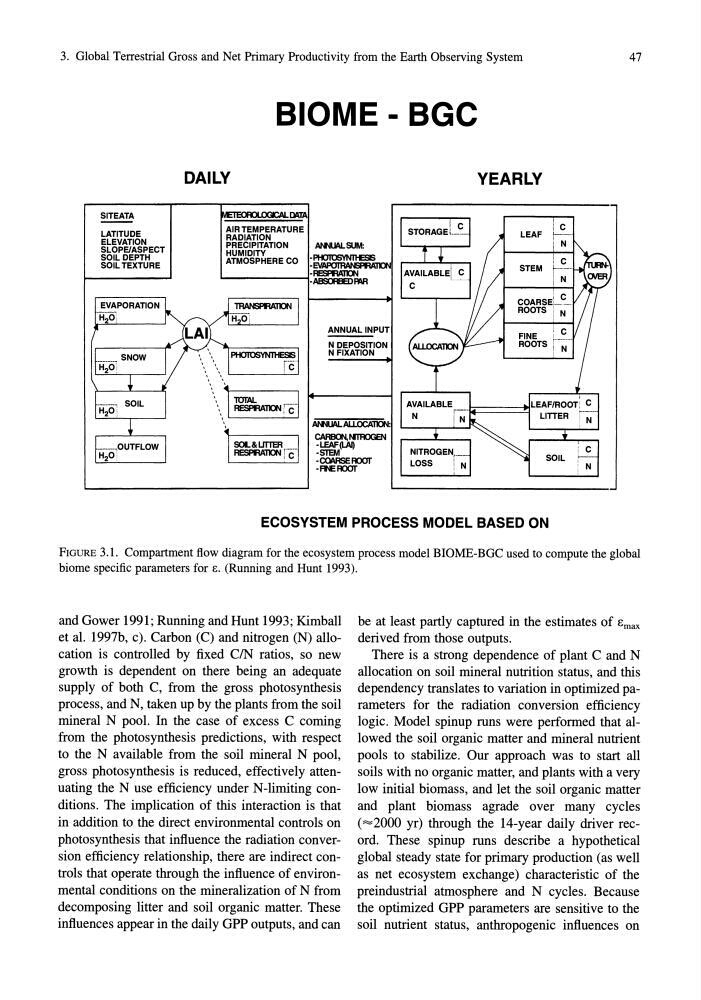
FIGURE 3.1. Compartment flow diagram for the ecosystem process model BIOME-BGC used to compute the global
biome specific parameters for E. (Running and Hunt 1993).
and Gower 1991; Running and Hunt 1993; Kimball
et al. 1997b, c). Carbon (C) and nitrogen (N) allocation is controlled by fixed C/N ratios, so new
growth is dependent on there being an adequate
supply of both C, from the gross photosynthesis
process, and N, taken up by the plants from the soil
mineral N pool. In the case of excess C coming
from the photosynthesis predictions, with respect
to the N available from the soil mineral N pool,
gross photosynthesis is reduced, effectively attenuating the N use efficiency under N-limiting conditions. The implication of this interaction is that
in addition to the direct environmental controls on
photosynthesis that influence the radiation conversion efficiency relationship, there are indirect controls that operate through the influence of environmental conditions on the mineralization of N from
decomposing litter and soil organic matter. These
influences appear in the daily GPP outputs, and can
be at least partly captured in the estimates of Emax
derived from those outputs.
There is a strong dependence of plant C and N
allocation on soil mineral nutrition status, and this
dependency translates to variation in optimized parameters for the radiation conversion efficiency
logic. Model spinup runs were performed that allowed the soil organic matter and mineral nutrient
pools to stabilize. Our approach was to start all
soils with no organic matter, and plants with a very
low initial biomass, and let the soil organic matter
and plant biomass agrade over many cycles
(=2000 yr) through the 14-year daily driver record. These spinup runs describe a hypothetical
global steady state for primary production (as well
as net ecosystem exchange) characteristic of the
preindustrial atmosphere and N cycles. Because
the optimized GPP parameters are sensitive to the
soil nutrient status, anthropogenic influences on
47
BlOME - BGe
DAILY
AIR TEMPERATURE
RADIATION
YEARLY
SITEATA
LATITUDE
ELEVATION
SLOPE/ASPECT
SOIL DEPTH
SOIL TEXTURE
PRECIPITATION
AllH.lAl..SUM:
~¥:b~~ERE CO -1'tCICS'INTlESI
L.------!:~RIIR
EVAPORATION
"HOi
, '
N DEPOSITION
NFIXATION
, ..
, ,
\\:J=--~
1~~r-c-l
ECOSYSTEM PROCESS MODEL BASED ON
FIGURE 3.1. Compartment flow diagram for the ecosystem process model BIOME-BGC used to compute the global
biome specific parameters for E. (Running and Hunt 1993).
and Gower 1991; Running and Hunt 1993; Kimball
et al. 1997b, c). Carbon (C) and nitrogen (N) allocation is controlled by fixed C/N ratios, so new
growth is dependent on there being an adequate
supply of both C, from the gross photosynthesis
process, and N, taken up by the plants from the soil
mineral N pool. In the case of excess C coming
from the photosynthesis predictions, with respect
to the N available from the soil mineral N pool,
gross photosynthesis is reduced, effectively attenuating the N use efficiency under N-limiting conditions. The implication of this interaction is that
in addition to the direct environmental controls on
photosynthesis that influence the radiation conversion efficiency relationship, there are indirect controls that operate through the influence of environmental conditions on the mineralization of N from
decomposing litter and soil organic matter. These
influences appear in the daily GPP outputs, and can
be at least partly captured in the estimates of Emax
derived from those outputs.
There is a strong dependence of plant C and N
allocation on soil mineral nutrition status, and this
dependency translates to variation in optimized parameters for the radiation conversion efficiency
logic. Model spinup runs were performed that allowed the soil organic matter and mineral nutrient
pools to stabilize. Our approach was to start all
soils with no organic matter, and plants with a very
low initial biomass, and let the soil organic matter
and plant biomass agrade over many cycles
(=2000 yr) through the 14-year daily driver record. These spinup runs describe a hypothetical
global steady state for primary production (as well
as net ecosystem exchange) characteristic of the
preindustrial atmosphere and N cycles. Because
the optimized GPP parameters are sensitive to the
soil nutrient status, anthropogenic influences on