

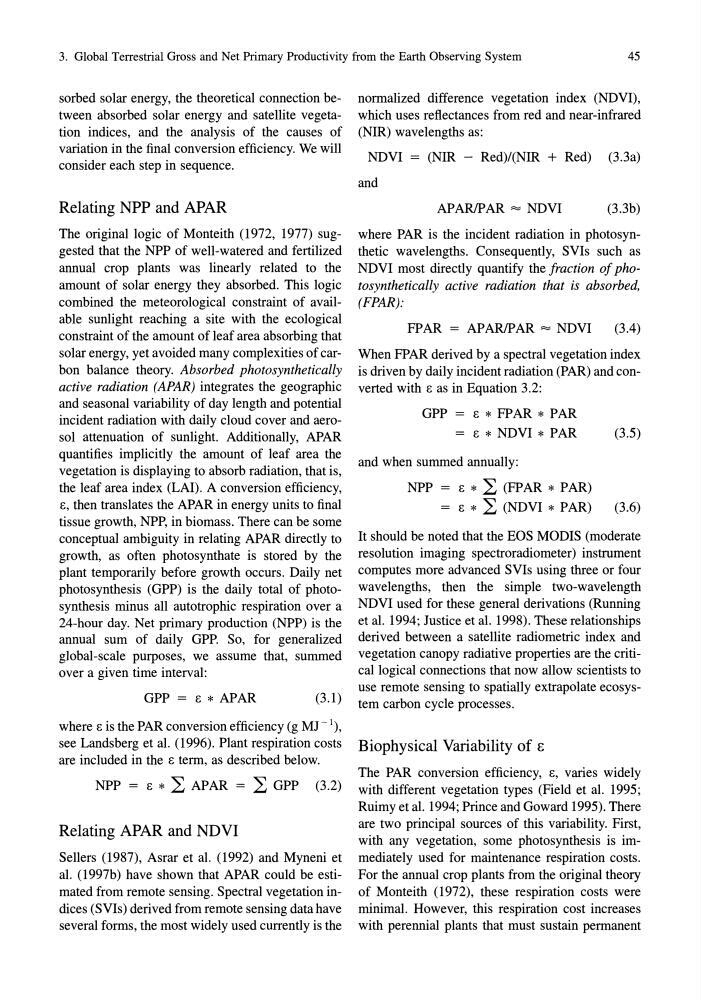
3. Global Terrestrial Gross and Net Primary Productivity from the Earth Observing System
45
sorbed solar energy, the theoretical connection between absorbed solar energy and satellite vegetation indices, and the analysis of the causes of
variation in the final conversion efficiency. We will
consider each step in sequence.
Relating NPP and APAR
The original logic of Monteith (1972, 1977) suggested that the NPP of well-watered and fertilized
annual crop plants was linearly related to the
amount of solar energy they absorbed. This logic
combined the meteorological constraint of available sunlight reaching a site with the ecological
constraint of the amount of leaf area absorbing that
solar energy, yet avoided many complexities of carbon balance theory. Absorbed photosynthetically
active radiation (APAR) integrates the geographic
and seasonal variability of day length and potential
incident radiation with daily cloud cover and aerosol attenuation of sunlight. Additionally, APAR
quantifies implicitly the amount of leaf area the
vegetation is displaying to absorb radiation, that is,
the leaf area index (LAI). A conversion efficiency,
E, then translates the APAR in energy units to final
tissue growth, NPP, in biomass. There can be some
conceptual ambiguity in relating APAR directly to
growth, as often photosynthate is stored by the
plant temporarily before growth occurs. Daily net
photosynthesis (GPP) is the daily total of photosynthesis minus all autotrophic respiration over a
24-hour day. Net primary production (NPP) is the
annual sum of daily GPP. So, for generalized
global-scale purposes, we assume that, summed
over a given time interval:
GPP = E * APAR
(3.1)
where E is the PAR conversion efficiency (g Mr I),
see Landsberg et al. (1996). Plant respiration costs
are included in the E term, as described below.
NPP = E * L APAR = L GPP (3.2)
Relating APAR and NDVI
Sellers (1987), Asrar et al. (1992) and Myneni et
al. (1997b) have shown that APAR could be estimated from remote sensing. Spectral vegetation indices (SVIs) derived from remote sensing data have
several forms, the most widely used currently is the
normalized difference vegetation index (NDVI),
which uses reflectances from red and near-infrared
(NIR) wavelengths as:
NDVI = (NIR - Red)/(NIR + Red) (3.3a)
and
APARIPAR = NDVI
(3.3b)
where PAR is the incident radiation in photosynthetic wavelengths. Consequently, SVIs such as
NDVI most directly quantify the fraction of photosynthetically active radiation that is absorbed,
(FPAR):
FPAR = APARIPAR = NDVI
(3.4)
When FPAR derived by a spectral vegetation index
is driven by daily incident radiation (PAR) and converted with E as in Equation 3.2:
GPP
E * FPAR * PAR
E * NDVI * PAR
(3.5)
and when summed annually:
NPP
E * L (FPAR * PAR)
= E * L (NDVI * PAR) (3.6)
It should be noted that the EOS MODIS (moderate
resolution imaging spectroradiometer) instrument
computes more advanced SVIs using three or four
wavelengths, then the simple two-wavelength
NDVI used for these general derivations (Running
et al. 1994; Justice et al. 1998). These relationships
derived between a satellite radiometric index and
vegetation canopy radiative properties are the critical logical connections that now allow scientists to
use remote sensing to spatially extrapolate ecosystem carbon cycle processes.
Biophysical Variability of E
The PAR conversion efficiency, E, varies widely
with different vegetation types (Field et al. 1995;
Ruimy et al. 1994; Prince and Goward 1995). There
are two principal sources of this variability. First,
with any vegetation, some photosynthesis is immediately used for maintenance respiration costs.
For the annual crop plants from the original theory
of Monteith (1972), these respiration costs were
minimal. However, this respiration cost increases
with perennial plants that must sustain permanent
45
sorbed solar energy, the theoretical connection between absorbed solar energy and satellite vegetation indices, and the analysis of the causes of
variation in the final conversion efficiency. We will
consider each step in sequence.
Relating NPP and APAR
The original logic of Monteith (1972, 1977) suggested that the NPP of well-watered and fertilized
annual crop plants was linearly related to the
amount of solar energy they absorbed. This logic
combined the meteorological constraint of available sunlight reaching a site with the ecological
constraint of the amount of leaf area absorbing that
solar energy, yet avoided many complexities of carbon balance theory. Absorbed photosynthetically
active radiation (APAR) integrates the geographic
and seasonal variability of day length and potential
incident radiation with daily cloud cover and aerosol attenuation of sunlight. Additionally, APAR
quantifies implicitly the amount of leaf area the
vegetation is displaying to absorb radiation, that is,
the leaf area index (LAI). A conversion efficiency,
E, then translates the APAR in energy units to final
tissue growth, NPP, in biomass. There can be some
conceptual ambiguity in relating APAR directly to
growth, as often photosynthate is stored by the
plant temporarily before growth occurs. Daily net
photosynthesis (GPP) is the daily total of photosynthesis minus all autotrophic respiration over a
24-hour day. Net primary production (NPP) is the
annual sum of daily GPP. So, for generalized
global-scale purposes, we assume that, summed
over a given time interval:
GPP = E * APAR
(3.1)
where E is the PAR conversion efficiency (g Mr I),
see Landsberg et al. (1996). Plant respiration costs
are included in the E term, as described below.
NPP = E * L APAR = L GPP (3.2)
Relating APAR and NDVI
Sellers (1987), Asrar et al. (1992) and Myneni et
al. (1997b) have shown that APAR could be estimated from remote sensing. Spectral vegetation indices (SVIs) derived from remote sensing data have
several forms, the most widely used currently is the
normalized difference vegetation index (NDVI),
which uses reflectances from red and near-infrared
(NIR) wavelengths as:
NDVI = (NIR - Red)/(NIR + Red) (3.3a)
and
APARIPAR = NDVI
(3.3b)
where PAR is the incident radiation in photosynthetic wavelengths. Consequently, SVIs such as
NDVI most directly quantify the fraction of photosynthetically active radiation that is absorbed,
(FPAR):
FPAR = APARIPAR = NDVI
(3.4)
When FPAR derived by a spectral vegetation index
is driven by daily incident radiation (PAR) and converted with E as in Equation 3.2:
GPP
E * FPAR * PAR
E * NDVI * PAR
(3.5)
and when summed annually:
NPP
E * L (FPAR * PAR)
= E * L (NDVI * PAR) (3.6)
It should be noted that the EOS MODIS (moderate
resolution imaging spectroradiometer) instrument
computes more advanced SVIs using three or four
wavelengths, then the simple two-wavelength
NDVI used for these general derivations (Running
et al. 1994; Justice et al. 1998). These relationships
derived between a satellite radiometric index and
vegetation canopy radiative properties are the critical logical connections that now allow scientists to
use remote sensing to spatially extrapolate ecosystem carbon cycle processes.
Biophysical Variability of E
The PAR conversion efficiency, E, varies widely
with different vegetation types (Field et al. 1995;
Ruimy et al. 1994; Prince and Goward 1995). There
are two principal sources of this variability. First,
with any vegetation, some photosynthesis is immediately used for maintenance respiration costs.
For the annual crop plants from the original theory
of Monteith (1972), these respiration costs were
minimal. However, this respiration cost increases
with perennial plants that must sustain permanent