

24. Ecosystem Climate Manipulations
needed. To simulate global warming in the field,
this energy input is best applied to the vegetation
canopy using overhead energy sources, and whenever possible, should be provided throughout the
year, so that changes such as the early initiation of
snowmelt and lengthening of the growing season
can be examined. The application of energy from
above constitutes an ecosystem-level warming experiment, as opposed to a soil-only warming experiment, and leads to warmer foliage as well as
soil.
The use of overhead heaters for ecosystem
warming was first applied by Harte et al. (1995b)
in a montane meadow in Colorado, in the United
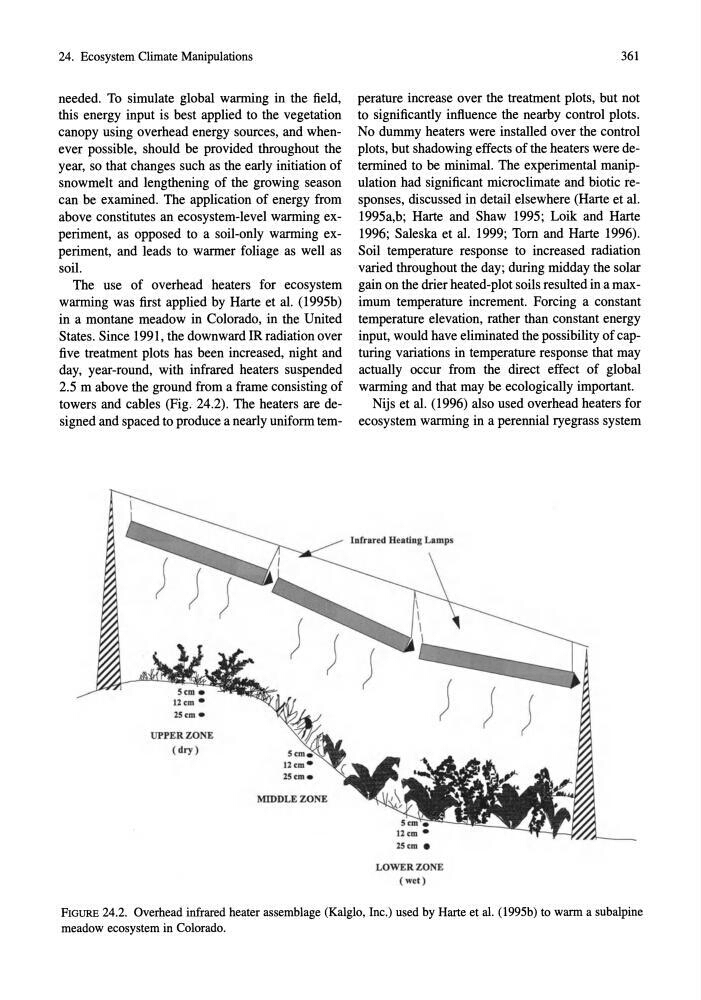
States. Since 1991, the downward IR radiation over
five treatment plots has been increased, night and
day, year-round, with infrared heaters suspended
2.5 m above the ground from a frame consisting of
towers and cables (Fig. 24.2). The heaters are designed and spaced to produce a nearly uniform temlScm .
UPPER ZONE
(dry )
25
361
perature increase over the treatment plots, but not
to significantly influence the nearby control plots.
No dummy heaters were installed over the control
plots, but shadowing effects of the heaters were determined to be minimal. The experimental manipulation had significant microclimate and biotic responses, discussed in detail elsewhere (Harte et al.
1995a,b; Harte and Shaw 1995; Loik and Harte
1996; Saleska et al. 1999; Tom and Harte 1996).
Soil temperature response to increased radiation
varied throughout the day; during midday the solar
gain on the drier heated-plot soils resulted in a maximum temperature increment. Forcing a constant
temperature elevation, rather than constant energy
input, would have eliminated the possibility of capturing variations in temperature response that may
actually occur from the direct effect of global
warming and that may be ecologically important.
Nijs et al. (1996) also used overhead heaters for
ecosystem warming in a perennial ryegrass system
LOWER ZONE
( wet)
FIGURE 24.2. Overhead infrared heater assemblage (Kalglo, Inc.) used by Harte et al. (1995b) to warm a subalpine
meadow ecosystem in Colorado.
needed. To simulate global warming in the field,
this energy input is best applied to the vegetation
canopy using overhead energy sources, and whenever possible, should be provided throughout the
year, so that changes such as the early initiation of
snowmelt and lengthening of the growing season
can be examined. The application of energy from
above constitutes an ecosystem-level warming experiment, as opposed to a soil-only warming experiment, and leads to warmer foliage as well as
soil.
The use of overhead heaters for ecosystem
warming was first applied by Harte et al. (1995b)
in a montane meadow in Colorado, in the United
States. Since 1991, the downward IR radiation over
five treatment plots has been increased, night and
day, year-round, with infrared heaters suspended
2.5 m above the ground from a frame consisting of
towers and cables (Fig. 24.2). The heaters are designed and spaced to produce a nearly uniform temlScm .
UPPER ZONE
(dry )
25
361
perature increase over the treatment plots, but not
to significantly influence the nearby control plots.
No dummy heaters were installed over the control
plots, but shadowing effects of the heaters were determined to be minimal. The experimental manipulation had significant microclimate and biotic responses, discussed in detail elsewhere (Harte et al.
1995a,b; Harte and Shaw 1995; Loik and Harte
1996; Saleska et al. 1999; Tom and Harte 1996).
Soil temperature response to increased radiation
varied throughout the day; during midday the solar
gain on the drier heated-plot soils resulted in a maximum temperature increment. Forcing a constant
temperature elevation, rather than constant energy
input, would have eliminated the possibility of capturing variations in temperature response that may
actually occur from the direct effect of global
warming and that may be ecologically important.
Nijs et al. (1996) also used overhead heaters for
ecosystem warming in a perennial ryegrass system
LOWER ZONE
( wet)
FIGURE 24.2. Overhead infrared heater assemblage (Kalglo, Inc.) used by Harte et al. (1995b) to warm a subalpine
meadow ecosystem in Colorado.