

358
(1) k:------~
(2)
(3)
(4)
(5)
(6)
(7)
(8)
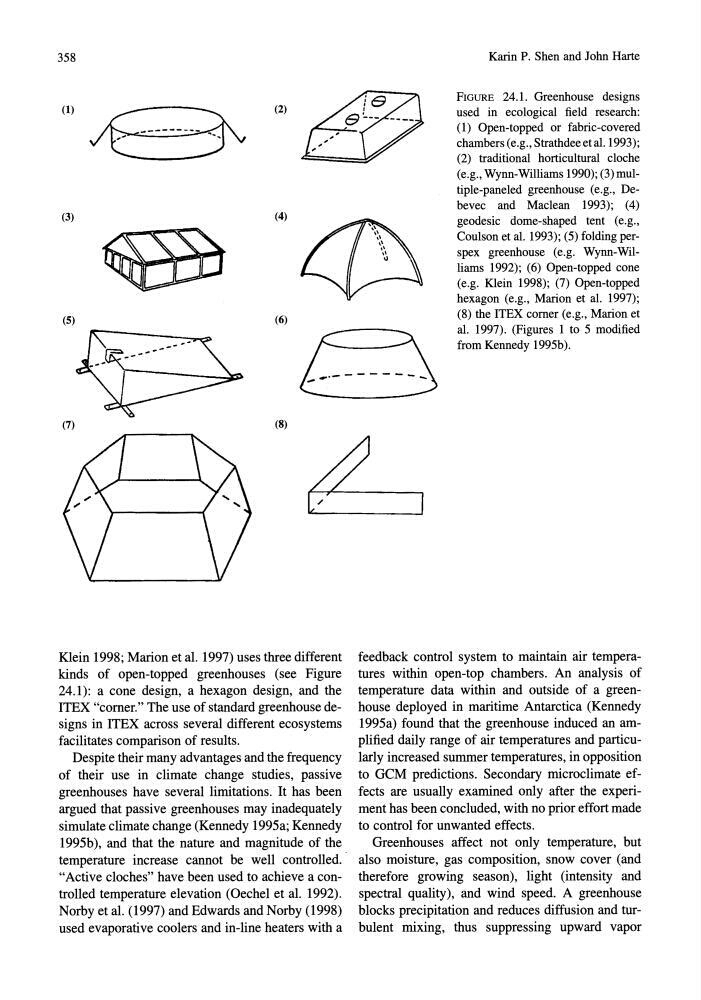
Klein 1998; Marion et al. 1997) uses three different
kinds of open-topped greenhouses (see Figure
24.1): a cone design, a hexagon design, and the
ITEX "comer." The use of standard greenhouse designs in ITEX across several different ecosystems
facilitates comparison of results.
Despite their many advantages and the frequency
of their use in climate change studies, passive
greenhouses have several limitations. It has been
argued that passive greenhouses may inadequately
simulate climate change (Kennedy 1995a; Kennedy
1995b), and that the nature and magnitude of the
temperature increase cannot be well controlled.·
"Active cloches" have been used to achieve a controlled temperature elevation (Oechel et al. 1992).
Norby et al. (1997) and Edwards and Norby (1998)
used evaporative coolers and in-line heaters with a
Karin P. Shen and John Harte
FIGURE 24.1. Greenhouse designs
used in ecological field research:
(1) Open-topped or fabric-covered
chambers (e.g., Strathdeeetal.1993);
(2) traditional horticultural cloche
(e.g., Wynn-Williams 1990); (3)multiple-paneled greenhouse (e.g., Debevec and Maclean 1993); (4)
geodesic dome-shaped tent (e.g.,
Coulson et al. 1993); (5) folding perspex greenhouse (e.g. Wynn-Williams 1992); (6) Open-topped cone
(e.g. Klein 1998); (7) Open-topped
hexagon (e.g., Marion et al. 1997);
(8) the ITEX comer (e.g., Marion et
al. 1997). (Figures 1 to 5 modified
from Kennedy 1995b).
feedback control system to maintain air temperatures within open-top chambers. An analysis of
temperature data within and outside of a greenhouse deployed in maritime Antarctica (Kennedy
1995a) found that the greenhouse induced an amplified daily range of air temperatures and particularly increased summer temperatures, in opposition
to GeM predictions. Secondary microclimate effects are usually examined only after the experiment has been concluded, with no prior effort made
to control for unwanted effects.
Greenhouses affect not only temperature, but
also moisture, gas composition, snow cover (and
therefore growing season), light (intensity and
spectral quality), and wind speed. A greenhouse
blocks precipitation and reduces diffusion and turbulent mixing, thus suppressing upward vapor
(1) k:------~
(2)
(3)
(4)
(5)
(6)
(7)
(8)
Klein 1998; Marion et al. 1997) uses three different
kinds of open-topped greenhouses (see Figure
24.1): a cone design, a hexagon design, and the
ITEX "comer." The use of standard greenhouse designs in ITEX across several different ecosystems
facilitates comparison of results.
Despite their many advantages and the frequency
of their use in climate change studies, passive
greenhouses have several limitations. It has been
argued that passive greenhouses may inadequately
simulate climate change (Kennedy 1995a; Kennedy
1995b), and that the nature and magnitude of the
temperature increase cannot be well controlled.·
"Active cloches" have been used to achieve a controlled temperature elevation (Oechel et al. 1992).
Norby et al. (1997) and Edwards and Norby (1998)
used evaporative coolers and in-line heaters with a
Karin P. Shen and John Harte
FIGURE 24.1. Greenhouse designs
used in ecological field research:
(1) Open-topped or fabric-covered
chambers (e.g., Strathdeeetal.1993);
(2) traditional horticultural cloche
(e.g., Wynn-Williams 1990); (3)multiple-paneled greenhouse (e.g., Debevec and Maclean 1993); (4)
geodesic dome-shaped tent (e.g.,
Coulson et al. 1993); (5) folding perspex greenhouse (e.g. Wynn-Williams 1992); (6) Open-topped cone
(e.g. Klein 1998); (7) Open-topped
hexagon (e.g., Marion et al. 1997);
(8) the ITEX comer (e.g., Marion et
al. 1997). (Figures 1 to 5 modified
from Kennedy 1995b).
feedback control system to maintain air temperatures within open-top chambers. An analysis of
temperature data within and outside of a greenhouse deployed in maritime Antarctica (Kennedy
1995a) found that the greenhouse induced an amplified daily range of air temperatures and particularly increased summer temperatures, in opposition
to GeM predictions. Secondary microclimate effects are usually examined only after the experiment has been concluded, with no prior effort made
to control for unwanted effects.
Greenhouses affect not only temperature, but
also moisture, gas composition, snow cover (and
therefore growing season), light (intensity and
spectral quality), and wind speed. A greenhouse
blocks precipitation and reduces diffusion and turbulent mixing, thus suppressing upward vapor