

312
Daniel E. Schindler, Brian R. Herwig, and Stephen R. Carpenter
goals and hypotheses, and provides a mechanism
with which to gain consensus among managers and
scientists about experimental design and manipulation strength (Trebitz et al. 1997).
Ecosystem manipulations should be substantial
and sustained to interpret responses in inherently
variable natural systems. Substantial manipulations
span the natural range of the independent variable.
Sustained manipulations are continued for several
generations or turnover times of the dependent
variables.
Experiments to study trophic cascades in lakes
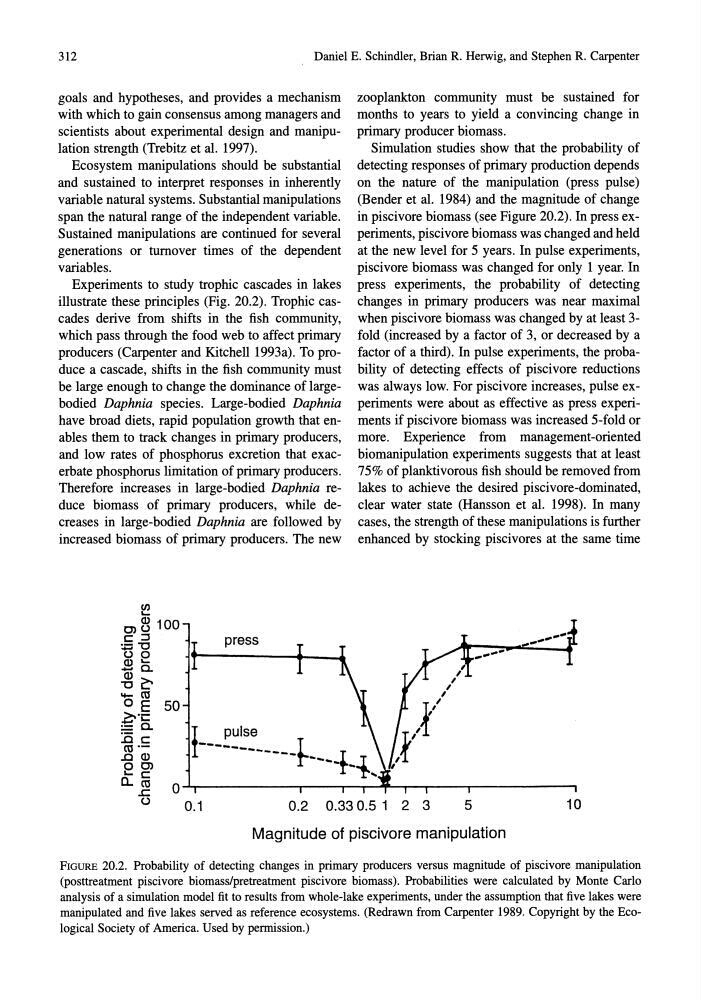
illustrate these principles (Fig. 20.2). Trophic cascades derive from shifts in the fish community,
which pass through the food web to affect primary
producers (Carpenter and Kitchell 1993a). To produce a cascade, shifts in the fish community must
be large enough to change the dominance of largebodied Daphnia species. Large-bodied Daphnia
have broad diets, rapid population growth that enables them to track changes in primary producers,
and low rates of phosphorus excretion that exacerbate phosphorus limitation of primary producers.
Therefore increases in large-bodied Daphnia reduce biomass of primary producers, while decreases in large-bodied Daphnia are followed by
increased biomass of primary producers. The new
~
0> ~ 100
c:::::l
:;::l"C
0 0
20.
~~ _m
press
zooplankton community must be sustained for
months to years to yield a convincing change in
primary producer biomass.
Simulation studies show that the probability of
detecting responses of primary production depends
on the nature of the manipulation (press pulse)
(Bender et al. 1984) and the magnitude of change
in piscivore biomass (see Figure 20.2). In press experiments, piscivore biomass was changed and held
at the new level for 5 years. In pulse experiments,
piscivore biomass was changed for only 1 year. In
press experiments, the probability of detecting
changes in primary producers was near maximal
when piscivore biomass was changed by at least 3fold (increased by a factor of 3, or decreased by a
factor of a third). In pulse experiments, the probability of detecting effects of piscivore reductions
was always low. For piscivore increases, pulse experiments were about as effective as press experiments if piscivore biomass was increased 5-fold or
more. Experience from management-oriented
biomanipulation experiments suggests that at least
75% of planktivorous fish should be removed from
lakes to achieve the desired piscivore-dominated,
clear water state (Hansson et al. 1998). In many
cases, the strength of these manipulations is further
enhanced by stocking piscivores at the same time
.-......
o E 50
~oc
=0.
:Cc
m o -
.cOl
00>
t,;;..c
~ ~
O~------------r----r-'~~'--r----~----------~
o
0.1
0.2 0.330.5 1 2 3
5
10
Magnitude of piscivore manipulation
FIGURE 20.2. Probability of detecting changes in primary producers versus magnitude of piscivore manipulation
(posttreatment piscivore biomass/pretreatment piscivore biomass). Probabilities were calculated by Monte Carlo
analysis of a simulation model fit to results from whole-lake experiments, under the assumption that five lakes were
manipulated and five lakes served as reference ecosystems. (Redrawn from Carpenter 1989. Copyright by the Ecological Society of America. Used by permission.)
Daniel E. Schindler, Brian R. Herwig, and Stephen R. Carpenter
goals and hypotheses, and provides a mechanism
with which to gain consensus among managers and
scientists about experimental design and manipulation strength (Trebitz et al. 1997).
Ecosystem manipulations should be substantial
and sustained to interpret responses in inherently
variable natural systems. Substantial manipulations
span the natural range of the independent variable.
Sustained manipulations are continued for several
generations or turnover times of the dependent
variables.
Experiments to study trophic cascades in lakes
illustrate these principles (Fig. 20.2). Trophic cascades derive from shifts in the fish community,
which pass through the food web to affect primary
producers (Carpenter and Kitchell 1993a). To produce a cascade, shifts in the fish community must
be large enough to change the dominance of largebodied Daphnia species. Large-bodied Daphnia
have broad diets, rapid population growth that enables them to track changes in primary producers,
and low rates of phosphorus excretion that exacerbate phosphorus limitation of primary producers.
Therefore increases in large-bodied Daphnia reduce biomass of primary producers, while decreases in large-bodied Daphnia are followed by
increased biomass of primary producers. The new
~
0> ~ 100
c:::::l
:;::l"C
0 0
20.
~~ _m
press
zooplankton community must be sustained for
months to years to yield a convincing change in
primary producer biomass.
Simulation studies show that the probability of
detecting responses of primary production depends
on the nature of the manipulation (press pulse)
(Bender et al. 1984) and the magnitude of change
in piscivore biomass (see Figure 20.2). In press experiments, piscivore biomass was changed and held
at the new level for 5 years. In pulse experiments,
piscivore biomass was changed for only 1 year. In
press experiments, the probability of detecting
changes in primary producers was near maximal
when piscivore biomass was changed by at least 3fold (increased by a factor of 3, or decreased by a
factor of a third). In pulse experiments, the probability of detecting effects of piscivore reductions
was always low. For piscivore increases, pulse experiments were about as effective as press experiments if piscivore biomass was increased 5-fold or
more. Experience from management-oriented
biomanipulation experiments suggests that at least
75% of planktivorous fish should be removed from
lakes to achieve the desired piscivore-dominated,
clear water state (Hansson et al. 1998). In many
cases, the strength of these manipulations is further
enhanced by stocking piscivores at the same time
.-......
o E 50
~oc
=0.
:Cc
m o -
.cOl
00>
t,;;..c
~ ~
O~------------r----r-'~~'--r----~----------~
o
0.1
0.2 0.330.5 1 2 3
5
10
Magnitude of piscivore manipulation
FIGURE 20.2. Probability of detecting changes in primary producers versus magnitude of piscivore manipulation
(posttreatment piscivore biomass/pretreatment piscivore biomass). Probabilities were calculated by Monte Carlo
analysis of a simulation model fit to results from whole-lake experiments, under the assumption that five lakes were
manipulated and five lakes served as reference ecosystems. (Redrawn from Carpenter 1989. Copyright by the Ecological Society of America. Used by permission.)