

20. Biotic Manipulations of Aquatic Ecosystems
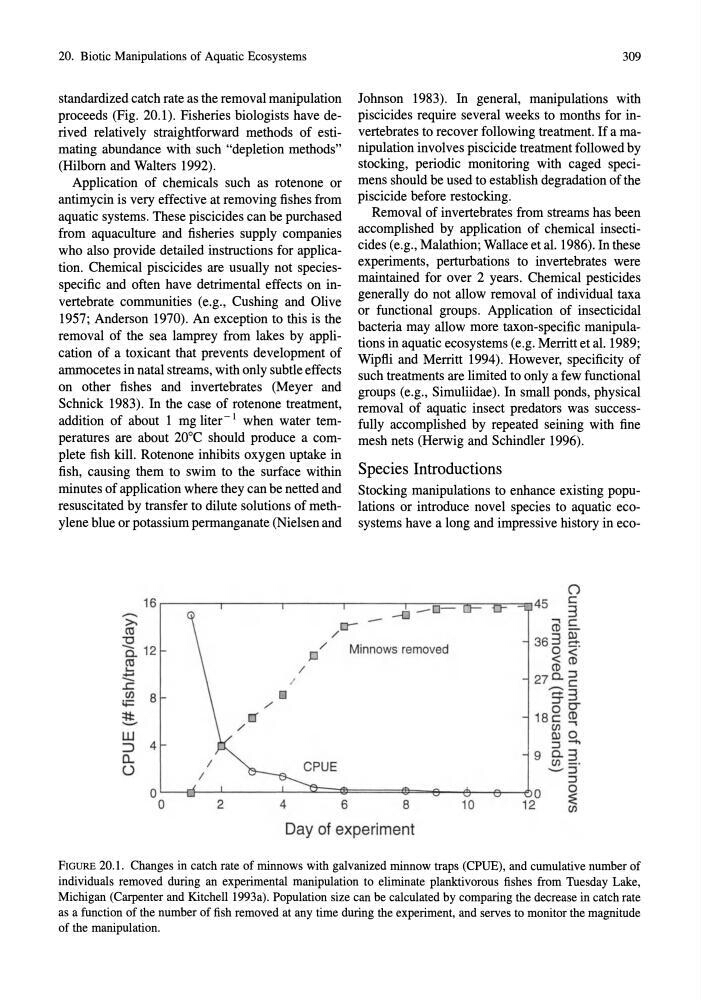
standardized catch rate as the removal manipulation
proceeds (Fig. 20.1). Fisheries biologists have derived relatively straightforward methods of estimating abundance with such "depletion methods"
(Hilborn and Walters 1992).
Application of chemicals such as rotenone or
antimycin is very effective at removing fishes from
aquatic systems. These piscicides can be purchased
from aquaculture and fisheries supply companies
who also provide detailed instructions for application. Chemical piscicides are usually not speciesspecific and often have detrimental effects on invertebrate communities (e.g., Cushing and Olive
1957; Anderson 1970). An exception to this is the
removal of the sea lamprey from lakes by application of a toxicant that prevents development of
ammocetes in natal streams, with only subtle effects
on other fishes and invertebrates (Meyer and
Schnick 1983). In the case of rotenone treatment,
addition of about 1 mg liter- 1 when water temperatures are about 20°C should produce a complete fish kill. Rotenone inhibits oxygen uptake in
fish, causing them to swim to the surface within
minutes of application where they can be netted and
resuscitated by transfer to dilute solutions of methylene blue or potassium permanganate (Nielsen and
309
Johnson 1983). In general, manipulations with
piscicides require several weeks to months for invertebrates to recover following treatment. If a manipulation involves piscicide treatment followed by
stocking, periodic monitoring with caged specimens should be used to establish degradation of the
piscicide before restocking.
Removal of invertebrates from streams has been
accomplished by application of chemical insecticides (e.g., Malathion; Wallace et al. 1986). In these
experiments, perturbations to invertebrates were
maintained for over 2 years. Chemical pesticides
generally do not allow removal of individual taxa
or functional groups. Application of insecticidal
bacteria may allow more taxon-specific manipulations in aquatic ecosystems (e.g. Merritt et al. 1989;
Wipfli and Merritt 1994). However, specificity of
such treatments are limited to only a few functional
groups (e.g., Simuliidae). In small ponds, physical
removal of aquatic insect predators was successfully accomplished by repeated seining with fine
mesh nets (Herwig and Schindler 1996).
Species Introductions
Stocking manipulations to enhance existing populations or introduce novel species to aquatic ecosystems have a long and impressive history in eco()
16 r------,-------.-------r------.---~=_rc~~~45
c
_
-f] _ 0 -
3
..........
>ro
'0
0.. 12
ro
....
......
-...
..c
(/)
8
1+=
:t:t:
-- ill
::l 4
D....
U
0
rr
/
/
o
/'
/
0/
.0/
Minnows removed
(Dc
363 ~
~
_c
..... 3
50"
18 C CD
(J) .....
OlD
:::J9 ~ 2_
~~--L-----L-~==~====~~--~~~~o
--:::J
:::J
D
::E
0
2
4
6
8
10
12
(J)
Day of experiment
FIGURE 20.1. Changes in catch rate of minnows with galvanized minnow traps (CPUE), and cumulative number of
individuals removed during an experimental manipulation to eliminate planktivorous fishes from Tuesday Lake,
Michigan (Carpenter and Kitche111993a). Population size can be calculated by comparing the decrease in catch rate
as a function of the number of fish removed at any time during the experiment, and serves to monitor the magnitude
of the manipulation.
standardized catch rate as the removal manipulation
proceeds (Fig. 20.1). Fisheries biologists have derived relatively straightforward methods of estimating abundance with such "depletion methods"
(Hilborn and Walters 1992).
Application of chemicals such as rotenone or
antimycin is very effective at removing fishes from
aquatic systems. These piscicides can be purchased
from aquaculture and fisheries supply companies
who also provide detailed instructions for application. Chemical piscicides are usually not speciesspecific and often have detrimental effects on invertebrate communities (e.g., Cushing and Olive
1957; Anderson 1970). An exception to this is the
removal of the sea lamprey from lakes by application of a toxicant that prevents development of
ammocetes in natal streams, with only subtle effects
on other fishes and invertebrates (Meyer and
Schnick 1983). In the case of rotenone treatment,
addition of about 1 mg liter- 1 when water temperatures are about 20°C should produce a complete fish kill. Rotenone inhibits oxygen uptake in
fish, causing them to swim to the surface within
minutes of application where they can be netted and
resuscitated by transfer to dilute solutions of methylene blue or potassium permanganate (Nielsen and
309
Johnson 1983). In general, manipulations with
piscicides require several weeks to months for invertebrates to recover following treatment. If a manipulation involves piscicide treatment followed by
stocking, periodic monitoring with caged specimens should be used to establish degradation of the
piscicide before restocking.
Removal of invertebrates from streams has been
accomplished by application of chemical insecticides (e.g., Malathion; Wallace et al. 1986). In these
experiments, perturbations to invertebrates were
maintained for over 2 years. Chemical pesticides
generally do not allow removal of individual taxa
or functional groups. Application of insecticidal
bacteria may allow more taxon-specific manipulations in aquatic ecosystems (e.g. Merritt et al. 1989;
Wipfli and Merritt 1994). However, specificity of
such treatments are limited to only a few functional
groups (e.g., Simuliidae). In small ponds, physical
removal of aquatic insect predators was successfully accomplished by repeated seining with fine
mesh nets (Herwig and Schindler 1996).
Species Introductions
Stocking manipulations to enhance existing populations or introduce novel species to aquatic ecosystems have a long and impressive history in eco()
16 r------,-------.-------r------.---~=_rc~~~45
c
_
-f] _ 0 -
3
..........
>ro
'0
0.. 12
ro
....
......
-...
..c
(/)
8
1+=
:t:t:
-- ill
::l 4
D....
U
0
rr
/
/
o
/'
/
0/
.0/
Minnows removed
(Dc
363 ~
~
_c
..... 3
50"
18 C CD
(J) .....
OlD
:::J9 ~ 2_
~~--L-----L-~==~====~~--~~~~o
--:::J
:::J
D
::E
0
2
4
6
8
10
12
(J)
Day of experiment
FIGURE 20.1. Changes in catch rate of minnows with galvanized minnow traps (CPUE), and cumulative number of
individuals removed during an experimental manipulation to eliminate planktivorous fishes from Tuesday Lake,
Michigan (Carpenter and Kitche111993a). Population size can be calculated by comparing the decrease in catch rate
as a function of the number of fish removed at any time during the experiment, and serves to monitor the magnitude
of the manipulation.