

19. Nutrient Manipulations in Terrestrial Ecosystems
have large effects on partitioning, adsorption, volatilization, and leaching. Thus, a constant rate of
fertilizer application may not add a consistent
amount of nutrients to the plant-available pool, and
site differences in response to fertilization may be
due to the different availability of added nutrients,
rather than due to differences in nutrient limitation.
The way that nutrients are added can influence
plant uptake (Malhi et al. 1989), and the distribution of biomass and nutrients (lmo and Timmer
1992), which can have large impacts on the interpretation of results. The following sections present
some general guidelines for designing a nutrient addition experiment, but for a complete review, Tisdale et al. (1993) is an invaluable reference.
Time Scale of Response
The interpretation of nutrient-addition experiments
requires a clear understanding of the sequential response of different ecosystem processes to nutrient
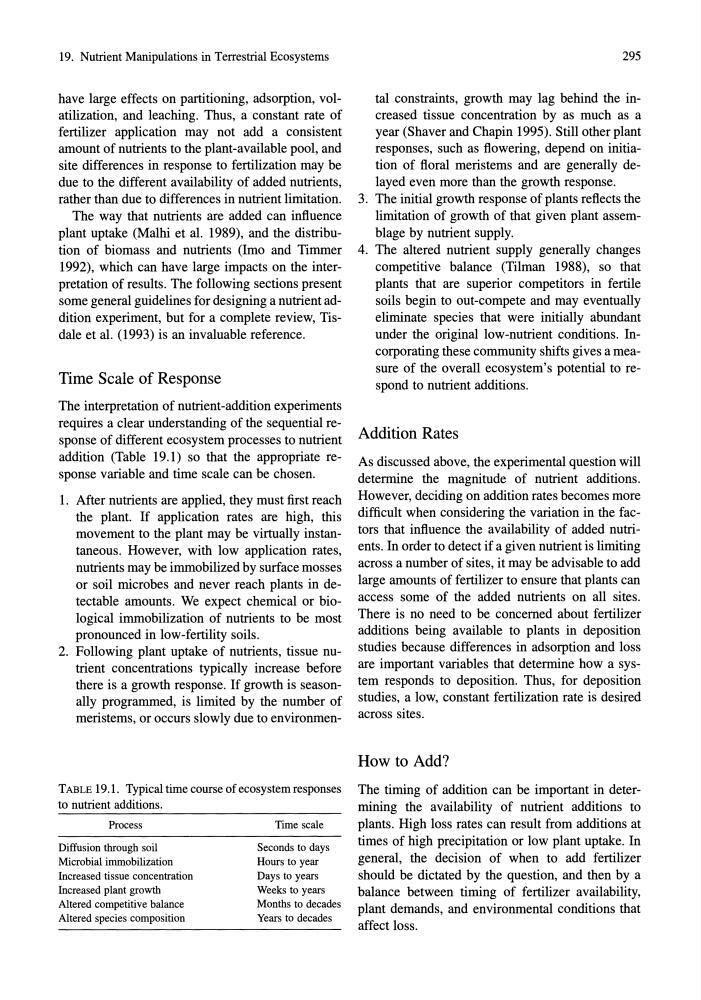
addition (Table 19.1) so that the appropriate response variable and time scale can be chosen.
1. After nutrients are applied, they must first reach
the plant. If application rates are high, this
movement to the plant may be virtually instantaneous. However, with low application rates,
nutrients may be immobilized by surface mosses
or soil microbes and never reach plants in detectable amounts. We expect chemical or biological immobilization of nutrients to be most
pronounced in low-fertility soils.
2. Following plant uptake of nutrients, tissue nutrient concentrations typically increase before
there is a growth response. If growth is seasonally programmed, is limited by the number of
meristems, or occurs slowly due to environmenTABLE 19.1. Typical time course of ecosystem responses
to nutrient additions.
Process
Diffusion through soil
Microbial immobilization
Increased tissue concentration
Increased plant growtb
Altered competitive balance
Altered species composition
Time scale
Seconds to days
Hours to year
Days to years
Weeks to years
Montbs to decades
Years to decades
295
tal constraints, growth may lag behind the increased tissue concentration by as much as a
year (Shaver and Chapin 1995). Still other plant
responses, such as flowering, depend on initiation of floral meristems and are generally delayed even more than the growth response.
3. The initial growth response of plants reflects the
limitation of growth of that given plant assemblage by nutrient supply.
4. The altered nutrient supply generally changes
competitive balance (Tilman 1988), so that
plants that are superior competitors in fertile
soils begin to out-compete and may eventually
eliminate species that were initially abundant
under the original low-nutrient conditions. Incorporating these community shifts gives a measure of the overall ecosystem's potential to respond to nutrient additions.
Addition Rates
As discussed above, the experimental question will
determine the magnitude of nutrient additions.
However, deciding on addition rates becomes more
difficult when considering the variation in the factors that influence the availability of added nutrients. In order to detect if a given nutrient is limiting
across a number of sites, it may be advisable to add
large amounts of fertilizer to ensure that plants can
access some of the added nutrients on all sites.
There is no need to be concerned about fertilizer
additions being available to plants in deposition
studies because differences in adsorption and loss
are important variables that determine how a system responds to deposition. Thus, for deposition
studies, a low, constant fertilization rate is desired
across sites.
How to Add?
The timing of addition can be important in determining the availability of nutrient additions to
plants. High loss rates can result from additions at
times of high precipitation or low plant uptake. In
general, the decision of when to add fertilizer
should be dictated by the question, and then by a
balance between timing of fertilizer availability,
plant demands, and environmental conditions that
affect loss.
have large effects on partitioning, adsorption, volatilization, and leaching. Thus, a constant rate of
fertilizer application may not add a consistent
amount of nutrients to the plant-available pool, and
site differences in response to fertilization may be
due to the different availability of added nutrients,
rather than due to differences in nutrient limitation.
The way that nutrients are added can influence
plant uptake (Malhi et al. 1989), and the distribution of biomass and nutrients (lmo and Timmer
1992), which can have large impacts on the interpretation of results. The following sections present
some general guidelines for designing a nutrient addition experiment, but for a complete review, Tisdale et al. (1993) is an invaluable reference.
Time Scale of Response
The interpretation of nutrient-addition experiments
requires a clear understanding of the sequential response of different ecosystem processes to nutrient
addition (Table 19.1) so that the appropriate response variable and time scale can be chosen.
1. After nutrients are applied, they must first reach
the plant. If application rates are high, this
movement to the plant may be virtually instantaneous. However, with low application rates,
nutrients may be immobilized by surface mosses
or soil microbes and never reach plants in detectable amounts. We expect chemical or biological immobilization of nutrients to be most
pronounced in low-fertility soils.
2. Following plant uptake of nutrients, tissue nutrient concentrations typically increase before
there is a growth response. If growth is seasonally programmed, is limited by the number of
meristems, or occurs slowly due to environmenTABLE 19.1. Typical time course of ecosystem responses
to nutrient additions.
Process
Diffusion through soil
Microbial immobilization
Increased tissue concentration
Increased plant growtb
Altered competitive balance
Altered species composition
Time scale
Seconds to days
Hours to year
Days to years
Weeks to years
Montbs to decades
Years to decades
295
tal constraints, growth may lag behind the increased tissue concentration by as much as a
year (Shaver and Chapin 1995). Still other plant
responses, such as flowering, depend on initiation of floral meristems and are generally delayed even more than the growth response.
3. The initial growth response of plants reflects the
limitation of growth of that given plant assemblage by nutrient supply.
4. The altered nutrient supply generally changes
competitive balance (Tilman 1988), so that
plants that are superior competitors in fertile
soils begin to out-compete and may eventually
eliminate species that were initially abundant
under the original low-nutrient conditions. Incorporating these community shifts gives a measure of the overall ecosystem's potential to respond to nutrient additions.
Addition Rates
As discussed above, the experimental question will
determine the magnitude of nutrient additions.
However, deciding on addition rates becomes more
difficult when considering the variation in the factors that influence the availability of added nutrients. In order to detect if a given nutrient is limiting
across a number of sites, it may be advisable to add
large amounts of fertilizer to ensure that plants can
access some of the added nutrients on all sites.
There is no need to be concerned about fertilizer
additions being available to plants in deposition
studies because differences in adsorption and loss
are important variables that determine how a system responds to deposition. Thus, for deposition
studies, a low, constant fertilization rate is desired
across sites.
How to Add?
The timing of addition can be important in determining the availability of nutrient additions to
plants. High loss rates can result from additions at
times of high precipitation or low plant uptake. In
general, the decision of when to add fertilizer
should be dictated by the question, and then by a
balance between timing of fertilizer availability,
plant demands, and environmental conditions that
affect loss.