

16. Ecosystem Nutrient Balance and Dynamics
erwise leach from the system, and can no longer be
affected by vegetation. In fact, significant denitrification, adsorption, and immobilization can take
place in deep mineral soil (Qualls and Haines
1992). Several studies have examined both streamwater chemistry at the watershed scale and withinsite soil solution chemistry with lysimeters (e.g.,
Sollins and McCorison 1981; Johnson et a1. 1995;
Fenn et a1. 1996; Adams et a1. 1997) although direct
comparisons are rare. At one site in the Hubbard
40
A
30
20
10
0
600
B
450
300
150
255
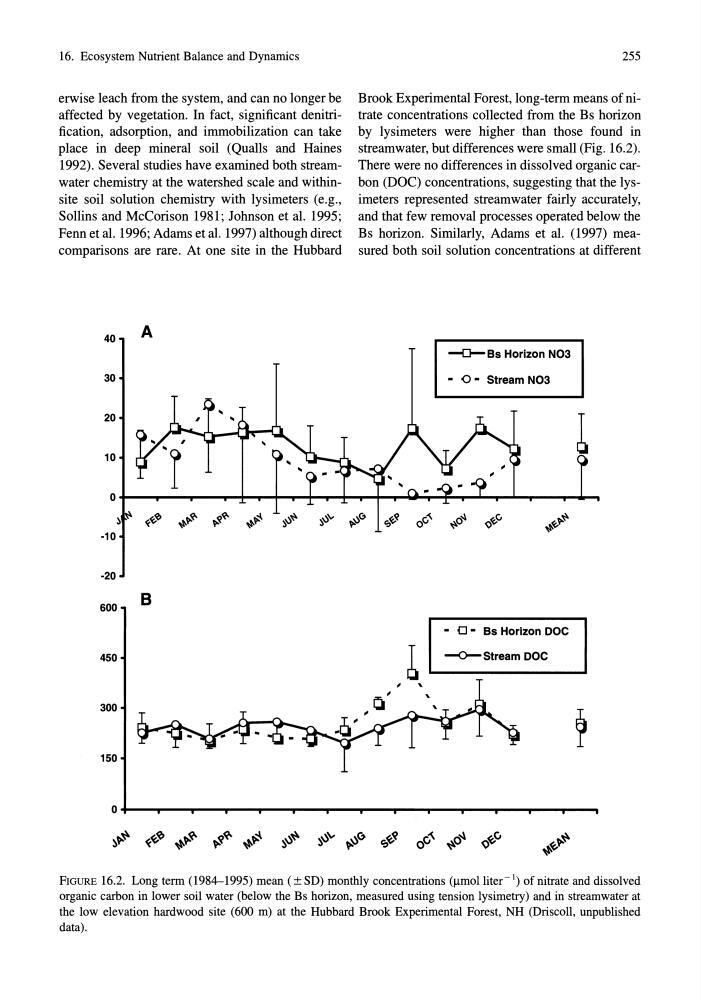
Brook Experimental Forest, long-term means of nitrate concentrations collected from the Bs horizon
by lysimeters were higher than those found in
streamwater, but differences were small (Fig. 16.2).
There were no differences in dissolved organic carbon (DOC) concentrations, suggesting that the lysimeters represented streamwater fairly accurately,
and that few removal processes operated below the
Bs horizon. Similarly, Adams et a1. (1997) measured both soil solution concentrations at different
~ Bs Horizon N03
- 0 - Stream N03
l
~o.
~
c"t,~
CJ-<'
0
~o~
~t,CJ
ft;,t-~
~
- 0 - Bs Horizon DOC
~
-o-Stream DOC
" "
O+---~--~---r--~--~--~~--~--~--~--~--~---r--~--~
FIGURE 16.2. Long term (1984-1995) mean (± SD) monthly concentrations (Jlmolliter- 1 ) of nitrate and dissolved
organic carbon in lower soil water (below the Bs horizon, measured using tension lysimetry) and in streamwater at
the low elevation hardwood site (600 m) at the Hubbard Brook Experimental Forest, NH (Driscoll, unpublished
data).
erwise leach from the system, and can no longer be
affected by vegetation. In fact, significant denitrification, adsorption, and immobilization can take
place in deep mineral soil (Qualls and Haines
1992). Several studies have examined both streamwater chemistry at the watershed scale and withinsite soil solution chemistry with lysimeters (e.g.,
Sollins and McCorison 1981; Johnson et a1. 1995;
Fenn et a1. 1996; Adams et a1. 1997) although direct
comparisons are rare. At one site in the Hubbard
40
A
30
20
10
0
600
B
450
300
150
255
Brook Experimental Forest, long-term means of nitrate concentrations collected from the Bs horizon
by lysimeters were higher than those found in
streamwater, but differences were small (Fig. 16.2).
There were no differences in dissolved organic carbon (DOC) concentrations, suggesting that the lysimeters represented streamwater fairly accurately,
and that few removal processes operated below the
Bs horizon. Similarly, Adams et a1. (1997) measured both soil solution concentrations at different
~ Bs Horizon N03
- 0 - Stream N03
l
~o.
~
c"t,~
CJ-<'
0
~o~
~t,CJ
ft;,t-~
~
- 0 - Bs Horizon DOC
~
-o-Stream DOC
" "
O+---~--~---r--~--~--~~--~--~--~--~--~---r--~--~
FIGURE 16.2. Long term (1984-1995) mean (± SD) monthly concentrations (Jlmolliter- 1 ) of nitrate and dissolved
organic carbon in lower soil water (below the Bs horizon, measured using tension lysimetry) and in streamwater at
the low elevation hardwood site (600 m) at the Hubbard Brook Experimental Forest, NH (Driscoll, unpublished
data).