

250
ecosystem nutrient budgets, including budgets at
the whole-watershed scale, at the smaller plot or
landscape scale, and in systems without readily
measurable hydrologic outflows, as well as uses of
nitrogen-15 eSN) tracer techniques to follow N in
ecosystems. I will focus primarily on forested ecosystems, as there is relatively little data in other
vegetation types at the watershed level (but see
Dodds et al. (1996) for an analysis of tall grass
prairie watersheds).
Input-Output Ecosystem Budgets
at the Watershed Scale
The most basic input-output budget for a forested
catchment can be constructed by comparing measured atmospheric inputs to fluvial outputs for a
watershed that meets the requirement of having
relatively impermeable bedrock. Geochemists have
used input-output budgets for decades to estimate
weathering rates and mechanisms, generally assuming that biota have little effect on the cations
measured in streamflow (e.g., Miller and Drever
1977; Johnson et al. 1968). However, ecosystem
ecologists are generally more interested in those nutrient ions that have substantial interactions with
both vegetation and the microbial community, makPre ci pitation
Kate Lajtha
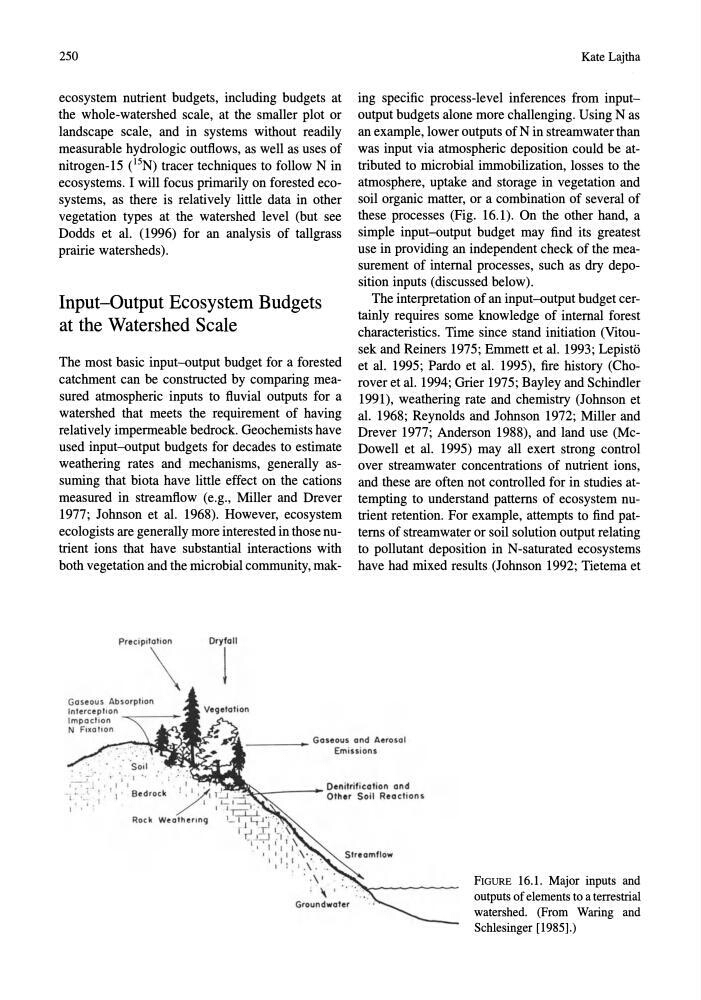
ing specific process-level inferences from inputoutput budgets alone more challenging. Using N as
an example, lower outputs of N in streamwater than
was input via atmospheric deposition could be attributed to microbial immobilization, losses to the
atmosphere, uptake and storage in vegetation and
soil organic matter, or a combination of several of
these processes (Fig. 16.1). On the other hand, a
simple input-output budget may find its greatest
use in providing an independent check of the measurement of internal processes, such as dry deposition inputs (discussed below).
The interpretation of an input-output budget certainly requires some knowledge of internal forest
characteristics. Time since stand initiation (Vitousek and Reiners 1975; Emmett et al. 1993; LepistO
et al. 1995; Pardo et al. 1995), fire history (Chorover et al. 1994; Grier 1975; Bayley and Schindler
1991), weathering rate and chemistry (Johnson et
al. 1968; Reynolds and Johnson 1972; Miller and
Drever 1977; Anderson 1988), and land use (McDowell et al. 1995) may all exert strong control
over streamwater concentrations of nutrient ions,
and these are often not controlled for in studies attempting to understand patterns of ecosystem nutrient retention. For example, attempts to find patterns of streamwater or soil solution output relating
to pollutant deposition in N-saturated ecosystems
have had mixed results (Johnson 1992; Tietema et
_ _ __
Gaseous and Aerosol
'tj~~~~1
Emis'S ions
! -:-'""?!~ _ _ _ ... Denitrificotion ond
Other Soil Reactions
Groundwoter
FIGURE 16.1. Major inputs and
outputs of elements to a terrestrial
watershed. (From Waring and
Schlesinger [1985].)
ecosystem nutrient budgets, including budgets at
the whole-watershed scale, at the smaller plot or
landscape scale, and in systems without readily
measurable hydrologic outflows, as well as uses of
nitrogen-15 eSN) tracer techniques to follow N in
ecosystems. I will focus primarily on forested ecosystems, as there is relatively little data in other
vegetation types at the watershed level (but see
Dodds et al. (1996) for an analysis of tall grass
prairie watersheds).
Input-Output Ecosystem Budgets
at the Watershed Scale
The most basic input-output budget for a forested
catchment can be constructed by comparing measured atmospheric inputs to fluvial outputs for a
watershed that meets the requirement of having
relatively impermeable bedrock. Geochemists have
used input-output budgets for decades to estimate
weathering rates and mechanisms, generally assuming that biota have little effect on the cations
measured in streamflow (e.g., Miller and Drever
1977; Johnson et al. 1968). However, ecosystem
ecologists are generally more interested in those nutrient ions that have substantial interactions with
both vegetation and the microbial community, makPre ci pitation
Kate Lajtha
ing specific process-level inferences from inputoutput budgets alone more challenging. Using N as
an example, lower outputs of N in streamwater than
was input via atmospheric deposition could be attributed to microbial immobilization, losses to the
atmosphere, uptake and storage in vegetation and
soil organic matter, or a combination of several of
these processes (Fig. 16.1). On the other hand, a
simple input-output budget may find its greatest
use in providing an independent check of the measurement of internal processes, such as dry deposition inputs (discussed below).
The interpretation of an input-output budget certainly requires some knowledge of internal forest
characteristics. Time since stand initiation (Vitousek and Reiners 1975; Emmett et al. 1993; LepistO
et al. 1995; Pardo et al. 1995), fire history (Chorover et al. 1994; Grier 1975; Bayley and Schindler
1991), weathering rate and chemistry (Johnson et
al. 1968; Reynolds and Johnson 1972; Miller and
Drever 1977; Anderson 1988), and land use (McDowell et al. 1995) may all exert strong control
over streamwater concentrations of nutrient ions,
and these are often not controlled for in studies attempting to understand patterns of ecosystem nutrient retention. For example, attempts to find patterns of streamwater or soil solution output relating
to pollutant deposition in N-saturated ecosystems
have had mixed results (Johnson 1992; Tietema et
_ _ __
Gaseous and Aerosol
'tj~~~~1
Emis'S ions
! -:-'""?!~ _ _ _ ... Denitrificotion ond
Other Soil Reactions
Groundwoter
FIGURE 16.1. Major inputs and
outputs of elements to a terrestrial
watershed. (From Waring and
Schlesinger [1985].)