

15. Biogenic Trace Gas Exchanges
methods are only useful for batch type collections
typical of the non-flow-though type enclosure sampling; others have the continuous or fast-responsetime capabilities and low detection limits required
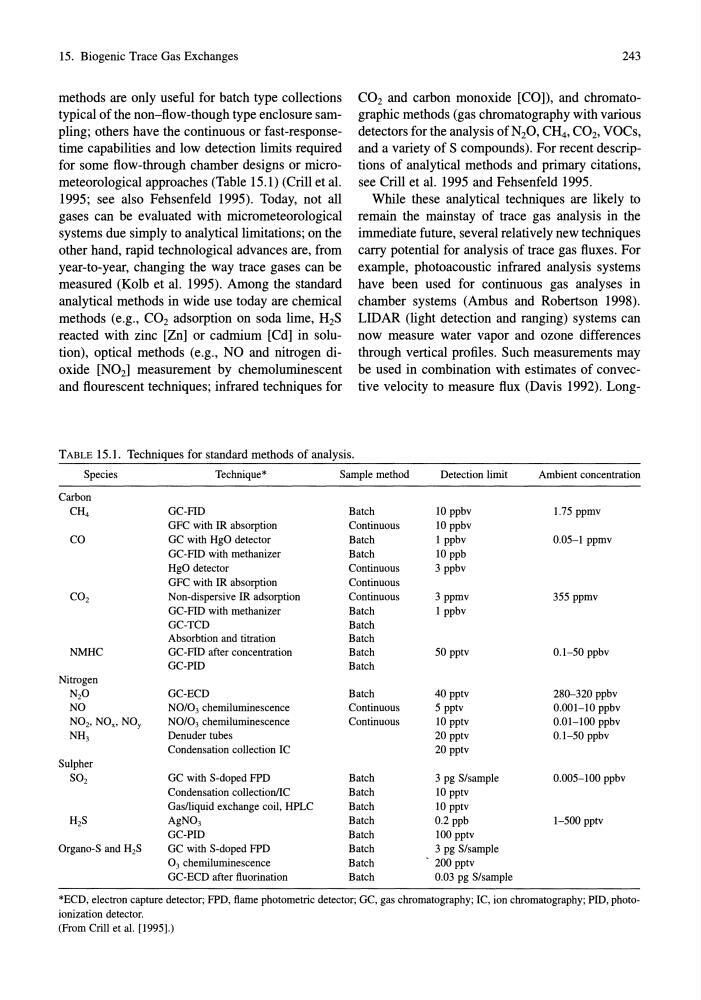
for some flow-through chamber designs or micrometeorological approaches (Table 15.1) (Crill et al.
1995; see also Fehsenfeld 1995). Today, not all
gases can be evaluated with micrometeorological
systems due simply to analytical limitations; on the
other hand, rapid technological advances are, from
year-to-year, changing the way trace gases can be
measured (Kolb et al. 1995). Among the standard
analytical methods in wide use today are chemical
methods (e.g., CO 2 adsorption on soda lime, H 2 S
reacted with zinc [Zn] or cadmium [Cd] in solution), optical methods (e.g., NO and nitrogen dioxide [N0 2 ] measurement by chemoluminescent
and flourescent techniques; infrared techniques for
243
CO2 and carbon monoxide [CO]), and chromatographic methods (gas chromatography with various
detectors for the analysis ofN 2 0, CH 4 , CO 2 , VOCs,
and a variety of S compounds). For recent descriptions of analytical methods and primary citations,
see Crill et al. 1995 and Fehsenfeld 1995.
While these analytical techniques are likely to
remain the mainstay of trace gas analysis in the
immediate future, several relatively new techniques
carry potential for analysis of trace gas fluxes. For
example, photoacoustic infrared analysis systems
have been used for continuous gas analyses in
chamber systems (Ambus and Robertson 1998).
LIDAR (light detection and ranging) systems can
now measure water vapor and ozone differences
through vertical profiles. Such measurements may
be used in combination with estimates of convective velocity to measure flux (Davis 1992). LongTABLE 15.1. Techniques for standard methods of analysis.
Species
Technique*
Carbon
CH4
GC-FID
GFC with IR absorption
CO
GC with HgO detector
GC-FlD with methanizer
HgO detector
GFC with IR absorption
CO2
Non-dispersive IR adsorption
GC-FlD with methanizer
GC-TCD
Absorbtion and titration
NMHC
GC-FID after concentration
GC-PID
Nitrogen
N20
GC-ECD
NO
NOI03 chemiluminescence
N02, NO" NOy
NOI03 chemiluminescence
NH3
Denuder tubes
Condensation collection IC
Sulpher
S02
GC with S-doped FPD
Condensation collectionlIC
Gaslliquid exchange coil, HPLC
H2S
AgN03
GC-PID
Organo-S and H2S
GC with S-doped FPD
0 3 chemiluminescence
GC-ECD after fluorination
Sample method
Detection limit
Batch
10 ppbv
Continuous
10 ppbv
Batch
I ppbv
Batch
10 ppb
Continuous
3 ppbv
Continuous
Continuous
3 ppmv
Batch
1 ppbv
Batch
Batch
Batch
50 pptv
Batch
Batch
40 pptv
Continuous
5 pptv
Continuous
10 pptv
20 pptv
20 pptv
Batch
3 pg S/sample
Batch
10 pptv
Batch
10 pptv
Batch
0.2 ppb
Batch
100 pptv
Batch
3 pg S/sample
Batch
. 200 pptv
Batch
0.03 pg S/sample
Ambient concentration
1.75 ppmv
0.05-1 ppmv
355 ppmv
0.1-50 ppbv
280-320 ppbv
0.001-10 ppbv
0.01-100 ppbv
0.1-50 ppbv
0.005-100 ppbv
1-500 pptv
*ECD, electron capture detector; FPD, flame photometric detector; GC, gas chromatography; IC, ion chromatography; PID, photoionization detector.
(From Crill et aI. [1995].)
methods are only useful for batch type collections
typical of the non-flow-though type enclosure sampling; others have the continuous or fast-responsetime capabilities and low detection limits required
for some flow-through chamber designs or micrometeorological approaches (Table 15.1) (Crill et al.
1995; see also Fehsenfeld 1995). Today, not all
gases can be evaluated with micrometeorological
systems due simply to analytical limitations; on the
other hand, rapid technological advances are, from
year-to-year, changing the way trace gases can be
measured (Kolb et al. 1995). Among the standard
analytical methods in wide use today are chemical
methods (e.g., CO 2 adsorption on soda lime, H 2 S
reacted with zinc [Zn] or cadmium [Cd] in solution), optical methods (e.g., NO and nitrogen dioxide [N0 2 ] measurement by chemoluminescent
and flourescent techniques; infrared techniques for
243
CO2 and carbon monoxide [CO]), and chromatographic methods (gas chromatography with various
detectors for the analysis ofN 2 0, CH 4 , CO 2 , VOCs,
and a variety of S compounds). For recent descriptions of analytical methods and primary citations,
see Crill et al. 1995 and Fehsenfeld 1995.
While these analytical techniques are likely to
remain the mainstay of trace gas analysis in the
immediate future, several relatively new techniques
carry potential for analysis of trace gas fluxes. For
example, photoacoustic infrared analysis systems
have been used for continuous gas analyses in
chamber systems (Ambus and Robertson 1998).
LIDAR (light detection and ranging) systems can
now measure water vapor and ozone differences
through vertical profiles. Such measurements may
be used in combination with estimates of convective velocity to measure flux (Davis 1992). LongTABLE 15.1. Techniques for standard methods of analysis.
Species
Technique*
Carbon
CH4
GC-FID
GFC with IR absorption
CO
GC with HgO detector
GC-FlD with methanizer
HgO detector
GFC with IR absorption
CO2
Non-dispersive IR adsorption
GC-FlD with methanizer
GC-TCD
Absorbtion and titration
NMHC
GC-FID after concentration
GC-PID
Nitrogen
N20
GC-ECD
NO
NOI03 chemiluminescence
N02, NO" NOy
NOI03 chemiluminescence
NH3
Denuder tubes
Condensation collection IC
Sulpher
S02
GC with S-doped FPD
Condensation collectionlIC
Gaslliquid exchange coil, HPLC
H2S
AgN03
GC-PID
Organo-S and H2S
GC with S-doped FPD
0 3 chemiluminescence
GC-ECD after fluorination
Sample method
Detection limit
Batch
10 ppbv
Continuous
10 ppbv
Batch
I ppbv
Batch
10 ppb
Continuous
3 ppbv
Continuous
Continuous
3 ppmv
Batch
1 ppbv
Batch
Batch
Batch
50 pptv
Batch
Batch
40 pptv
Continuous
5 pptv
Continuous
10 pptv
20 pptv
20 pptv
Batch
3 pg S/sample
Batch
10 pptv
Batch
10 pptv
Batch
0.2 ppb
Batch
100 pptv
Batch
3 pg S/sample
Batch
. 200 pptv
Batch
0.03 pg S/sample
Ambient concentration
1.75 ppmv
0.05-1 ppmv
355 ppmv
0.1-50 ppbv
280-320 ppbv
0.001-10 ppbv
0.01-100 ppbv
0.1-50 ppbv
0.005-100 ppbv
1-500 pptv
*ECD, electron capture detector; FPD, flame photometric detector; GC, gas chromatography; IC, ion chromatography; PID, photoionization detector.
(From Crill et aI. [1995].)