

240
empirically related variables, including wind speed
and wind shear (e.g., Liu and Schwab 1987; Wanninkhof 1992), or turbulence parameters obtained
from meteorological and irradiance measurements
(e.g., Imberger 1985), along with measured saturation anomalies between surface water and the air
above. This approach is appealing because of the
relative ease of measuring wind speeds (the variable most commonly used in the empirical models),
and because it, unlike the enclosure methods, can
be used in any weather. Chemical input-output
budgets have also been used to calculate gas transfer (reaeration) coefficients in rivers, in cases in
which point sources of inputs with excess gases
serve as inputs and careful measurements of concentration changes and flow downstream are possible (e.g., Clark et al. 1992).
As noted earlier, gas flux in freshwater and
coastal marine ecosystems also occurs by ebullition, the one-way transport of gases from organicrich reducing sediments to the atmosphere. Bubbles
are formed in some sediments because the production of CH4 raises the partial pressures of the dissolved gases above the hydrostatic pressure in the
sediment (Chanton and Dacey 1991). Once formed,
the bubbles can be released from the sediments,
often due to some kind of perturbation, and can
rise quickly through the water column to the atmosphere, bypassing the potentially oxidizing
sediment-water interface, water column, or plant
root system. As CH4-rich bubbles are formed and
released from sediments, they strip the sediments
of other dissolved gases. Numerous studies, especially of CH4 emissions in freshwater and coastal
marine environments, have indicated that ebullition
is a dominant pathway of flux in many ecosystems
(e.g., Crill et al. 1988; Chanton and Martens 1988;
Martens et al. 1992).
Ebullition has been measured using air-filled
floating chambers and with submerged water-filled
bubble traps; sampling has most often focused on
emission of CH 4 . The floating chamber collects gas
diffusing through the water column in addition to
bubbles; the two different transport mechanisms
can be distinguished via measurement of abrupt
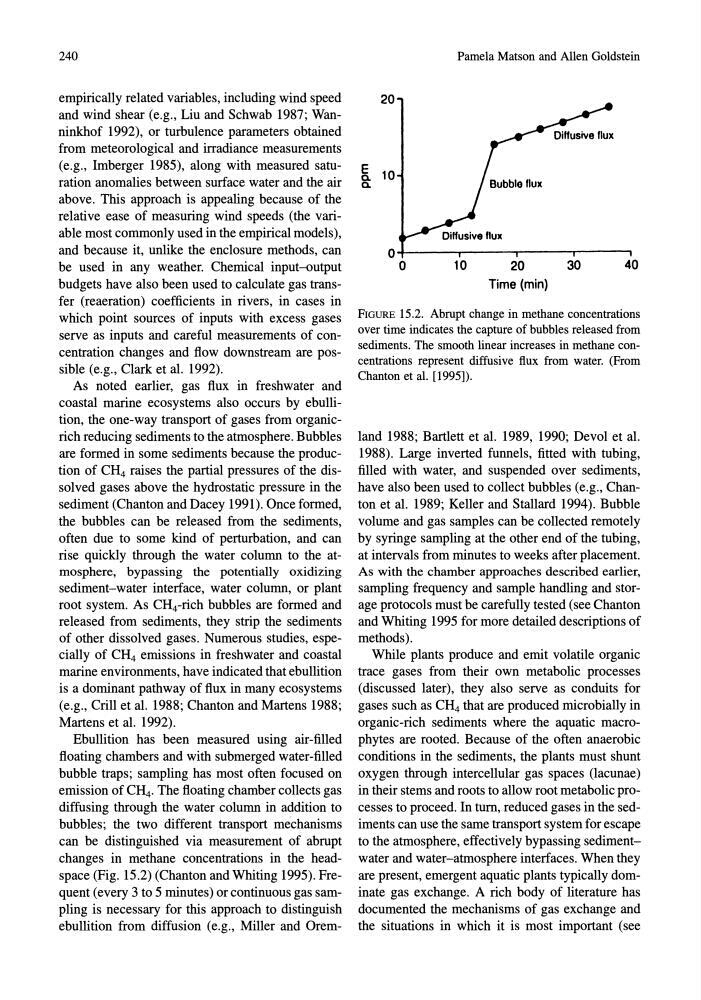
changes in methane concentrations in the headspace (Fig. 15.2) (Chanton and Whiting 1995). Frequent (every 3 to 5 minutes) or continuous gas sampling is necessary for this approach to distinguish
ebullition from diffusion (e.g., Miller and OremPamela Matson and Allen Goldstein
20
E
~ 10
O+-----~-----,------r-----,
o
10
20
Time (min)
30
40
FIGURE 15.2. Abrupt change in methane concentrations
over time indicates the capture of bubbles released from
sediments. The smooth linear increases in methane concentrations represent diffusive flux from water. (From
Chanton et al. [1995]).
land 1988; Bartlett et al. 1989, 1990; Devol et al.
1988). Large inverted funnels, fitted with tubing,
filled with water, and suspended over sediments,
have also been used to collect bubbles (e.g., Chanton et al. 1989; Keller and Stallard 1994). Bubble
volume and gas samples can be collected remotely
by syringe sampling at the other end of the tubing,
at intervals from minutes to weeks after placement.
As with the chamber approaches described earlier,
sampling frequency and sample handling and storage protocols must be carefully tested (see Chanton
and Whiting 1995 for more detailed descriptions of
methods).
While plants produce and emit volatile organic
trace gases from their own metabolic processes
(discussed later), they also serve as conduits for
gases such as CH 4 that are produced microbially in
organic-rich sediments where the aquatic macrophytes are rooted. Because of the often anaerobic
conditions in the sediments, the plants must shunt
oxygen through intercellular gas spaces (lacunae)
in their stems and roots to allow root metabolic processes to proceed. In tum, reduced gases in the sediments can use the same transport system for escape
to the atmosphere, effectively bypassing sedimentwater and water-atmosphere interfaces. When they
are present, emergent aquatic plants typically dominate gas exchange. A rich body of literature has
documented the mechanisms of gas exchange and
the situations in which it is most important (see
empirically related variables, including wind speed
and wind shear (e.g., Liu and Schwab 1987; Wanninkhof 1992), or turbulence parameters obtained
from meteorological and irradiance measurements
(e.g., Imberger 1985), along with measured saturation anomalies between surface water and the air
above. This approach is appealing because of the
relative ease of measuring wind speeds (the variable most commonly used in the empirical models),
and because it, unlike the enclosure methods, can
be used in any weather. Chemical input-output
budgets have also been used to calculate gas transfer (reaeration) coefficients in rivers, in cases in
which point sources of inputs with excess gases
serve as inputs and careful measurements of concentration changes and flow downstream are possible (e.g., Clark et al. 1992).
As noted earlier, gas flux in freshwater and
coastal marine ecosystems also occurs by ebullition, the one-way transport of gases from organicrich reducing sediments to the atmosphere. Bubbles
are formed in some sediments because the production of CH4 raises the partial pressures of the dissolved gases above the hydrostatic pressure in the
sediment (Chanton and Dacey 1991). Once formed,
the bubbles can be released from the sediments,
often due to some kind of perturbation, and can
rise quickly through the water column to the atmosphere, bypassing the potentially oxidizing
sediment-water interface, water column, or plant
root system. As CH4-rich bubbles are formed and
released from sediments, they strip the sediments
of other dissolved gases. Numerous studies, especially of CH4 emissions in freshwater and coastal
marine environments, have indicated that ebullition
is a dominant pathway of flux in many ecosystems
(e.g., Crill et al. 1988; Chanton and Martens 1988;
Martens et al. 1992).
Ebullition has been measured using air-filled
floating chambers and with submerged water-filled
bubble traps; sampling has most often focused on
emission of CH 4 . The floating chamber collects gas
diffusing through the water column in addition to
bubbles; the two different transport mechanisms
can be distinguished via measurement of abrupt
changes in methane concentrations in the headspace (Fig. 15.2) (Chanton and Whiting 1995). Frequent (every 3 to 5 minutes) or continuous gas sampling is necessary for this approach to distinguish
ebullition from diffusion (e.g., Miller and OremPamela Matson and Allen Goldstein
20
E
~ 10
O+-----~-----,------r-----,
o
10
20
Time (min)
30
40
FIGURE 15.2. Abrupt change in methane concentrations
over time indicates the capture of bubbles released from
sediments. The smooth linear increases in methane concentrations represent diffusive flux from water. (From
Chanton et al. [1995]).
land 1988; Bartlett et al. 1989, 1990; Devol et al.
1988). Large inverted funnels, fitted with tubing,
filled with water, and suspended over sediments,
have also been used to collect bubbles (e.g., Chanton et al. 1989; Keller and Stallard 1994). Bubble
volume and gas samples can be collected remotely
by syringe sampling at the other end of the tubing,
at intervals from minutes to weeks after placement.
As with the chamber approaches described earlier,
sampling frequency and sample handling and storage protocols must be carefully tested (see Chanton
and Whiting 1995 for more detailed descriptions of
methods).
While plants produce and emit volatile organic
trace gases from their own metabolic processes
(discussed later), they also serve as conduits for
gases such as CH 4 that are produced microbially in
organic-rich sediments where the aquatic macrophytes are rooted. Because of the often anaerobic
conditions in the sediments, the plants must shunt
oxygen through intercellular gas spaces (lacunae)
in their stems and roots to allow root metabolic processes to proceed. In tum, reduced gases in the sediments can use the same transport system for escape
to the atmosphere, effectively bypassing sedimentwater and water-atmosphere interfaces. When they
are present, emergent aquatic plants typically dominate gas exchange. A rich body of literature has
documented the mechanisms of gas exchange and
the situations in which it is most important (see