

202
Robert B. Jackson, Laurel J. Anderson, and William T. Pockman
-2.0
-1.8
~
-1.6
~ -1.4
'5j
a
-1.2
iQ -1.0
~
..
8. -0.8
.g -06
OJ
•
:;; -0.4
-0.2
40
....
!!! .. 30
~
'0 . .
E
'"
l:! 20
'" a.
'"
E j
'0
> 10
0
o
\
\
1
Permanent wilting
\
percentage
\ Chino silty clay loam
:\
?
\
Panache
capacity
I e~ Field "
loam
I \
-10
20
30
40
50
Soil moisture content as % of dry weight
Unavailable water
Sand
Sandy
Loam
Silt
Clay
loam
loam
loam
in very wet and very dry soils. Its major limitation
is the requirement for destructive sampling. Other
complications arise for stony soils, where em and
e v can be underestimated by including the mass and
trivial water-holding capacity of stones. Stones
>2 mm in diameter should be sieved from all samples and removed from calculations of em and ev
(Gardner 1986; Rowell 1994), though the volume
of stones must be taken into account when ecosystem estimates of total water content are calculated.
Sampling an accurate soil volume for ev can also
be difficult in stony soils. Rowell (1994) discusses
practical approaches for soil sampling and bulk
60
70
0.4
0.3
0.2
0.1
0
Clay
'g
'0
E
.!::!
E
~
... c:
'"
.. c 0
u
....
'"
...
'"
::
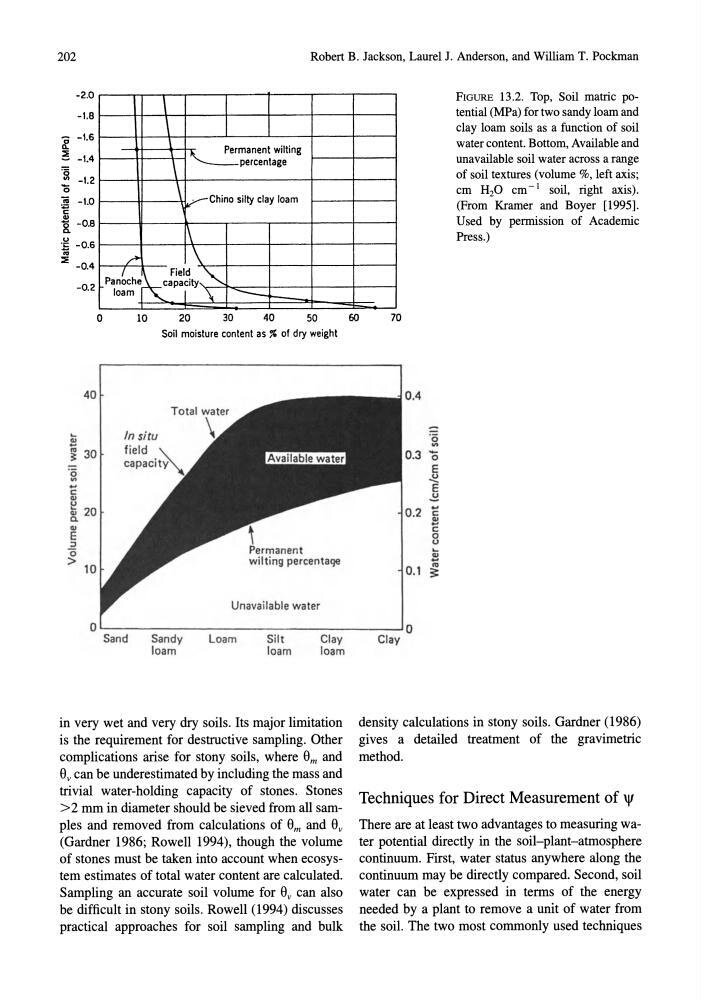
FIGURE 13.2. Top, Soil matric potential (MPa) for two sandy loam and
clay loam soils as a function of soil
water content. Bottom, Available and
unavailable soil water across a range
of soil textures (volume %, left axis;
cm H 2 0 cm - j soil, right axis).
(From Kramer and Boyer [1995].
Used by permission of Academic
Press.)
density calculations in stony soils. Gardner (1986)
gives a detailed treatment of the gravimetric
method.
Techniques for Direct Measurement of '"
There are at least two advantages to measuring water potential directly in the soil-plant-atmosphere
continuum. First, water status anywhere along the
continuum may be directly compared. Second, soil
water can be expressed in terms of the energy
needed by a plant to remove a unit of water from
the soil. The two most commonly used techniques
Robert B. Jackson, Laurel J. Anderson, and William T. Pockman
-2.0
-1.8
~
-1.6
~ -1.4
'5j
a
-1.2
iQ -1.0
~
..
8. -0.8
.g -06
OJ
•
:;; -0.4
-0.2
40
....
!!! .. 30
~
'0 . .
E
'"
l:! 20
'" a.
'"
E j
'0
> 10
0
o
\
\
1
Permanent wilting
\
percentage
\ Chino silty clay loam
:\
?
\
Panache
capacity
I e~ Field "
loam
I \
-10
20
30
40
50
Soil moisture content as % of dry weight
Unavailable water
Sand
Sandy
Loam
Silt
Clay
loam
loam
loam
in very wet and very dry soils. Its major limitation
is the requirement for destructive sampling. Other
complications arise for stony soils, where em and
e v can be underestimated by including the mass and
trivial water-holding capacity of stones. Stones
>2 mm in diameter should be sieved from all samples and removed from calculations of em and ev
(Gardner 1986; Rowell 1994), though the volume
of stones must be taken into account when ecosystem estimates of total water content are calculated.
Sampling an accurate soil volume for ev can also
be difficult in stony soils. Rowell (1994) discusses
practical approaches for soil sampling and bulk
60
70
0.4
0.3
0.2
0.1
0
Clay
'g
'0
E
.!::!
E
~
... c:
'"
.. c 0
u
....
'"
...
'"
::
FIGURE 13.2. Top, Soil matric potential (MPa) for two sandy loam and
clay loam soils as a function of soil
water content. Bottom, Available and
unavailable soil water across a range
of soil textures (volume %, left axis;
cm H 2 0 cm - j soil, right axis).
(From Kramer and Boyer [1995].
Used by permission of Academic
Press.)
density calculations in stony soils. Gardner (1986)
gives a detailed treatment of the gravimetric
method.
Techniques for Direct Measurement of '"
There are at least two advantages to measuring water potential directly in the soil-plant-atmosphere
continuum. First, water status anywhere along the
continuum may be directly compared. Second, soil
water can be expressed in terms of the energy
needed by a plant to remove a unit of water from
the soil. The two most commonly used techniques