

200
Robert B. Jackson, Laurel J. Anderson, and William T. Pockman
Water flux to atmosphere
Canopy flux calculations
Eddy flux measurements
Transpiration
Water from
atmosphere
Evaporation
from soil
Water flow through plants
Sap flow
Hydraulic conductivity
Pressure chamber
Pressure chamber Remote sensing
Psychrometry
TOR
Filter paper
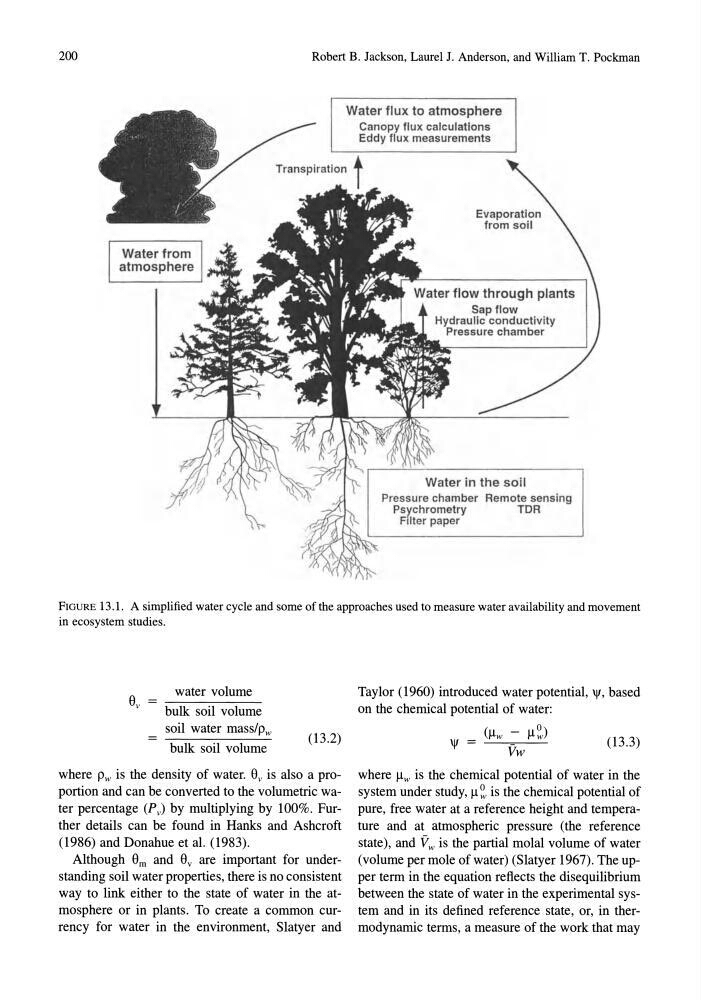
FIGURE 13.1. A simplified water cycle and some of the approaches used to measure water availability and movement
in ecosystem studies.
Taylor (1960) introduced water potential, 'JI, based
on the chemical potential of water:
water volume
bulk soil volume
soil water mass/pw
bulk soil volume
(13.2)
'JI = ().lw - ).l ?v)
(13.3)
Vw
where Pw is the density of water. 8v is also a proportion and can be converted to the volumetric water percentage (P J by multiplying by 100%. Further details can be found in Hanks and Ashcroft
(1986) and Donahue et al. (1983).
Although 8 m and 8 v are important for understanding soil water properties, there is no consistent
way to link either to the state of water in the atmosphere or in plants. To create a common currency for water in the environment, Slatyer and
where Ilw is the chemical potential of water in the
system under study, Il?v is the chemical potential of
pure, free water at a reference height and temperature and at atmospheric pressure (the reference
state), and Vw is the partial molal volume of water
(volume per mole of water) (Slatyer 1967). The upper term in the equation reflects the disequilibrium
between the state of water in the experimental system and in its defined reference state, or, in thermodynamic terms, a measure of the work that may
Robert B. Jackson, Laurel J. Anderson, and William T. Pockman
Water flux to atmosphere
Canopy flux calculations
Eddy flux measurements
Transpiration
Water from
atmosphere
Evaporation
from soil
Water flow through plants
Sap flow
Hydraulic conductivity
Pressure chamber
Pressure chamber Remote sensing
Psychrometry
TOR
Filter paper
FIGURE 13.1. A simplified water cycle and some of the approaches used to measure water availability and movement
in ecosystem studies.
Taylor (1960) introduced water potential, 'JI, based
on the chemical potential of water:
water volume
bulk soil volume
soil water mass/pw
bulk soil volume
(13.2)
'JI = ().lw - ).l ?v)
(13.3)
Vw
where Pw is the density of water. 8v is also a proportion and can be converted to the volumetric water percentage (P J by multiplying by 100%. Further details can be found in Hanks and Ashcroft
(1986) and Donahue et al. (1983).
Although 8 m and 8 v are important for understanding soil water properties, there is no consistent
way to link either to the state of water in the atmosphere or in plants. To create a common currency for water in the environment, Slatyer and
where Ilw is the chemical potential of water in the
system under study, Il?v is the chemical potential of
pure, free water at a reference height and temperature and at atmospheric pressure (the reference
state), and Vw is the partial molal volume of water
(volume per mole of water) (Slatyer 1967). The upper term in the equation reflects the disequilibrium
between the state of water in the experimental system and in its defined reference state, or, in thermodynamic terms, a measure of the work that may