

188
(513C Analysis of Organic Matter
The off-line analysis of the ol3C in organic matter
involves an in-tube combustion with cupric oxide
and a silver foil catalyst (Buchanan and Corocoran
1959). Quartz tubes are loaded with 2 to 3 mg dried
organic matter, 1 g cupric oxide, and silver foil (if
halogens or S is present), which are then sealed
under vacuum. The materials are combusted at
850°C for 4 hr and then allowed to slowly cool.
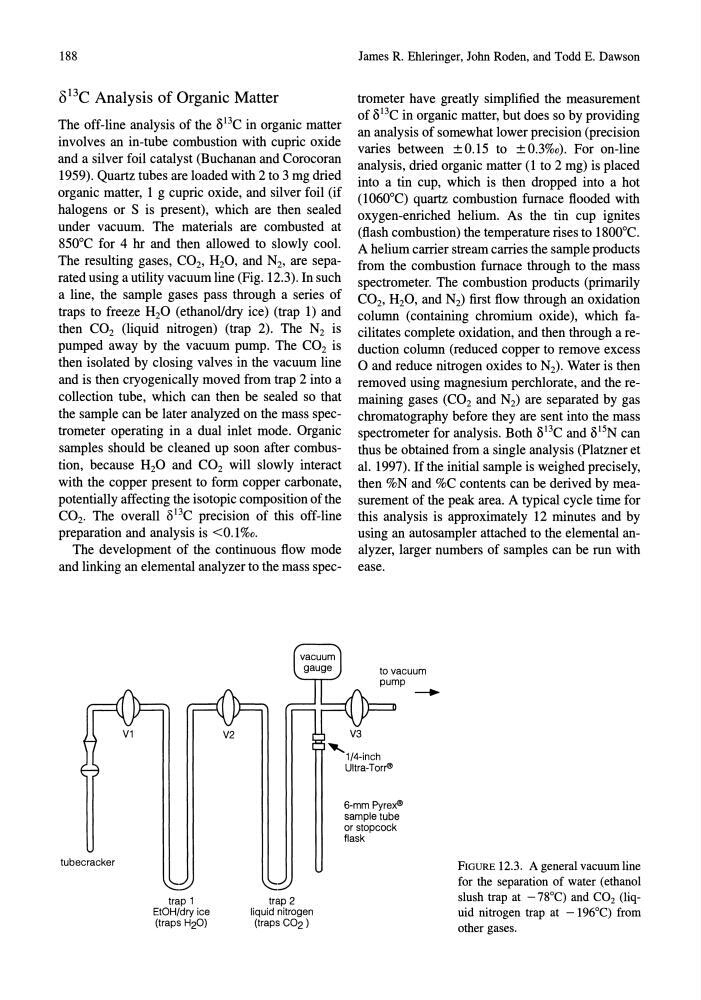
The resulting gases, CO 2 , H20, and N2, are separated using a utility vacuum line (Fig. 12.3). In such
a line, the sample gases pass through a series of
traps to freeze H 2 0 (ethanoVdry ice) (trap 1) and
then CO 2 (liquid nitrogen) (trap 2). The N2 is
pumped away by the vacuum pump. The CO2 is
then isolated by closing valves in the vacuum line
and is then cryogenically moved from trap 2 into a
collection tube, which can then be sealed so that
the sample can be later analyzed on the mass spectrometer operating in a dual inlet mode. Organic
samples should be cleaned up soon after combustion, because H20 and CO2 will slowly interact
with the copper present to form copper carbonate,
potentially affecting the isotopic composition of the
CO 2 , The overall ol3C precision of this off-line
preparation and analysis is <0.1%0.
The development of the continuous flow mode
and linking an elemental analyzer to the mass spectubecracker
trap 1
EtOH/dry ice
(traps H20)
V2
trap 2
liquid nitrogen
(traps C02)
James R. Ehleringer, John Roden, and Todd E. Dawson
trometer have greatly simplified the measurement
of ol3C in organic matter, but does so by providing
an analysis of somewhat lower precision (precision
varies between ±0.15 to ±0.3%0). For on-line
analysis, dried organic matter (1 to 2 mg) is placed
into a tin cup, which is then dropped into a hot
(1060°C) quartz combustion furnace flooded with
oxygen-enriched helium. As the tin cup ignites
(flash combustion) the temperature rises to 1800°C.
A helium carrier stream carries the sample products
from the combustion furnace through to the mass
spectrometer. The combustion products (primarily
CO 2 , H 2 0, and N 2 ) first flow through an oxidation
column (containing chromium oxide), which facilitates complete oxidation, and then through a reduction column (reduced copper to remove excess
o and reduce nitrogen oxides to N 2 ). Water is then
removed using magnesium perchlorate, and the remaining gases (C0 2 and N 2 ) are separated by gas
chromatography before they are sent into the mass
spectrometer for analysis. Both ol3C and 0 15 N can
thus be obtained from a single analysis (Platzner et
al. 1997). If the initial sample is weighed precisely,
then %N and %C contents can be derived by measurement of the peak area. A typical cycle time for
this analysis is approximately 12 minutes and by
using an autos ampler attached to the elemental analyzer, larger numbers of samples can be run with
ease.
to vacuum
pump
6-mm PyreX®
sample tube
or stopcock
flask
FIGURE 12.3. A general vacuum line
for the separation of water (ethanol
slush trap at -78°C) and CO2 (liquid nitrogen trap at - 196°C) from
other gases.
(513C Analysis of Organic Matter
The off-line analysis of the ol3C in organic matter
involves an in-tube combustion with cupric oxide
and a silver foil catalyst (Buchanan and Corocoran
1959). Quartz tubes are loaded with 2 to 3 mg dried
organic matter, 1 g cupric oxide, and silver foil (if
halogens or S is present), which are then sealed
under vacuum. The materials are combusted at
850°C for 4 hr and then allowed to slowly cool.
The resulting gases, CO 2 , H20, and N2, are separated using a utility vacuum line (Fig. 12.3). In such
a line, the sample gases pass through a series of
traps to freeze H 2 0 (ethanoVdry ice) (trap 1) and
then CO 2 (liquid nitrogen) (trap 2). The N2 is
pumped away by the vacuum pump. The CO2 is
then isolated by closing valves in the vacuum line
and is then cryogenically moved from trap 2 into a
collection tube, which can then be sealed so that
the sample can be later analyzed on the mass spectrometer operating in a dual inlet mode. Organic
samples should be cleaned up soon after combustion, because H20 and CO2 will slowly interact
with the copper present to form copper carbonate,
potentially affecting the isotopic composition of the
CO 2 , The overall ol3C precision of this off-line
preparation and analysis is <0.1%0.
The development of the continuous flow mode
and linking an elemental analyzer to the mass spectubecracker
trap 1
EtOH/dry ice
(traps H20)
V2
trap 2
liquid nitrogen
(traps C02)
James R. Ehleringer, John Roden, and Todd E. Dawson
trometer have greatly simplified the measurement
of ol3C in organic matter, but does so by providing
an analysis of somewhat lower precision (precision
varies between ±0.15 to ±0.3%0). For on-line
analysis, dried organic matter (1 to 2 mg) is placed
into a tin cup, which is then dropped into a hot
(1060°C) quartz combustion furnace flooded with
oxygen-enriched helium. As the tin cup ignites
(flash combustion) the temperature rises to 1800°C.
A helium carrier stream carries the sample products
from the combustion furnace through to the mass
spectrometer. The combustion products (primarily
CO 2 , H 2 0, and N 2 ) first flow through an oxidation
column (containing chromium oxide), which facilitates complete oxidation, and then through a reduction column (reduced copper to remove excess
o and reduce nitrogen oxides to N 2 ). Water is then
removed using magnesium perchlorate, and the remaining gases (C0 2 and N 2 ) are separated by gas
chromatography before they are sent into the mass
spectrometer for analysis. Both ol3C and 0 15 N can
thus be obtained from a single analysis (Platzner et
al. 1997). If the initial sample is weighed precisely,
then %N and %C contents can be derived by measurement of the peak area. A typical cycle time for
this analysis is approximately 12 minutes and by
using an autos ampler attached to the elemental analyzer, larger numbers of samples can be run with
ease.
to vacuum
pump
6-mm PyreX®
sample tube
or stopcock
flask
FIGURE 12.3. A general vacuum line
for the separation of water (ethanol
slush trap at -78°C) and CO2 (liquid nitrogen trap at - 196°C) from
other gases.